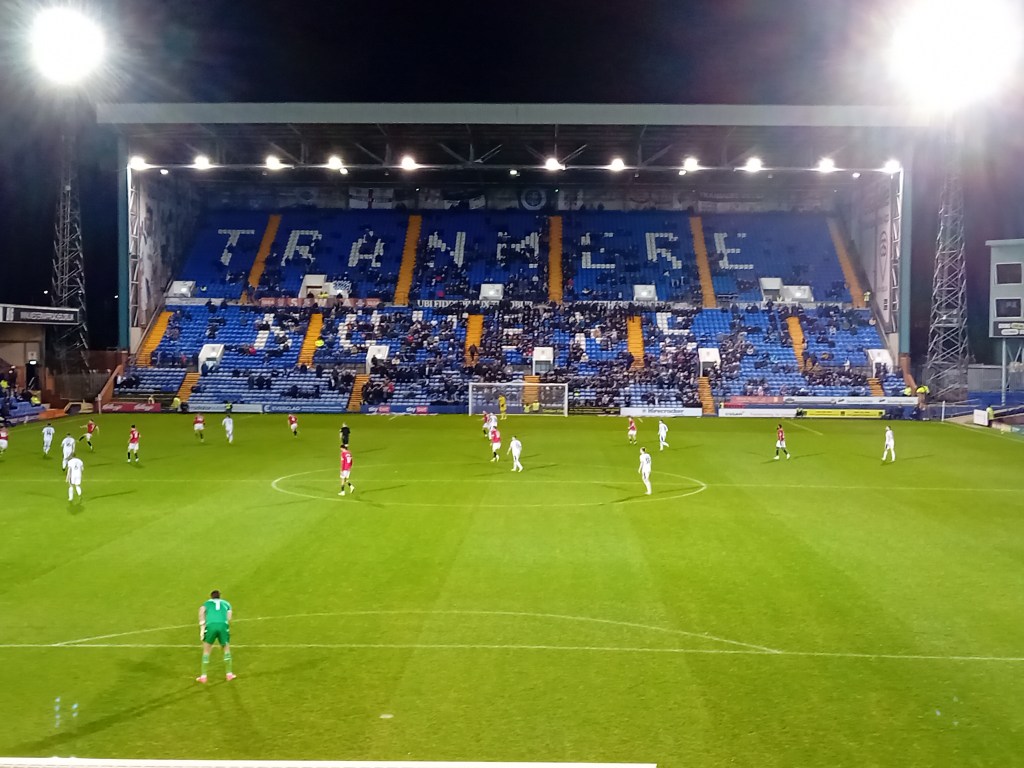
A day-trip to Tranmerius – Vomitorium, anybody?
Yes – a day-trip to Tranmere indeed. So the first question gullible readers are likely to ask is:
“It Tranmere a real place? Or is it a made-up one – like Port Vale; Raith (of Rovers fame) – and Narnia?”
Well – Tranmere is a real place just across the River Mersey from Liverpool on the Wirral Peninsular.
As we shall see, Tranmere – `Tranmerius’ way back when – has its roots in Roman times. I can exclusively reveal that it was founded by a local tribe which finally bent the knee to Roman conquest of the area from their headquarters in nearby Deva Victrix, these days known as Chester. The descendants of this tribe even now secretly revere the lesser-known Tranmerius Caesar as an actual god. It was after this ancient Emperor that their original settlement by the side of the River Mersius was initially not only named but dedicated.
Other historians would have you believe otherwise. Ignore them. They will tell you that the Wirral Peninsular was occupied by Vikings from what is present-day Norway during the Tenth Century. They will also tell you that these Norse (Northern) Vikings were in constant conflict with another load of Southern (`Scorse’ – now bastardised to `Scouse’ in that region) Danish Vikings who had invaded the lands to the north of the River Mersius. They will insist, furthermore, that the town’s origins can be explained by the Old Norse words `Trani” and “Meir”. This has nothing to do with mere gender issues but actually meant `a sandbank with cranes.’ No – not the sort of cranes that can be seen across the River Mersey from the Wirral at Liverpool docks – but Cranes as in the gawky-looking birds with long spindly legs and a bill which is almost as spindly and nearly as long.
Well you can forget that too. Instead, ask yourself the obvious questions which these self-styled `experts’ choose to ignore. These are: what do the words `tran’ and `mere’ mean in Latin?
`Tran’ means `on the other side of’ as in the Latin-derived English word `Transatlantic’. `Mere’ simply means `pure’ in Latin.
So `Tranmere’ is the untouched land on the other side of the River Mersius from the larger settlement Lecurlacus (`Iecur’ meaning`liver’ in Latin and `lacus’ lake or pool). Obviously.
It all makes perfect sense when you come to think of it, doesn’t it? So please don’t go believing anything else any shameless charlatans might try to tell you to the contrary.
The fact is that a mysterious Roman sect is still secretly alive and active in the town – and at the heart of the club itself. And this can be proved by subtle clues which I am now going to painstakingly identify and actually interpret.
In fact, the town which the settlement of Tranmerius – or Trani-meir if you prefer – plus the football club that can be found there now and the stadium at which it plays are named after areas of the larger Wirral town of Birkenhead: Tranmere and Prenton. There are a lot of other bits of this town as well: Bebington; Bidston & St James; Claughton; Oxton and Rock Ferry to be precise.
Over the years, Tranmere Rovers has had two Club Crests, the earliest of which reflects some aspects of the town of which both it and its supporters had been affected by over the years. You can see the first one here that it adopted once it changed its name from Belmont FC to Tranmere Rovers during 1885.

The symbols in the crest – the tree at the top right of the shield, for instance – all have significance. The tree is supposed to be an oak – and oak trees were once plentiful in the Roman settlement of Tranmerius and the Viking one of Trannyland Trani-Meir as well. You will note the picture of a ship within a football at the top of the crest. This represents the tradition of shipbuilding in Birkenhead, which still exists – very unusually in post-industrial Britain – in the shape of Cammell-Laird shipbuilders on the banks of the Mersey in the town.
The so-called `experts’ will try and convince you that the Latin inscription “Ubi fides I I lux et robur” which accompanies the crest actually means:
“Wherever there is Faith, There is also Light and Strength.”
It doesn’t. And what on earth is that supposed to mean anyway? (Apart from a badly remembered quote from Conservative Prime Minister Margaret Thatcher? Didn’t the Iron Lady once assure working class communities such as miners and the shipbuilding one that Tranmere Rovers sprung from: “Where there is hope, let us bring despair?” I think you will find that she actually did…)
Again, I can exclusively reveal that any such interpretation is a myth based on a total misunderstanding of Tramerius and even Latin itself. The motto actually means something altogether different – and the irrefutable proof of this will be forthcoming right at the end of this account in the very words used by an employee of Tranmere Rovers when he translated it for me.
But that’s it as far as a potted history of Tranmere and its football club is concerned, for now at least.
Last Tuesday – December 3rd 2024 – myself and three of my Morecambe-supporting pals set off on a visit to modern-day Tranmere and its current League Two team at their Prenton Park stadium. We did so – according to BBC Sport – in order to watch Southend United be entertained by Rovers in a League Two football match there. Here’s what `Auntie’ told us on December 4th:
“Morecambe manager Derek Adams says another trip to Chelsea is fabulous news for all concerned with the Lancashire club. They will head to Stamford Bridge in the FA Cup in early January after being paired with the Premier League giants in the third round draw. For the financially-troubled Shrimpers, it is a repeat of a tie in 2021 at the same stage in which Chelsea won 4-0.”
(I must make it plain to our readers who don’t hang onto every word printed or broadcast by the BBC that this organisation has been repeatedly telling people all season – and actually much longer – that Morecambe and its Manager, Derek Adams, are in charge of a club nicknamed the “Shrimpers” – which is Southend United. And as we all know, the BBC never gets things wrong, does it?)
Anyway, we left Morecambe in the morning and headed down the M6 and then the M58 past Skelmersdale and Kirkby (football clubs we are all old enough to remember seeing play Morecambe in the Northern Premier League times many years ago. I personally saw Kirkby Town, for instance, for the first time on Good Friday, 9th April 1971 at Christie Park. Now that’s fascinating, isn’t it? No it isn’t. Sorry…)
At Switch Island, we followed the A59 to Walton and then Everton, where we detoured to drive all the way around Goodison Park: up Goodison Road; right at Gwladys Street and then right again down Bullens Road. From there, we went down Everton Valley alongside Stanley Park – with the huge stands of Anfield in the near distance – and headed towards Kirkdale and the Sandhills Industrial Estate. The plan was to visit Pearsons Glass there to get a match for the triangle of glass I had cut out of one of our number’s 1920s vestibule leaded lights, which I intend to show him how to repair sometime soon.
And that, dear readers, is where our cunning plan to then head towards the Wirral via one of the Mersey Tunnels went completely off the tracks. The young man who actually cut us a large slab of the glass we needed turned out to be an Everton supporter. He asked us if we had seen the new stadium at Bramley-Moore dock. Given that it was only about half a mile away and is by far the largest object on the horizon, it would be impossible not to…
He suggested we leave our car in their car park and walk down to the stadium site, using a short cut he pointed out to us. So we did.
Inevitably, it’s impossible in this Health & Safety conscious era to actually enter a building site this – or probably any – size. But we managed to get a few photos of what several passing Everton supporters cheerfully assured us would be the most impressive stadium to grace the Championship next season.

We engaged some of the Security Bods in conversation. They love it – hardly anybody must speak to them about non-work related stuff – if anybody speaks to them at all during a normal working day, I suppose. One – an Asian chap – was so gratified to be spoken to by people who clearly had an interest in what was going on – despite their confusing red hats and shirts – that he showed us a video he had recorded on his phone of the interior of the ground. It’s almost ready to be handed-over to the club (this should happen next month) and what we could see was truly amazing. Another Security Bod – a woman this time – seemed to share my amazement that this entire edifice is built over the water of what could be a working dock if the stadium is reverse-engineered some time in the future. She pointed at some red fencing on the concourse among the old tramlines and original stone setts which will become a feature of the ground.
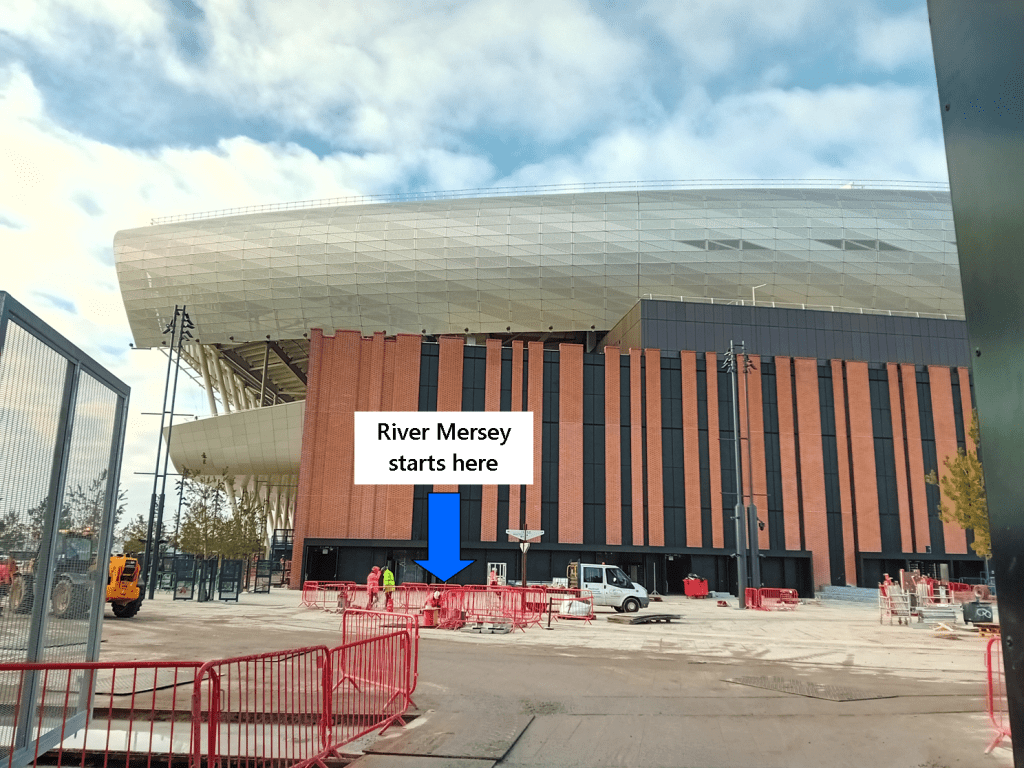
“The Mersey starts there!” she said. “It flows right under the pitch to the far side of the stadium and the original dock wall.”
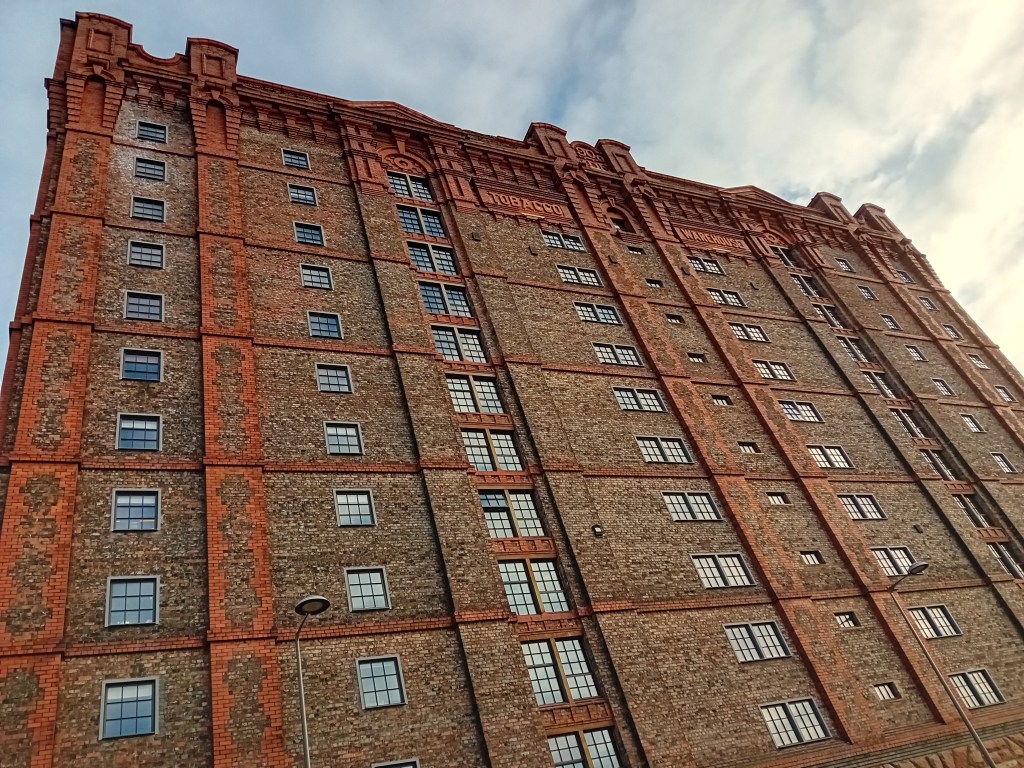
All thoughts of Tranny-mere forgotten, we decided to carry on along Regent Road where the new football ground is towards the central waterfront in Liverpool. On the way, we passed this simply enormous building. It is the one hundred and twenty year old Tobacco Warehouse adjacent to Stanley Dock and is apparently the world’s largest brick-built industrial premises. No doubt the emergence of Everton just a short distance away on the other side of Regent Road has accelerated the redevelopment of this huge edifice but even now, some of the 550 apartments which will be constructed in the interior can be bought for a mere £265,000 to £610,000 each. Car parking is an absolute snip at just £15,000 per year in addition. Oh – plus other charges relating to the leasehold of each unit. So get in now before it’s too late and your ordinary Everton supporters snap them all up – this is Social Housing In Action, ladies and gentlemen, in Twenty-First Century Britain…
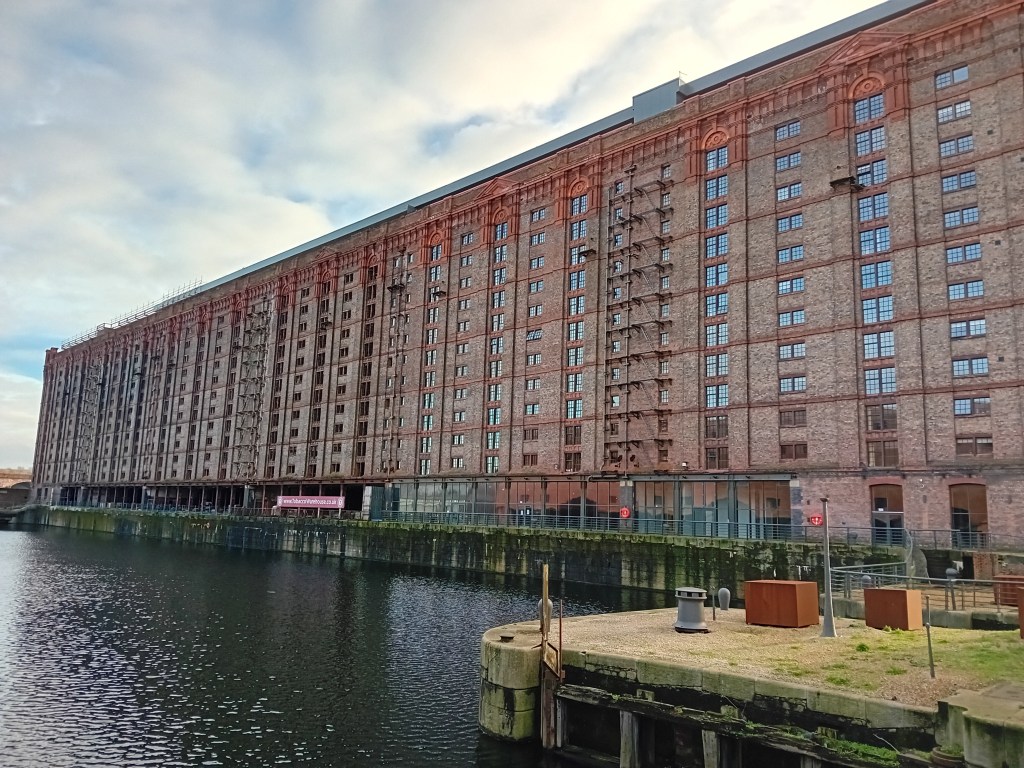
(P.S. what’s £437,000 – the average between a £265k and a £610k flat – multiplied by 550? Oh – plus 550x£15k for parking annually ad infinitum? That’s right: quite a lot. So somebody somewhere is making a packet out of this nice example of urban regeneration, aren’t they? I wonder who…)
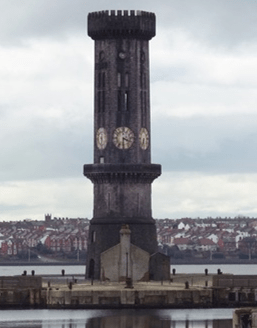
Stanley Dock actually has an outlet into the River Mersey. This is via a man-made island built of Scottish stone and designed by the same clever clogs who was the architect of the original Tobacco Warehouse: one Jesse Hartley. It is topped by the Victoria Tower, known to the locals as the “Dockers’ Clock” because its six clocks tell passing workers; road and river traffic precisely what the time is at any given hour of the day or night. When the sun goes down, the clock faces are illuminated and you can clearly see them even from the other side of the Mersey.
And beyond the dock basin at the other end, there can be found the beginning of the Leeds-Liverpool Canal. So it is possible – theoretically at least – to sail a barge from the Irish Sea via Liverpool all the way to Leeds using this route. The link fell into disuse during the latter part of the Twentieth Century but a £22 million redevelopment means that it has been possible to make this trip again since 2009. And as we stood and gawped at the set of multiple locks (also designed by Jesse Hartley) which take boats upwards to start the first part of this journey, we got talking to a woman – who was not in the first bloom of youth, it must be said – who intends to cycle the entire route from Stanley Dock to the River Aire in Leeds next year. Good luck to her; I hope she manages it.
But there were still more wonders to be seen on the Liverpool waterfront. As we came nearer to the famous Liver Building, another enormous construction came into sight: this:
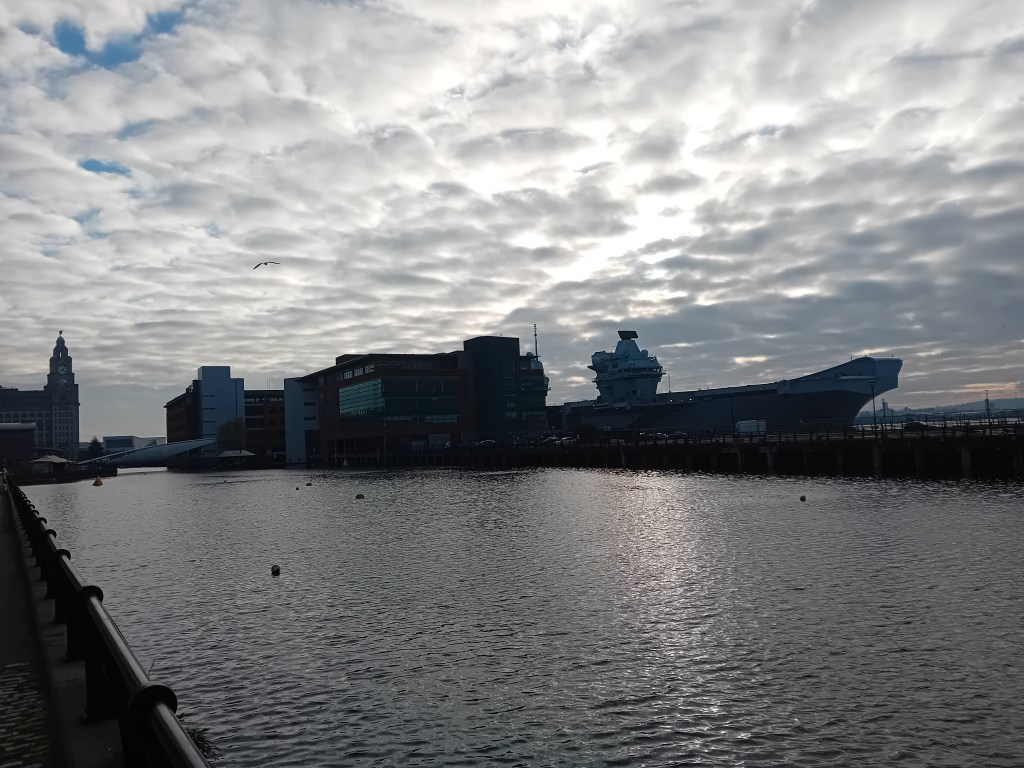
It is the 65,000 ton Prince of Wales – the largest Capital ship in the Royal Navy which was launched in 2017 after being built at Rosyth Dockyard on the Firth of Forth – one of Britain’s few remaining shipbuilding yards apart from Cammell-Laird at Birkenhead and Vickers/BAe Systems at Barrow. As you can see, it’s huge: 280 metres (980 feet) long – so you can barely miss it. Particularly with an Exocet missile. As we approached this floating annihilation machine, we were talking about the problems it has experienced in recent times. It broke-down on its Maiden Voyage when a mis-aligned propeller shaft actually broke. Since then, it has flooded twice during its first year’s service alone and has experienced severe electrical problems since. As we were speculating about whether or not it has actually suffered engine failure as well, a hard-hatted; yellow-vested worker from the Everton site passed by and clearly heard what we were saying. He turned and pointed towards the ship and – in an unmistakably strong Scouse accent – announced:
“Them Russians will be shittin’ themselves about tha’!”
Suitably reassured, we carried on to the cafe at the (relatively) new Museum of Liverpool before seeing some of the sights of the centre of the city. I will spare the embarrassment of myself and my pals by not sharing the photos one of our number persuaded a passing Chinese tourist to take of us posed by the statue of Liverpool’s favourite sons – The Beatles – in the shadow of the Liver Building. But – this aberration apart – just walking around some of the city’s many treasures was an experience in itself for septuagenarian country bumpkins from Morecambe like us…
On the Albert Dock adjacent to the (temporarily) closed Tate, we saw a modern `sculpture’ which doubtless had hidden imagery as well as deep meanings that mere mortals need art experts to help us to even begin to understand.

So here’s a quick quiz for you.
- Does the juxtaposition of the colours you can perceive indicate changes in mood as the shifting profiles you encounter as you walk around this pile of apparently random shapes reflects the very complexity of life itself whilst putting into its true perspective the vastness of the Universe of which we are a mere grain of shifting sand?
- Is it just a load of colourful crap piled high as the creator laughs all the way to the bank with his massive Arts Council fee for having the brass neck to pull-off such a stunt to exploit the gullible rich?
- Or – bringing us all back to earth with a bump and reminding some of us why we had set out on our quest in the first place – is it a representation of the sort of Totem Pole that the Scorse would have created in this neck of the (oak) woods over a thousand years ago?
As we struggled with this conundrum, we drove through the Wallasey Tunnel and scouted-out the route we should take to Prenton Park later on. We parked nearby and walked to the ground. As we got nearer, I saw a man skulking about in the shadows. A vaguely familiar man. He had a trowel in his hand and he was digging in a particular place, looking about furtively from time to time as he did so. As we drew even nearer, I recognised him as the current Swindon Manager and former Blackpool boss, Ian Holloway. We asked him what he was doing.
Having heard the stuff he had come out with recently about his training ground being haunted and his wife being about to cleanse it using the herb Sage, I asked him if he was in the process of purifying the ground. Or as he on a secret scouting mission from Swindon?
“No!” he said, quite indignantly I thought. “I’m indulging in one of my other hobbies – archaeology!”
And at this point, the whole question of Tranmerius – Roman settlement – or Trani-Meir, the Viking village raised its ugly head again because he went on to say in that inimitable West Country lilt of his:
“I think this is an ancient burial site and the gods are angry. That’s why Tranmere lose so many games at home!”
“You don’t say” I remarked. “And what have you unearthed?”
“A Norse!” he replied. “A Norse skeleton!”
“A Norse?” I asked, suspiciously. “How do you know it’s not Roman?”
“How the hell would I know if it’s Roman or not?”
“Well – you knew it was a Norse!”
He looked at me as if I had lost my senses.
“It’s got four legs an’ a big head – of course it’s an ‘orse, you idiot!”
Suitably enlightened, we ended-up at New Brighton to see (in the darkness) all the things we had previously visited from the other side of the Mersey. We had something to eat – and then we set off for the key part of our quest: to watch Tranmere Rovers come from behind twice to draw 2-2 with Morecambe. Or was it really Southend United and the Beeb was right after all? Sorry, Shrimpers fans – it was bad enough to actually be them…)
The game was played in a gale which created a wind chill factor of below freezing. All very well for those hardy sea dogs who crew the Prince of Wales and were Guests of Honour at Prenton Park tonight but not so welcome to other ancient mariners such as ourselves. The game was really poor but if you really do want to read an account of it, you can do so here:
What happened on the field was so completely forgettable, in fact, that the most striking memory of it I have is a notice I saw at the bottom of a stairwell between the concourse and the seats in the Cowshed end. Here it is:
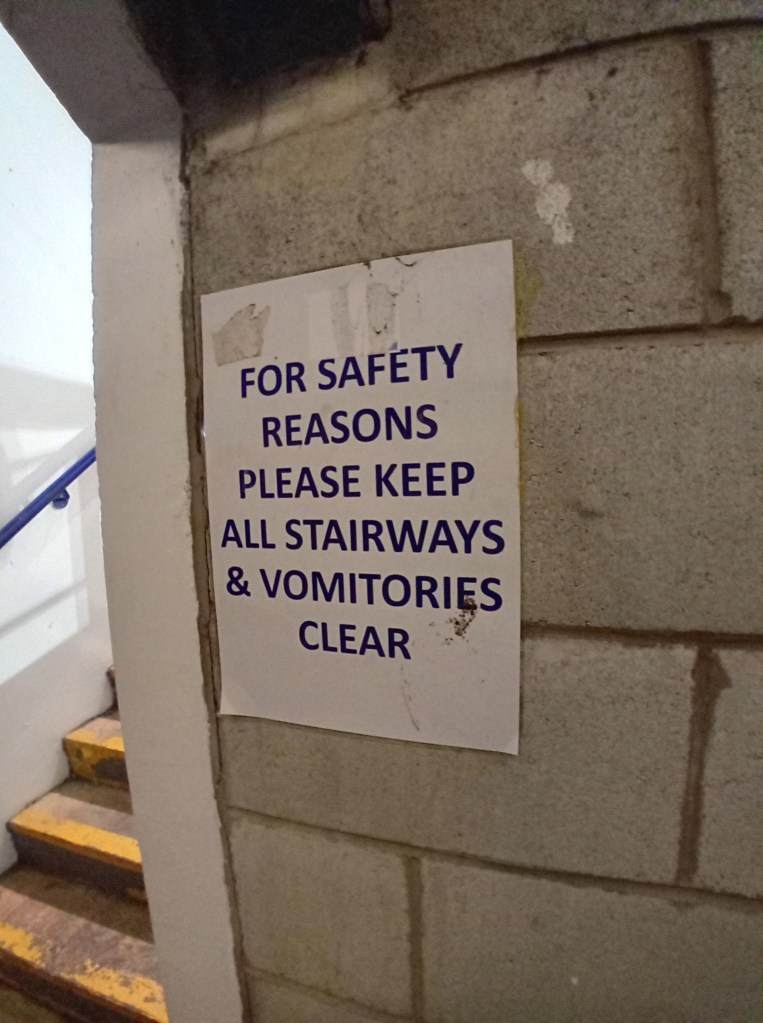
I must confess that in all my Three Score years and Ten, I had never heard the word `vomitories’ before and wondered if it must be a spelling mistake. Surely a vomitorium is a place where people are given emetics to make them throw-up. (In fact, it actually can mean exactly this nightmare scenario.) But a far more obscure definition – which I suspect has only ever been known to the good people of Roman Tranmerius – is this one:
“A vomitorium is a passageway in an ancient Roman amphitheatre that connects an outside entrance to a tier of seats”.
Which takes us right back to where we started and my final truth – as if any more was needed – that there really is a secret sect which worships Tranmerius Caesar and can still be found in Tranmere and its football club at this very moment in time.
This is a copy of the ticket I used to gain entry to the sacred part of the Roman site which Prenton Park now represents: the Cowshed.
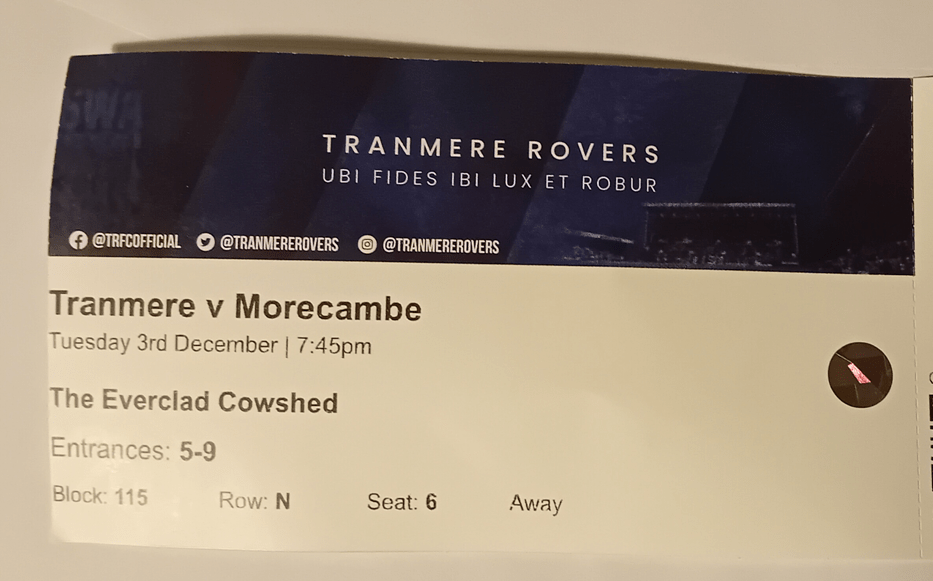
Take good notice of the line underneath the top one reading `TRANMERE ROVERS’. As I mentioned earlier, when the young man who was about to scan this ticket and let me into the hallowed ground took it from me in order to do this, I asked him what the Latin bit actually meant. And this is how he replied:
“I haven’t a bloody clue mate! I just work here!”
Need I say any more? – forget everything you might have been told about Vikings and misleading Latin translations concerning Tranmere and its football club. In this age of false news; dodgy history; conspiracy theories- social media hoaxes and rank poor journalism about “Shrimpers” and the like, it’s always reassuring to know that you can believe without question everything you read on these pages at least…
 shrimplythebestfootball