The National League Explained (by a newcomer from Morecambe).
Part One – Aldershot to Braintree Town.
The situation at Morecambe Football Club is currently utterly shambolic. Staff and players haven’t been paid for ages; events scheduled for the Mazuma Mobile Stadium – weddings; Wakes; even Blood Donor sessions – can’t go ahead; the Board of Directors have resigned en masse; the unpaid Manager has no budget to sign new players – and the club is under an embargo from the National League in any case.
This is happening as the appalling owner – Essex `businessman’ Jason Whittingham – has effectively gone to ground. He told everyone just over a week ago that he was committed to selling the club to EFL- approved Panjab Warriors. The paperwork was ready; the Warriors had committed themselves to paying the staff and players immediately and all that was needed was Mr Whittingham’s signature. He promised to sign exactly seven days ago – on Monday, 7th July 2025.
But he was lying. Instead, he told the World and his Wife that he needed more time last Monday but would definitely sign on Tuesday. But he was lying again. On Tuesday, nothing changed. Then – later in the week – he publicly lashed-out at individuals who he claimed had been harassing himself and his family and promised retribution – but said absolutely nothing to explain either why he had still not signed or what he planned to do to resolve the developing crises at the club. Towards the end of the week – responding to Questions in Parliament; a personal letter sent to him by local MP Lizzi Collinge asking him to explain what he was up to; constant media questions to him and lots of other pressure – Jason Whittingham announced that a Mystery Buyer was about to buy the club from him and that this unknown person would let his identity be known to the public `shortly’. He also promised the following: `further announcements to follow tomorrow’. If you go on the club’s website right now, you will see that this latest pack of lies was posted on the club’s official website four long days ago.
It’s all complete drivel. As good people at the club have sleepless nights worrying about their futures and how they will pay the bills, all this man is interested in is trying to save his own financial neck by clinging onto the one asset from which he has consistently made a profit over all the years he has had it in his grip. He doesn’t give a damn about the club; he doesn’t give a damn about the damage he is causing to other people’s lives – ranging from staff and players at Morecambe FC to people in desperate need of blood transfusions in this region. He is a liar, a fantasist and an absolute disgrace as a human being.
But – if he can indulge in unbridled fantasy – so can I…
Let’s pretend that none of this nonsense has actually happened for a moment. Let’s pretend ours is a `normal’ club with decent ownership and a team which is ready and able to face the challenge of the National League this season.
What follows is my guide to the clubs we are going to meet in it. I intend to release this in daily batches of six. By the end of the process – Thursday – Morecambe FC may not be a member of the National League anymore. We might have been expelled. Worse still, we may have ceased to exist altogether. So we need to get on with it, don’t we?
Morecambe Football Club ended its eighteen-year long adventure in the English Football League (EFL) last season. It found itself in the utterly shameful position of being the officially worst team not only in League Two but the whole of part of the English Football Pyramid: tiers Two to Four (the Premier League being at the almost unassailable top of this increasingly top-loaded structure) which the EFL still controls.
For most of the Twentieth Century, this traditionally conservative and actually reactionary organisation deliberately excluded clubs like ours from joining its ranks because the Football League was then a Closed Shop which preferred mediocrity but familiarity to New Blood which could potentially rejuvenate it.
But things finally changed forever in 1987 when – for the first time ever – the dross which has been clogging the bottom of the old Fourth Division for countless decades began the slow process of being booted out and breaths of fresh air in the shape of clubs like ours were finally allowed to replace them among its previously totally exclusive ranks. Wigan Athletic once played on the same level as the Shrimps in the Northern Premier League during the late 1960s and early 1970s. Since then, one of the very few authentically non-League clubs to infiltrate the ranks of the EFL Closed Shop have risen to the exalted heights of the Premier League and actually won the FA Cup. They remain a role model for `little’ clubs all over England to aspire to. At least it is now possible to try and do so – if you are good enough.
The Conference from which the Shrimps graduated for the first time into the hallowed land of the EFL has changed its name and very nature during the best part of two decades since Morecambe was a part of it. This competition has now been re-badged as the National League.
So what are we letting ourselves in as members of it for this coming season?
A tough ride, I suspect: the National League is currently made up of more than fifty percent of clubs which – like Morecambe – have fallen out of the EFL in very recent times.
The rest – as we once were – are dynamic clubs hoping to emulate our achievement and transforming what was once a small town non-League club into something that could hold its own in the elite of English football until very recently.
But what do we – locked in northwest Lancashire by the side of Morecambe Bay in an inlet of the Irish Sea – already know about the clubs we are hoping to overcome in the next few months as the 2025 t0 2026 season progresses?
Let’s have a quick look at the opposition….
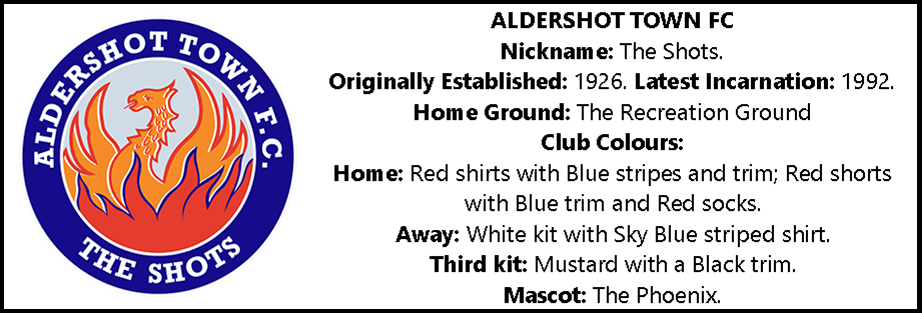
The Recreation Ground can be found 271 miles south of Morecambe’s Mazuma Mobile Stadium in Hampshire, just over forty miles south-west of London.
The original Shots were founded in 1926 and were a Football League club from 1932 until they went bust as a member of the old Fourth Division during the 1991-2 season: they had to resign in March 1992 as a long-term financial crisis finally totally undermined the club’s viability. In doing so, they were the first Football League club to fail during a season since the original Accrington Stanley did so in 1966. Just as happened then, all of Aldershot’s results were scrubbed from the record – regardless of how the sudden loss of points affected the teams unlucky to have actually played against them and won or drawn – until the very moment at which they eventually failed altogether.
The current incarnation of the Shots was founded in the spring of 1992 and still play at the same venue as the original club. The new Shots have emulated Accrington and risen from the ashes (hence the Phoenix pictured on the club’s badge) to fight their way back through the lowest tier of the Football Pyramid in Britain to re-establish themselves as a senior club once more.
In the 2007/2008 season, they actually won a place back in the EFL but only lasted for five seasons despite reaching the League Two Play-Offs in 2010. Then they once again experienced financial trouble and fell out of the League again before entering Administration in May 2013.
The Shots reached the National League Play-Offs for the first time in 2017 and did so again – unsuccessfully once more – just twelve months later. Only a year after this, though, they were technically relegated to the National League South but were saved when Gateshead were expelled in their place for financial irregularities. This year, they made history for the club when they played at Wembley for the first (and only) time ever, winning the FA Trophy with a three-nil victory over Spennymoor Town. As far as the National League is concerned, last season they finished in sixteenth position.
Morecambe have met Aldershot ten times in the past, all in League Two. The Shots have won three of these; the Shrimps five. Chris Blackburn – centre-back in Morecambe’s historic win over Exeter City in the Conference Play-Off Final in 2006 – immediately left for an unsuccessful stint in Hampshire and another player who wore both clubs’ colours was Manny Panther – last seen in a Morecambe shirt during the 2009-10 season.
Morecambe will travel to the Recreation Ground on Monday, 25th August 2025 for a night match. Aldershot Town will be visiting the Mazuma Mobile Stadium for the first time in twelve years on Saturday, 28th March 2026.
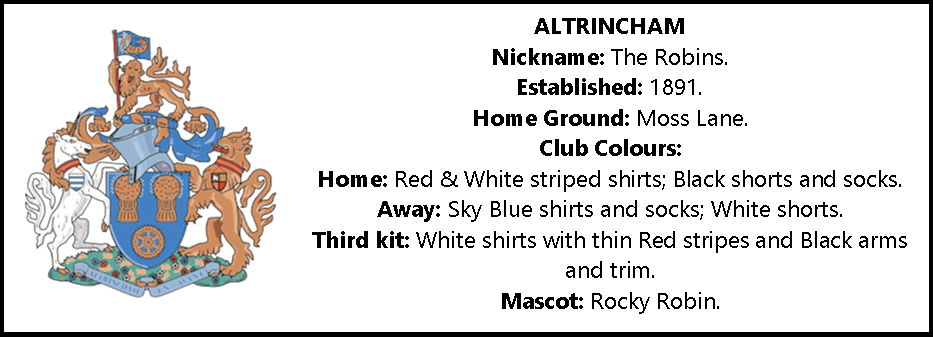
It’s just 72 miles from the Mazuma Mobile Stadium to Moss Lane in Altrincham, eight miles south-west of Manchester. The Robins have played at this venue since 1910 but were actually founded nineteen years earlier than this in 1891: almost three decades before Morecambe FC was first established.
The Shrimps first encountered Altrincham when they both became founder-members of the Northern Premier League (NPL) during 1968. The Robins were a part of the triumvirate of really strong clubs which had left the Cheshire League to inaugurate this new competition. But unlike Macclesfield Town and Wigan Athletic, they have never been able to enter the Hallowed Ground of the EFL. Back in 1968, the Football League was a Closed Shop which the NPL was created precisely to try and break open; replacing the stranglehold of weaker clubs in this elite cabal with new blood which could – and should – have revitalised the entire English game at that time.
By rights (and in terms of sheer talent alone) the Robins should have broken into this fortress when – led by later Manchester City Chairman Peter Swales – they consistently did well in the new league. Altrincham also regularly beat Football League opponents in a succession of FA Cup runs during which they reached the Third Round proper for four years in a row between 1978 and 1982. (One of their claims to fame is that they have knocked more EFL clubs out of the FA Cup than any other non-league team ever: seventeen altogether – and counting.)
In 1979, they became inaugural members of the National League and Football Conference’s predecessor: the Alliance Premier League, which they were Champions of during their first two seasons.
But still they were kept out of the Football League by the way the competition was rigged by the consistently reactionary old fossils who have always administered it, then as now.
Seven years later, they caused one of the biggest all-time upsets of FA Cup history when they beat then members of the upper tier Birmingham City (with a young David Seaman in goal) 1-2 at St Andrews.
The 1990s were not happy times for the Robins, however and the club were twice relegated back to the Northern Premier League. By 2003, however, they had battled their way via the new Conference North into the renamed Vauxhall Football Conference but were reprieved on four occasions from further relegations by the resignation of Canvey Island; the liquidation of Halifax and the expulsion of both Scarborough and then Boston United.
Their luck ran out when they were relegated to the newly-renamed National League North in 2011. They bounced back only to be relegated anew in 2015 before slipping even lower into the Northern Premier League just twelve months later. But they fought their way back once more and turned fully professional for the first time ever in 2022 as a National League member. They reached the Play-Offs in 2024 only to be knocked-out by eventual winners Bromley in the semi-finals. Last season, they finished ninth in the National League.
In 1978, the Robins won the FA Trophy at Wembley, beating Leatherhead 3-1 four years after the Shrimps had achieved this biggest feat in their own history at the time. Altrincham then lost their next final appearance in 1981 by the only goal of the game against Enfield. In 1986, however, they were back at Wembley again when they beat Runcorn by one goal to nil and thus won the Trophy for a second time: only three clubs (the now defunct Scarborough and Telford United plus Woking – who we will think about in due course) have ever won the FA Trophy more than Altrincham have.
Morecambe last encountered the Robins in the Conference two decades ago (both clubs won two of four league games) but before that, they met countless times in the NPL.
I’m not entirely sure how to record all these results but I can tell you that Morecambe lost 1: 4 to Altrincham at Christie Park on Saturday 6th December 1969; beat them 2:1 on Tuesday, 8th September 1970 and lost to them sometime in the 1971-72 season by two goals to three because these were games I personally attended.
A number of players have performed for both clubs, most notably Kevin Ellison; Jack Redshaw and – very recently – Marcus Dackers.
Morecambe will be playing their fourth National League fixture – and second home league game – against Altrincham on Saturday, 23rd August 2025. The return game is due to be played at Moss Lane on Saturday, 3rd January 2026.
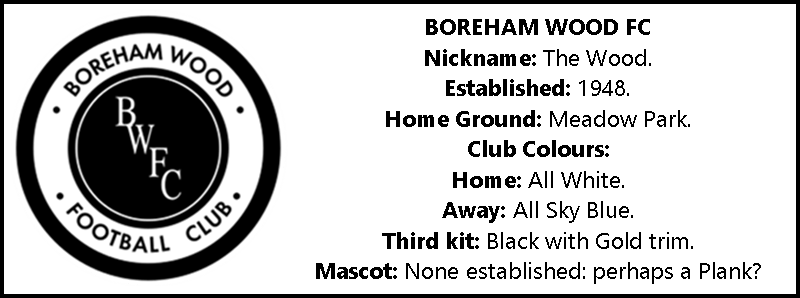
Boreham Wood’s home ground – Meadow Park – can be found 234 miles south from the Mazuma Mobile Stadium in the leafy Home County of Hertfordshire. The Wood are another authentically non-league club with aspirations to play in an EFL which they have never been members of. The club was founded as recently as 1948 and has gradually progressed through the lower tiers of English football in the south east of the country over the ensuing years, albeit with the occasional set-back. They were promoted from the National League South during 2015 and made national headlines when they beat an EFL club – Blackpool – for the first-ever time by two goals to one in a First Round FA Cup tie during the 2017-18 season.
At the end of that campaign, they also reached the National League Play-Off Final at Wembley. But the closest they have ever been to entering the Hallowed Ground of the EFL ended with a 2-1 defeat by Tranmere Rovers.
A year later, they reached the Play-Offs again but were beaten at the semi-final stage by eventual winners Harrogate Town.
They then beat Southend United – then a Football League club – in the FA Cup during 2020 and a year later eliminated League One AFC Wimbledon and then Championship Bournemouth before falling at the fifth round hurdle to Everton by two goals to nil at Goodison Park.
More disappointment followed in 2023 when they again failed in the Play-Off Semi-Finals to EFL-bound Notts County; 3-2 after extra time.
Just a year later, they were surprisingly relegated to National League South but immediately bounced back via the Play-Offs to start their National League career once again this season.
So it cannot be said that the club should be immediately renamed Boreham Rigid – being a fan of the Wood has rarely had any dull moments.
The Wood and the Shrimps have never met for a football match in any competition. But Piero Mingoia has played for both clubs (Morecambe briefly on-loan from Watford six years ago). Morecambe’s centre forward last season – Lee Angol – also once played on-loan from Luton for Boreham Wood and finished the 2014–15 season as the Conference South’s top scorer with 25 goals from 39 appearances. He also scored key goals in the club’s FA Cup campaign and Play-Off victory, helping them to promotion to the National League for the first time in their history.
Boreham Wood will play Morecambe for the very first time by the Lancashire seaside on Saturday, 6th September. The Shrimps will then Knock on Wood – or at least the door at Meadow Park – on Saturday, 18th April 2026.
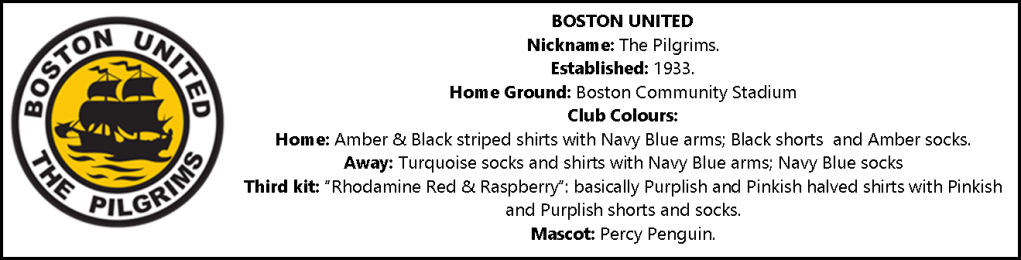
Boston United’s home ground – the Boston Community Stadium – was built in 2020 to replace the old one-time Greyhound Track at York Street which had been their home for 83 years until that time.
The ground – complete with classic pylon floodlights and wooden stands – can still be found, overgrown and dilapidated, about three miles north of the new venue. In a sense, this could be argued to be an allegory for the club itself – something rotting in the heart of a distinctly rural town just as there seems to have been something rotten in the heart of the club for much of its relatively recent existence.
Blimey – that’s a bit heavy isn’t it?
So let’s ask ourselves: what is Boston actually famous for?
Sorry – time’s up.
The internet tells us:
Boston, Lincolnshire, is known for its rich history as a medieval port, its iconic landmark, St. Botolph’s Church (also known as “The Stump”)
Boston has also been described as `the least integrated town in England’ with 75% of its inhabitants voting for Brexit in a bid to expel mostly Eastern European migrants who have been indispensible to gathering the harvests in a predominantly agrarian economy but are resented by the bulk of the natives for complex reasons.
But – at the risk of becoming far too Woke and on-message – is a football club really a reflection of the community it is supposed to represent?
The jury’s out – make your own mind up.
Whatever, the new Boston United stadium is 190 miles from the Mazuma Mobile Stadium as you cross from the western to the eastern seaboard of England from the Irish Sea’s Morecambe Bay inlet to the side of the North Sea and The Wash in rural Lincolnshire.
United’s nickname is `the Pilgrims’ due a petty tenuous link between Plymouth’s Pilgrim Fathers (some of whom allegedly originated in Lincolnshire but from which – in the absence of such god-given facilities as railways or roads at the time – it was hundreds of miles away by sea) and the Boston they founded in what is now Massachusetts in the USA.
Whatever, it is supposed to be their ship – The Mayflower – that features on the club’s badge.
You could argue – particularly as a native of particular city in Devon with a football club of its own called Argyle – that this representation is actually fraudulent. But – in the relatively recent past – these particular Lincolnshire Pilgrims have been no strangers to fraudulent activities and theirs is a very chequered recent history indeed…
The up-side for the club is what remains a record win for any non-league club against EFL opposition when they demolished Derby County (then a Second Division club) at the old Baseball Ground by an astounding six goals to one during the mid-1950s.
In 1985, the club played at Wembley for the first and only time so far when they met Wealdstone in the FA Trophy final but lost by two goals to one.
Back in the day, Morecambe and United first came across each other as founder-members of the Northern Premier League. Boston had previously been members of the Midland League; joined the Southern League briefly; were then refused entry back into the Midland League and were actually playing in the West Midlands League when they joined forces with Morecambe of the Lancashire Combination and others in the new NPL during 1968.
The Pilgrims were a powerhouse in the new competition, winning it four times and coming second once before becoming founder-members of the Alliance Premier League in 1980. But when the Alliance morphed into the Football Conference, Boston took a step backwards…
They were relegated back to the NPL in 1993 but soon transferred to the Southern League once more, winning it in 2000. They became full-time professional a year later and won the Conference to finally become a Football League Club in 2001.
Their new status didn’t last very long though – and arguably should not have been awarded in the first place anyway. The club’s rather less than personable Manager – the literally heavyweight Glaswegian bruiser Steve Evans – along with Chairman Pat Malkinson were charged with breaking FA rules concerning player registrations and were banned (Evans for an astonishing twenty months) as the club was fined four points into the bargain. The pair also received suspended jail sentences for “Conspiring to cheat the public revenue between 1997 and 2002”.
This scandal caused genuine controversy because if these points had been deducted – as they should have been – from Boston’s haul to win the Conference at the time the offences were actually committed, league runners-up Dagenham & Redbridge would have been promoted to the EFL instead of them. And this hasn’t been forgotten in east London…
Evans returned to the fold after his long-term ban and managed to keep the Pilgrims in the EFL until 2007, when they were relegated on the last day of the League Two season – and he immediately abandoned the sinking Pilgrim Fathers’ ship for Pastures New at Crawley Town.
But – due to even more shady financial shenanigans off the pitch and under pressure from the HMRC – the club were booted out of the EFL straight into the Conference North. This was effectively a double relegation and I don’t think this has happened to any other English Football League club ever. (Although one I can think of may be on the verge of suffering an equally severe punishment – or even worse…) Further humiliation lay in store as the Pilgrims were banned from all Conference leagues and ended-up back in the NPL in time for the 2008-9 season.
Finally returned to the Conference North under the joint management of Paul Hurst and Rob Scott, more bad blood was spilt as the club successfully sued both of them for breach of contract when they jointly upped sticks and moved to relatively nearby Grimsby Town in 2011. The Mariners had to pay Boston over ten grand in compensation and this also hasn’t been forgotten in north Lincolnshire.
Off the field, though, things hardly improved.
A Pilgrim is apparently an individual who seeks what they see as Hallowed Ground somewhere away from where they find themselves at the beginning of their Pilgrimage.
But Boston’s new Pilgrims were frustrated in this sacred duty as they sought the Promised Land of their new ground a few miles to the south of their abandoned Valhalla, a.k.a. York Street.
They found themselves playing at Gainsborough Trinity’s ground for a period when York Street had been dumped but their new stadium wasn’t ready. And so it went on for some time as the very future of the club lay in the balance for several more years. Eventually though, their fourteen-year absence from the National League ended two years ago with a Play-Off win against Brackley Town in the National North final. Last season, the Pilgrims finished nineteenth in the National League.
Morecambe have played Boston countless times in the old NPL. I can tell you for certain that Morecambe lost to them one-nil at Christie Park on Saturday 8th November 1969 and then beat them a season later on Saturday 9th January 1971 by the same score at the same venue because I was there.
The Shrimps’ very first fixture in the National League is scheduled to be played at the Boston Community Stadium on Saturday, 9th August 2025. United will then make a Pilgrimage to Lancashire on Saturday, 6th December 2025.
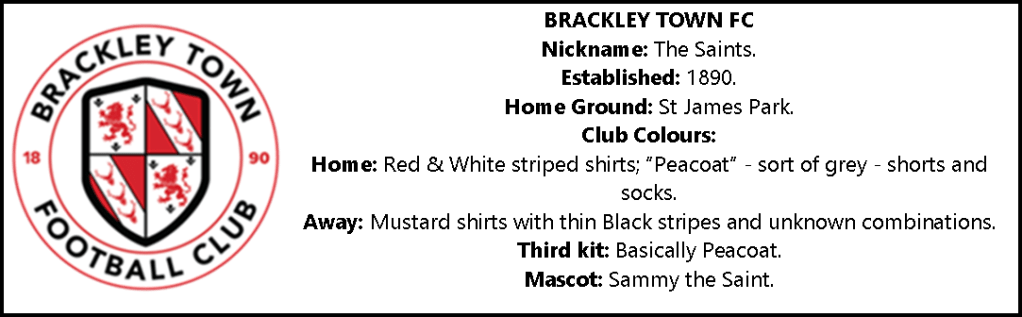
Ask your average football fan which teams play at St James Park and you will usually be told: “Newcastle United” followed by the more enlightened among us with “Exeter City”. But another St James Park – Brackley Town’s home turf – can be found precisely 189 miles south from the Mazuma Mobile Stadium in deepest, darkest Northamptonshire, close to the Oxfordshire and Buckinghamshire borders. Brackley is a small rural town of just over sixteen thousand people which once became prosperous on the basis of the wool trade provided by the sheep farming that was centred on the locality. Brackley Town – known as “The Saints” simply because of the association with the name of their stadium – was founded eons ago in 1890 and not a lot happened during the first century or so of their existence. There were regular promotions and relegations in the Sothern; Hellenic; United Counties and various other leagues until they were finally promoted to the National League North during 2012. Two years later, they reached the First Round Proper of the FA Cup for only the second time ever but took their first EFL scalp with a replay win over Gillingham by the only goal of the game following a 1-1 draw at Priestfield.
The club won the FA Trophy at Wembley seven years ago by beating Bromley 5-4 after Extra Time and penalties once the game ended 1-1. This success was followed by lots of near misses as far as winning promotion to the National League was concerned, losing on four occasions in the Play-Offs to Harrogate Town in 2018; York City in 2022; Kidderminster Harriers a year later and then Boston United in 2024. But at the end of last season, the Saints managed to win National League North outright and the coming campaign will be the beginning of the club’s adventure in the highest ever position in the English football pyramid they have ever inhabited.
Perhaps surprisingly – given Brackley’s status as relative minnows over the last few decades and the fact that the two clubs’ paths have never crossed competitively – there are a few players who have played for both clubs, most notably Justin Jackson and Carl Baker.
Morecambe’s opening home game of the season will be against Brackley Town on Saturday, 16th August 2025. The Shrimps will then travel to St James Park on Saturday, 13th December 2025.
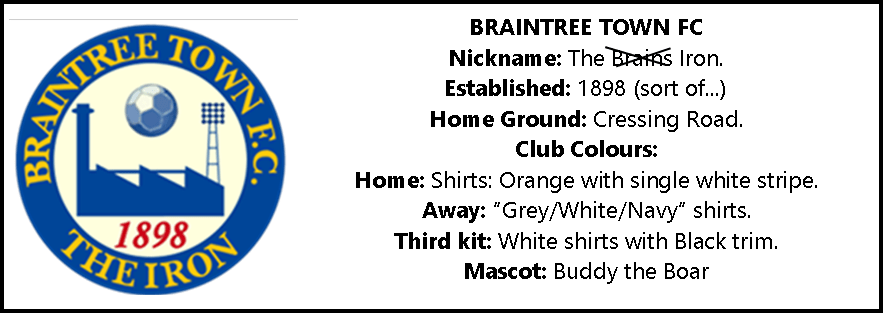
Braintree Town’s Cressing Road ground – voted the worst in the National League by at least one YouTuber – can be found 269 miles south from the Mazuma Mobile Stadium and roughly seventeen miles west of Colchester in Essex. Given its current sponsorship name, I’m surprised that the only vegan club on the planet – Forest Green Rovers – refuses to visit it at all on principle because the stadium is currently known as The Rare Breed Meat Co Stadium.
This gives a whole new meaning to the question asked by a waiter: ”Would you like your steak rare – or really rare?”
(Note to Self: If they genuinely are rare breeds, surely it doesn’t really make a lot of sense to keep on eating them, does it?…)
Whatever – long before the fate of any rare breeds became entangled with the club, it was founded as long ago as 1898 as Manor Works, which was the factory team of the Crittall Window Company. This firm apparently specialised in manufacturing metal window frames and from this, the club earned its nickname The Iron. During 1921, the club changed its name to Crittall Athletic and then Braintree & Crittall Athletic in 1968 before dropping the Works-related prefix altogether during 1981 – although a factory image still features on the club badge. They have been both Champions and Cup Winners in a number of local leagues in Essex but in 2012 finally reached what Buddhists might describe as the fifth Circle of Rebirth (The Inner Circle of Nirvana being represented by the Premier League) – otherwise known as the National League to you and me.
They were relegated to the National League South in 2017 for a single year; bounced back – and then were relegated back there again for five long seasons during 2019.
Last season, the Iron (not to be confused with Scunthorpe United) enjoyed their third stint in the National League and finished seventeenth. They clearly aspire to move even higher, as this statement on their website underlines:
“The floodlighting at the Cressing Road Stadium has recently been upgraded to over 250 lux to meet the entry requirements to the Football League. This upgrade, together with six new turnstiles and a total refurbishment of the dressing rooms was completed in March 2007 at a cost of over £600,000 to meet the ground grading requirements for entry into the National League in 2011. A further £200,000 was spent on improvements to the Cressing Road Stadium, including additional turnstiles, toilets, terracing, etc., during season 2011-12 to secure The Football Association’s ‘A’ Grade to ensure that the ground met the entry criteria for promotion to the Football League.”
The only player I have discovered who has played for both Braintree and Morecambe – who have yet to meet in a competitive football match – is the late lamented Christian Mbulu.
Morecambe will initiate their relationship withBraintree Town at Cressing Road on Saturday, 29th November 2025. They will then host the Essex Iron on Saturday, 14th March 2026.
 shrimplythebestfootball