The National League Explained (by a newcomer from Morecambe).
Part Two – Carlisle United to Hartlepool United.

Carlisle United has a long and quite chequered history. During the 1970s they actually reached the then pinnacle of English football – the First Division – for one single season.
I can still remember watching Match of the Day when this happened. As the unmistakable and dulcet tones of Barry Davis explained to viewers where he was and why, the screen pictured a sheep. Then the camera panned-out to show a fell-side full of the woolly creatures until – at last – a river and then a very dilapidated football ground came into view. “This” said Barry, “Is Carlisle United!”
They started off quite well. I was working in London way back then and was at White Hart Lane on the opening day of the season watching Bobby Robson’s fantastic Ipswich Town team giving Spurs a lesson in the arts of the Beautiful Game: they completely outplayed Tottenham and beat them quite badly. But the home crowd was offered at least some cheer at half time by the news that Carlisle were winning against Chelsea – and finally won their first-ever match at this exalted level by two goals to nil at Stamford Bridge. This was on Saturday, 17th August 1974: a day that will live forever in Carlisle folklore. They then won their next two fixtures as well and found themselves at the top of the Division with maximum points after three games. But United’s initial success didn’t last and they were relegated at the rock bottom of the Division at the end of their adventure with the Big Boys of the English game…
Since then, they have found themselves out of the Football League altogether even before last season’s latest relegation and have flirted with the possibility of joining the Scottish League before finally battling their way back into the EFL. Brunton Park – Carlisle’s home for the last 116 years – can be found just 68 miles north of the Mazuma Mobile Stadium in Cumbria’s County Town.
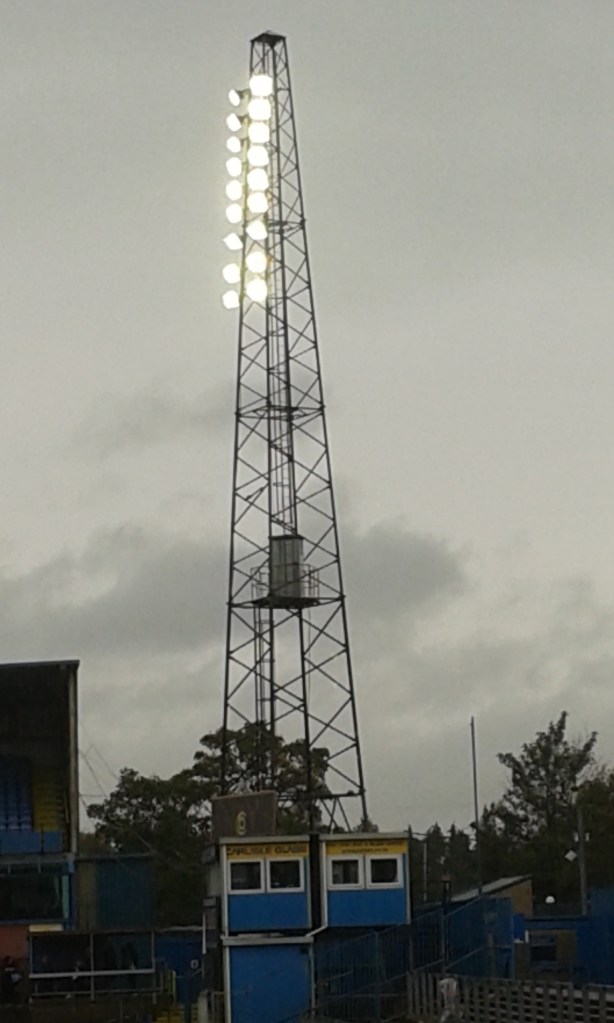
I’ve already mentioned that the ground looked dilapidated even way back in the 1970s. It’s not improved with age – where else would you find awful floodlight pylons like these, for instance? – it looks like the light clusters at the top have simply fallen off.
During October 2018, myself and partner Annie went to see Morecambe win at Brunton Park – for a welcome change – by two goals to nil. Apart from the victory, the day was memorable for the weather – Storm Callum was wreaking havoc with the infrastructure of the north-west of England and – with a part of a railway embankment washed away on the West Coast Main Line near Kendal – we were extremely lucky to get back home by train after the game. But it was also memorable for this picture of stalwart Morecambe fans Jordan and his carer Sam:
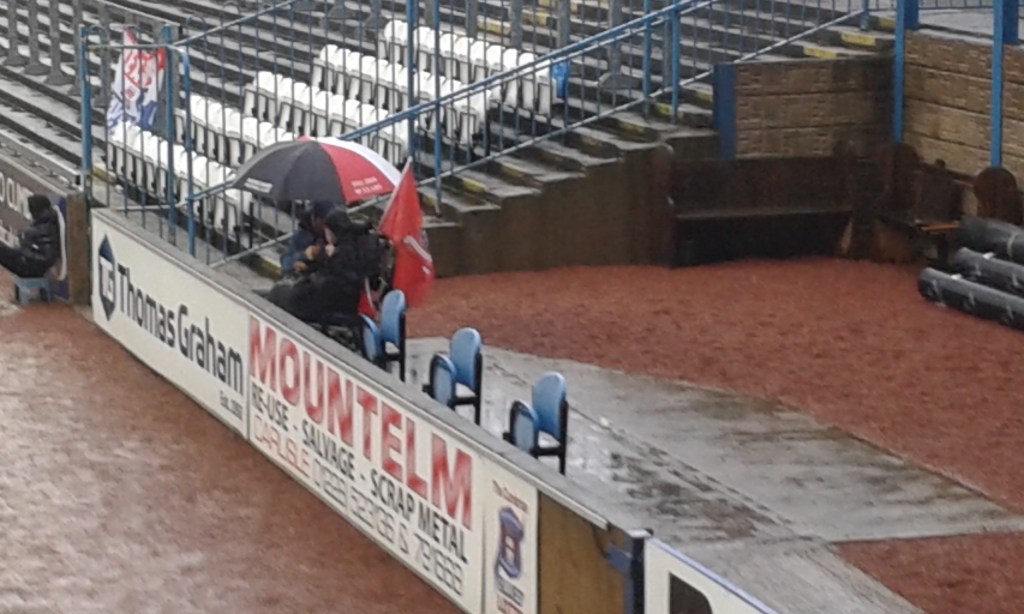
I took this photo of them struggling against the elements on the bit of waste ground behind one of the goals that Carlisle reserved for disabled fans at the time. After it had been published on the old D3D4 Football site, it went viral. In no time at all, BBC Radio Five was on the case. They changed their schedules to present a programme specifically about disabled spaces at football grounds in England and Anna Foster – now a presenter on Radio Four’s `Today’ programme – did a live interview with Sam in which he spoke passionately but very sensibly about the issue.
The ownership at the club were unmoved. They said that all of Brunton Park basically needed knocking down updating and that visiting disabled fans could basically lump it – or sit with the Carlisle contingent in more sheltered parts of the stadium. When this point was put to Sam on live radio, he explained that the whole point of taking Jordan to football matches was that he could enjoy a sense of belonging – with fellow Morecambe supporters, not with strangers – a point that was clearly lost on the hard-hearted hierarchy at United. The mass of Blues fans were outraged by this, to their considerable credit – and rebelled. This is what the Carlisle United Disabled Supporters Group had to say about it in December 2018:
“The low point of the year had to be the publicity the club received about the treatment of visiting wheelchair fans at the Morecambe game. The match had taken place in torrential rain and photos of a young boy sitting in the rain had, rightly, embarrassed us all.
I went down to Brunton Park on the Monday morning after the match and I was assured that the Morecambe fans were, on three separate occasions, offered the chance to move to a dry area but they chose to remain in the uncovered area in the Waterworks End.
I have to be fair and say the bad publicity was justified. The problem of away fans in an area where there was no shelter had been known about for some time. Now thankfully that problem has been addressed.
The club provided a roofed area for two wheelchairs at the bottom of the Pioneer Stand which was available for use before the next home game. Shelter4less provided the club with an excellent shelter free of charge. It arrived flat packed and I would like to thank the groundstaff for their sterling efforts in putting it together and installing it in situ at the Pioneer Stand side of the Waterworks End.”
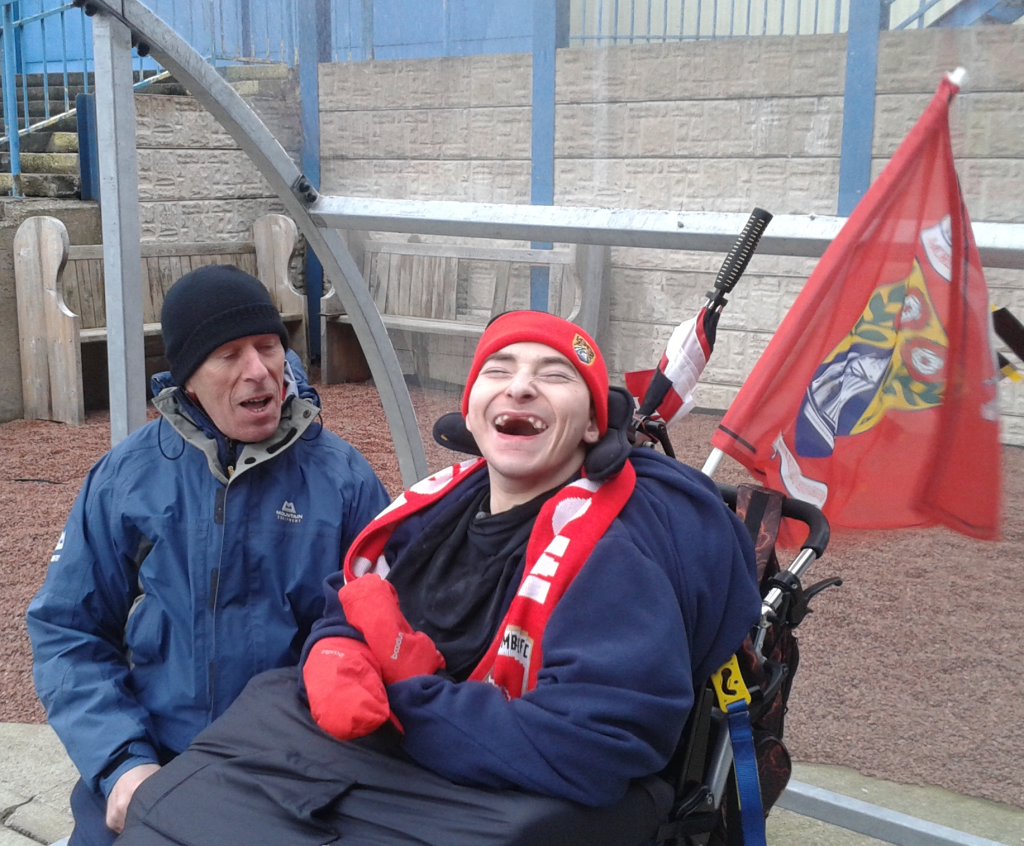
So next time we went to watch Morecambe – thanks to their efforts – there was at least a shelter to keep all wheelchair users at least a little bit dry during stormy weather. And someone I can think of was very happy about this…
Anyway: United was founded as the result of the merger or collapse of other clubs in the city in 1904 and started playing at Brunton Park in 1909. They initially played in both Divisions of the Lancashire Combination but then transferred to the North Eastern League during 1910. Less than eighteen years later – after being Champions of the north Eastern League at least once – they were elected to the Football League.
They spent exactly three decades from 1928 in the lowest tier of the EFL: initially the Third Division North and latterly in the Fourth Division after the League was shaken-up during 1958. They actually won this Division in 1956 and then were immediately promoted to the Second Division (what is now known as the Championship.) In 1974 – as we have seen – they went one stage better – to the very pinnacle of English league football; the First Division. But that was as good as it got and they lasted only one season before being relegated again to the Third Division in 1978. After that, they rallied briefly but both 1986 and 1987 saw further relegations which took them back to the bottom Division all over again. Crises and dodgy owners have come and gone since – as Carlisle themselves have come and gone from the EFL. They were relegated for the first time in 2004 but they should also have gone down at the end of the 1991-92 season, when they came bottom of the entire EFL but were saved by the collapse of Aldershot during the campaign.
Last season, the Cumbrians accompanied Morecambe out of League Two with the unwanted distinction of being the second worst team in the entire EFL. This was their second demotion in a row. But one of the contrasts with our club is that – whilst we have spent literally no money whatsoever on transfer fees over the last twelve months (and actually far longer), Carlisle has invested well over a million pounds in its squad. But the city is much bigger than our little seaside resort and the United fan base is several times larger as well. This is reflected in Morecambe’s pretty dire record against the Blues: only five wins in twenty-five major games as opposed to thirteen for United plus other losses for the Shrimps in minor cup competitions and friendlies over the years.
For what purpose, though? You sometimes wonder if the club’s nickname – the Blues – mirrors the effect it has had on its long-suffering fans over the decades. United’s achievements on the field do not reflect the potential imbalance in resources between themselves and a lot of other English clubs. The only competition they have ever thrived in is the Football League Trophy. They reached the Final in 1995; 2003; 2006 and 2001 (losing to Birmingham City; Bristol City; Swansea and Southampton in succession). But they actually won it in 1997 (beating Colchester United on penalties after a scoreless 120 minutes) and then again in 2010 (when they defeated Brentford one-nil.) This season, they will have another go at winning the FA Trophy, which has so far eluded them.
Far too many players have worn both the blue of Carlisle and the red of Morecambe over the years to be listed here. But one worthy of a special mention is Carlisle Captain of last season and former Morecambe Skipper Sam Lavelle. He was a real asset at our club both on and off the field and a real credit to himself and his family (his father, Ben also once played for the Shrimps) into the bargain.
Morecambe will play Carlisle United at Brunton Park onTuesday, 30th December 2025 at quarter to eight in the evening. The return fixture at the Maz will be playedon Easter Monday, 6th April 2026.
.
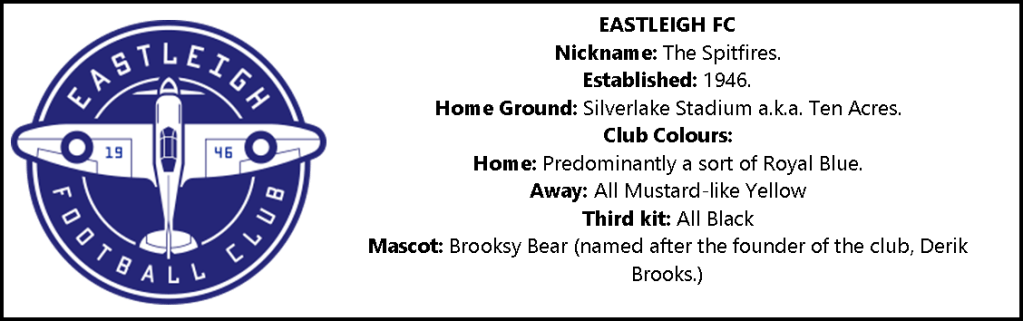
Eastleigh’s Silverlake Stadium can be found 272 miles south from the Mazuma Mobile Stadium and just five miles north of central Southampton in Hampshire on the south coast of England. The ground is not actually in Eastleigh but can be found just over two miles south in a suburb of Southampton called Swaythling and it was by this name that the club was initially known. It was re-christened Eastleigh in 1980 for reasons I cannot explain. Swaythling is almost five miles from Woolson – by the mouth of the River Itchen and a stone’s throw from the sea. On the River could once be found the site of Supermarine – a historic and famous aircraft manufacturing company. Supermarine’s whole focus during the 1920s and 1930s was to create seaplanes capable of winning the prestigious Schneider Trophy in the face of opposition from American and European competitors. In 1931, the Supermarine S6B seaplanewon the Trophy outright for Britain and became the prototype of the most famous RAF fighter of World War Two, the Supermarine Spitfire – after which the club is now named, also for reasons I can’t explain: its links with both Eastleigh and Supermarine seem tenuous in the extreme other then the Spitfire’s Test Flights were made from nearby Eastleigh Aerodrome, now known as Southampton Airport. Oh – and they once had a Mascot called Sammy the Spitfire. (In reality, Sammy was actually a dog…)
Whatever, the original club was founded by a group of friends in the Fleming Arms in Swaythling on May 22nd 1946 and it initially played on Southampton Common or a ground at Walnut Avenue in Swaythling, depending on which source you want to believe. It moved to its current ground – then known as Ten Acres – during 1957. Not a lot happened from then until the club was promoted to the Conference South in 2005 and they stayed there until 2014 when they won the Play-Offs to earn a place in the Football Conference proper. They started writing national headlines in 2015 when they beat Lincoln City in the FA Cup and again a year later when they beat EFL Bristol Rovers and then fellow National Leaguers Macclesfield, who they walloped 4-0 in a game that was televised live. Three years later – after disposing of several other EFL clubs – they won 1-3 at Swindon Town in another game which was shown live by the BBC.
They have not really hit the headlines much in recent times but last season, they finished lucky thirteenth in the National League: their tenth consecutive season at this level.
Morecambe and Eastleigh’s paths have never crossed in the past. A few players have performed for both Eastleigh and Morecambe, most notably Champion Diver JJ McKiernan and one of the worst signings our club has ever made: Wes McDonald.
The first meeting between the two clubs is scheduled to be on Saturday, 25th October 2025 in Hampshire. Eastleigh will then visit Morecambe on Saturday, 21st February 2026.

Forest Green Rovers has a unique claim to fame: it is the only Vegan football club on the planet. Its old Hippy of an owner – Dale Vince – has guided a small club based in the village of Nailsworth, Gloucestershire from non-league obscurity to the giddy heights of League One to a double relegation back to the National League one year ago.
Their ground – the New Lawn – can be found 197 miles south west(ish) from the Mazuma Mobile Stadium but plans are still in place to re-locate it to the middle of nowhere to play at a place called the Eco Stadium. This environmentally-friendly edifice will be made out of wood and other sustainable materialsin a catchment area of a few sheep and the occasional cow somewhere near the M5.
But at least these animals are safe in the knowledge that nobody at the club will eat them.
Meat and dairy products are banned from the New Lawn, which has an organic grass surface; recycled water resources and various other innovations rare at most football grounds. The team play in strips made from recycled coffee beans and if only they had a decent Manager (or an owner who knows how to select one), they might be doing ok.
Last season, FGR finished third in the National League but their push for an immediate return to the Football League was thwarted by Southend United, to whom they lost in the semi-finals. Steve Cotterill – FGR’s umpteenth Manager in just two seasons – was rewarded for his efforts by the sack in June 2025. Mr Vance may be absolutely Right-On as an individual but his recent managerial choices have all been absolutely Right-Off: to the Labour Exchange usually…
Morecambe and FGR have met lots of times in the FA Cup, EFL and the Conference prior to that but I can’t find the full record of all their contests. So we’ll have to make do with five wins for the Shrimps; four for the (very) Green Devils and three matches drawn in recent times in the EFL and FA Cup.
Not many players have been employed by both clubs but a notable exception was Farrend Rawson, the loss to Accrington Stanley of whom – as influential Team Captain on and off the field – is one of the reasons Morecambe is now a non-league club – and Stanley isn’t….
Morecambe will start their re-acquaintance with Forest Green Rovers at the Maz on Tuesday, 2nd September 2025. The Shrimps’ final game of the campaign will be at the New Lawn on Saturday, 25th April 2026.

Gateshead is another club with a sometimes very troubled history which currently plays at the International Athletics Track in the town which it also shares with no less than two Rugby Union clubs. The Gateshead International Stadium is situated 118 miles north east from the Mazuma Mobile Stadium
Gateshead began life in 1930 as a Football League club after financially-troubled South Shields Adelaide moved the few miles across Tyneside to Redhugh Park and continued to play as Gateshead; `the Tynesiders’ or – more commonly – `The Heed’ (reflecting the local pronunciation of the second part of the name of the town they are based in).
You could argue that this was an early version of the Wimbledon/Milton Keynes Cons scandal with one difference: South Shields apparently wanted the change which happened at the time: or at least some of their Directors presumably did. But things didn’t go well and the new Frankenstein club was let down in 1960 by the Old Boys Network which usually ensured the survival of the four bottom-most clubs in the lowest tier of the EFL: Division Four. The Heed didn’t actually come bottom: they were third from it but out they went anyway as the predominantly industrial northern, Midlands and southern EFL clubs seized the opportunity of ditching a long and often problematic journey to the North East and elected non-league Peterborough United in their stead.
The club’s official website still whinges that this wasn’t fair – but what was fair about the fact that clubs like Wigan Athletic; Barnet; Altrincham – or ourselves (which were all at least a match for the likes of Gateshead at that time) had not even a sniff of holding the exalted position the Heed had enjoyed for the last more or less pointless thirty years in which they had achieved precisely nothing of any real worth?
Worse was soon to come. Their application to join the Scottish League was refused and Gateshead ended-up initially in the Northern Counties League for two seasons and then the North Regional League. Some sort of hope of a better future seemed to suggest itself when the Tynesiders became inaugural members – with Morecambe – of the new Northern Premier League in 1968. But as if to prove the point that they were never good enough to be a Football League club in the first place, they consistently struggled against authentic non-league sides in the NPL and were relegated into the obscurity of the Midland League of all competitions after a break of twelve months again after only two seasons. They lasted precisely two years in this league before – in 1973 – the club went bust altogether.
But history was to repeat itself, astonishingly enough. As Gateshead set out on their downward trajectory, a new club calling themselves South Shields was moving in the opposite direction. During 1974, the new club decided to sell its 25,000 capacity Simonside Hall ground in the town and chose to re-locate to the Gateshead Stadium instead. (Where did the money go? With disturbing echoes of Milton Keynes’ rogue outfit, many Shields’ fans were not happy about this, boycotted the new incarnation and started all over again in the town. They now play in the National League North.)
At the time of the latest transformation, South Shields were members of the Northern Premier League. But – now calling themselves Gateshead United – the Son of Frankenstein club (despite wins against Football League opposition such as Grimsby and Crewe in the FA Cup) didn’t last long in the NPL. In 1977, this club also went bust.
On this occasion, a new Gateshead FC was immediately formed by natives of the town. The latest incarnation of the club not only retained the defunct United’s NPL status (should it have, really?) but went on to win the title in 1983 with a record 100 points and an astonishing 114 goals scored in just 42 games. This earned them promotion to the Alliance Premier League. – just one step away from the EFL, albeit that this bastion of the mediocre was still a totally Closed Shop at the time. They lasted precisely two years before relegation but won the NPL again in 1986. And so it went on: relegation and promotion following dizzyingly regularly during the years that followed. But when they were relegated back to the Northern Premier League yet again in 1998, the club’s future was in doubt once more. They fell even further into the NPL First Division in 2003 for a single season and continued to struggle until the acquisition of it during 2006 by a native of Gateshead – Graham Wood – marked a transformation of the club’s fortunes. The Heed became full-time professional in 2010 and actually reached the Conference Play-Off Final – with the prize of EFL membership eventually actually available – in 2014 only to lose to Cambridge United by the odd goal in three at Wembley. With Mike Williamson at the helm, Gateshead returned to this venue and reached the FA Trophy Final for the first time in 2023 only to lose to FC Halifax by the only goal of the game. A year later, though, they were back again and finally managed to beat Solihull Moors by one goal to nil
Changes in ownership and financial problems familiar to most football clubs in the English game means that the defeat against Cambridge and the victory over Solihull have been the high points of the club’s recent history. Last season, however, the Heed finished eighth in the National League.
I suspect that any team on Tyneside must inevitably struggle in the shadow of the huge club to be found to the north of the river: Newcastle United. Establishing their own identity in a town best known for the concrete monstrosity of a car park featured memorably in the film Get Carter; an Anthony Gormley sculpture concerning an Angel (which is apparently haunted by a Nazi apparition) by the side of the A1 (as featured on the club’s crest) and – very belatedly – the former Grain Store Baltic art centre by the side of the Tyne can’t be easy, can it?
No – even if you do have a five-year old lad called Robert Hall among your roll-call of natives who was abducted – and experimented upon – by aliens in 1940. He was warned by Men From the Ministry (implicitly MI5) not to tell anybody about this – but when another alien tried to abduct the poor wee bairn all over again, he was saved by his uncle, who killed the creature from some other solar system with a shovel.
Doubt it? The alien’s remains can apparently still be found somewhere beneath the floor in Gateshead’s St Cuthbert’s Church on Belsham Road, just south of the Tyne.
Beat that, Alan Shearer!…[1]
After that, I’m not even going to try to explain why their Mascot is called Rooney the Goat – it’s probably best not to know (except that `Goat’ is apparently an abbreviation of Greatest Of All Time)… (If you want to find out yourself, you can contact the Goat on @GoatRooney on X.)
However, the only statistics I can find about clashes between Morecambe and The Heed refer to the Football Conference almost thirty years ago: two wins for the Shrimps during 1997-8 when Gateshead were relegated at the end of the season; Morecambe winning 1-4 away and then 2-0 at Christie Park. But the clubs had met earlier than that – on Saturday 8th March 1969, for instance, in the Northern Premier League: Morecambe won 2-0 as I stood and watched.They won by the same score in the same competition at Christie Park on Saturday, 25th October 1969 as well: I was there again. I know there were other games – the reverse fixtures of these two for a start plus others in the Conference in the two seasons following the Shrimps’ promotion to it in 1995 – which don’t seem to be recorded on the internet.
Be that as it may, I have been able to find details of three players who have both played on-loan for both clubs: defender Alex Whitmore; forward Ged Garner and current Motherwell goalkeeper Archie Mair.
Both of Morecambe’s games against Gateshead will be night matches, played on Tuesday evenings. The first game is at home on 30th September 2025; the reverse fixture will be in the north-east on Tuesday, 25th February 2026.

Halifax – an imposing stone-built industrial town in West Yorkshire – has traditionally been a Rugby League stronghold. Soccer – Association Football – has always played second fiddle.
However, the original Halifax Town AFC was formed in 1911 and played in the Yorkshire Combination for a season before joining the Midland League. They became members of the Football League at the newly-built Shay ground (81 miles from the Mazuma Mobile Stadium) in 1921 and lasted as an EFL club until 1993, when they were relegated to the Football Conference. By this time – despite beginning to share the Shay with the rugby club Halifax Panthers, Town were in big financial trouble, owing the tax man alone almost eighty thousand pounds: a huge debt at the time. After initially struggling in their reduced circumstances, the club rallied and actually won the Conference – and thus a place back in the EFL again – at the end of the 1997-98 season. But they were soon down once more: in 2002. A rookie Chris Wilder was then appointed Manager and took the Shaymen to the Conference Play-Off Final in Leicester during 2006 only for them to lose to Hereford United (who had accounted for Morecambe in the semi-finals) by the odd goal in five after extra time.
By this time, the club were in even deeper financial doo-doo and rumours that the Shay was about to be sold to be replaced by a supermarket or perhaps a sports complex resulted in actual bids for the ground by several property speculators. It survived, however – and continued to survive the reality that the club had gone into Administration owing the HMRC alone over £800,000 and with a total debt of two million smackers – and maybe a tad more.
They were deducted ten points by the Conference during the 2007-08 season for going into Administration as a result of this but technically avoided relegation on the last day of the campaign. To no avail – having failed to implement the Company Voluntary Agreement agreed with the Conference to bring the club out of Administration, Halifax were banished to the Northern Premier League Division One. At this point – hardly surprisingly – Halifax Town went bust.
But FC Halifax almost immediately rose from the ashes, with the same Board of Directors as before and the same home ground: the Shay. They started again from scratch in the NPL First Division; four steps down from the Football League of which they had been such proud members for over seventy years.
They won the division at the first attempt and the NPL Premier the season after that. Then they reached the Play-Offs in the Conference North during 2012, narrowly losing to Gainsborough Trinity before bouncing back a year later, beating Brackley Town in the Play-Off Final to enter the Conference Premier. They reached the Play-Offs in this at the end of the 2013-14 season but narrowly lost again in the semi-finals, this time to eventual winners Cambridge United. In 2016, though, they were relegated back to the recently re-named National League North but bounced straight back with a Play-Off win over Chorley. Since then, they have been regularly knocking on the door of the EFL but not quite gaining entry. They were beaten at the Play-Off stage by Chesterfield in 2022 and Solihull Moors in 2024. Last season, they finished sixth in the National League but again fell in the semi-finals of the Play-Offs when they were walloped 4-0 by eventual winners Oldham Athletic.
The internet tells us that the only time Morecambe and FC Halifax have met has been in the FA Cup during 2018. This ended with embarrassment for the Shrimps as the Shaymen drew 1-1 at the Maz and then knocked EFL Morecambe out of the competition by winning the replay by the only goal of the game. Again, though, they have certainly met many more times than these two games but I have no way of retrieving all these statistics.
Several players have been employed by both clubs, most notably – and recently – AJ Leitch-Smith; Jordan Slew and Jamie Stott. Perhaps more importantly, iconic ex-Morecambe Manager Jim Harvey was also boss at AFC Halifax at one time and earned the eternal affection of their fans by taking his team to Leicester City’s stadium and winning the FA Trophy Final in 2016: they beat Grimsby Town by the only goal of the game. Seven years later, they emulated this feat – this time at Wembley – when they overcame Gateshead by one goal to nil.
Morecambe’s two games against FC Halifax Town this term will both be played under floodlights. The first one will be at the Maz on Tuesday, 24th September 2025. The second will be in Yorkshire on Tuesday, 21st January 2026.
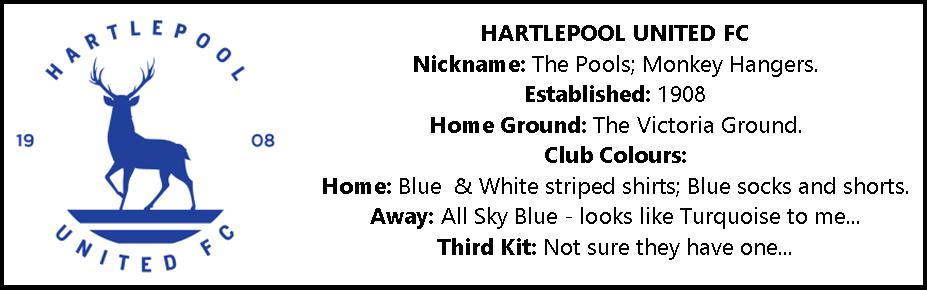
Hartlepool United was founded in 1908 as the Hartlepools (note the plural) United Football & Athletic Club Company Ltd. (Why the plural? After extensive and painstaking research, I have discovered that there was a football link between the fishing port of Old Hartlepool and the town proper, then known as West Hartlepool. As the two places basically merged as creeping building development work brought them together at least geographically, the two separate clubs they previously had merged in 1908: hence the extra `s’…)
I remember `Sir’ John Hall – one-time owner of Newcastle United – ranting ages ago about some supposed `Geordie Nation’ as if it was a rival to Judaism as the Chosen People or a better version to Adolf Hitler’s Master Race – contrasts that aren’t without their irony I suppose. Whatever the weaknesses of this pretty elitist notion, there is no doubt that the north-east of England as a whole contains certain distinct identities. Up there, Geordies are also known as `Tackems’ and people from nearby Sunderland `Mackems’. (`We makem – you takem!”) The tribal rivalry between the two places has often deteriorated into serious violence when their football clubs meet. But their antagonism apparently stretches back to the Civil War. Newcastle were Royalists; Sunderland Parliamentarians (one of the few battles the Mackems have ever won when you come to think of it…)
I digress. Middlesbrough is also in the north-east and they don’t generally like it when outsiders call them Geordies – the town is much further south on the River Tees and has an identity all of its own. So where does that leave Hartlepool or even Hartlepools?
It leaves it a bit further north from Middlesboro but about thirty miles south of both Sunderland and Newcastle, nestled by the side of the North Sea.
So what is the collective name for a resident of the town? It is certainly not `Geordie’ or `Smackem’ – it is something both far more unusual and specific; they are all Monkey Hangers.
I kid you not. The legend is that – just over two hundred years ago during the Napoleonic Wars – a French ship was wrecked in a storm just off Hartlepool. The only survivor was a monkey – probably a pet or a ship’s mascot. The locals had never seen a monkey before – but they equally had never seen a Frenchman either. But they knew that Napoleon’s sailors spoke a language unlike their own. And wore a uniform. So when the terrified creature – which had been dressed in his own Monkey Suit not unlike its drowned crew – started chattering, the natives took the poor thing to be speaking French – and hanged it as a Napoleonic spy.
I would expect most people – in these supposedly enlightened times – to be embarrassed by this tale of utterly primitive and mindless savagery. But the good people of Hartlepool have not only embraced it but promoted it – indulging in literal Gallows Humour by calling their football club’s Mascot H’angus, for example. (The man behind the mask actually became the Mayor of Hartlepool in 2002, running on the slogan `free bananas for schoolchildren!’).
But that’s enough about the distinct culture of the place. What do we know about the club?
Their Council-owned Victoria Ground – once home to the long defunct West Hartlepool Rugby Union Club – is 109 miles from the Mazuma Mobile Stadium in Morecambe. Once founded, Hartlepools United played in the North Eastern League from 1908 until 1921. This was a pivotal year for many Football League Clubs as it marked the introduction of new regionalised Divisions: Divisions Thee North and South. They stayed in this lowest tier – rebranded the Fourth Division during 1958 – for the best part of half a century, only once gaining promotion (in 1968) before immediately being relegated again. They chose to call themselves just plain `Hartlepool’ at this time before becoming Hartlepool United in 1977.
These minor details are important – in the absence of actually winning anything worth writing home about for almost all its history, there is not a lot more to say about a club whose slogan could have been `mediocre’ for most of its existence so far.
Wait a minute, though – Brian Clough not only played for them but started his Managerial career at the Victoria Ground even though he soon moved on to Pastures New at Derby County. Oh – and Cyril Knowles (ex-Spurs full-back) was also moderately successful at the club (“Nice One Cyril!”) until brain cancer sadly intervened – he has a stand named after him at the ground. Ah – and a stand at the Victoria Ground on the site where Cyril’s commemorative one can be found today was bombed by a German Zeppelin and completely destroyed during 1916. (A claim for compensation by the club was subsequently rejected by the government in Berlin.)
Whilst searching in vain for anything else positive to say about them, I discovered one record which Hartlepool would definitely not like to hold, however. This is the number of times they have had to apply for re-election in the Closed Shop of the Football League. Between 1914 and 1984, the club had to rely on the Old Boy’s Network to keep them a member of the elite as they applied for re-election no less than fourteen times (that’s a staggering twice a decade on average). This is shameful not just for the club itself but for an EFL organisation which was prepared to tolerate this absurd situation when clubs outside their cosy little cabal had far more to offer – but couldn’t get in. So when the bastion of Football League privilege was finally broken in 1987, the clock was ticking for the Monkey Hangers.
Defying past expectations, Hartlepool had not only actually been in League One for most of the Twenty-First Century but reached the Play-Off Final against Sheffield Wednesday at Cardiff in 2005 – only to lose 4-2. Normal Service was quickly resumed as they were relegated back to League Two – albeit for only a single season – in 2006. But time finally caught-up with the Pools. Having slipped back into League Two again in 2014, they were at last relegated out of the EFL altogether during 2017.
The Board at Hartlepool had the good sense, however, to poach Manager Dave Challinor from AFC Fylde and under his guidance, Hartlepool were back in the Big Time by 2022. Dave left for further success at then non-league Stockport County and the club he left behind began to struggle anew. They survived for just two seasons in the EFL and last season – with Simon Grayson at the helm – Pools finished eleventh in the National League. If they win anything worth winning this time out – the FA Trophy – for instance, it will be their first notable success in over a century of trying.
The Shrimps and the Pools have met twelve times in the past in various competitions. Morecambe have won three of these; Hartlepool twice as many. They will next meet under floodlights when Morecambe travel to the Victoria Ground on Tuesday, 4th November 2025. Hartlepool will travel to the west coast of the country for the reverse fixture on Tuesday, 24th March 2026 for another evening game.
[1] Don’t blame me for this drivel. It’s the fault of the local rag – Number 5: https://www.chroniclelive.co.uk/news/history/10-things-you-probably-never-13589693
 shrimplythebestfootball