The National League Explained (by a newcomer from Morecambe).
Part Three – Rochdale to Sutton United.
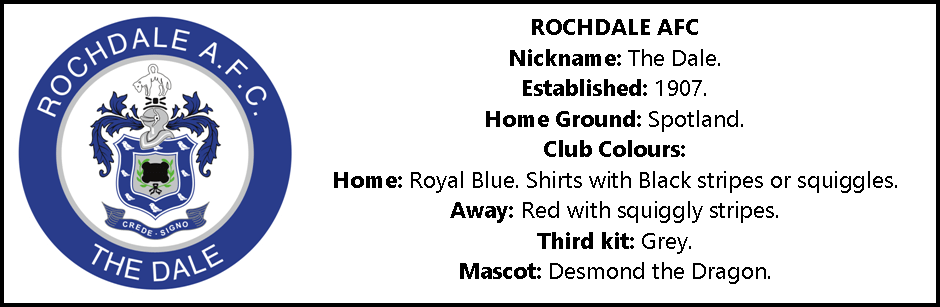
Rochdale AFC has played at Spotland – 64 miles south from the Mazuma Mobile Stadium in what was once Lancashire but is now Greater Manchester – since 1920. The ground is now totally owned by the club and has been since 2016 – at a time when they had shared it with local Rugby League club Rochdale Hornets since 1988.
(Spotland was the venue chosen for a World Cup Rugby League game between Ireland and Fiji in 2013 and attracted 9,000 spectators: over three times the football club’s usual home gate – which was an average of just 2,552 last season.)
Rochdale AFC was founded in 1907 with the motto “Crede Signo’, which seemingly means `believe in this sign‘ – and sounds much nicer than `Crude Signo’ which probably involves your fingers and doesn’t sound very nice at all….
But what does `believe in this sign‘ actually mean? Which sign?
Of the Times?
Give Way?
Who knows? Is it meaningful? Is the fact that the two words are also an anagram of Green Disco similarly significant? As I say, who knows?
Anyway, Dale initially played in the Lancashire Combinations (Second; then First Divisions) and later in the Central League. Like so many of their peers, they took advantage of the Football League’s expansion in 1921 and became original members of the Third Division North. This was eventually re-badged as The Fourth Division and – exactly eighty years later – they were still in it. (That is to say, they were still in the EFL’s lowest tier, now known as League Two. To be fair, they had been promoted once in 1969 but five years later were back again in the basement of the EFL’s Closed Shop.)
During 2010, though, they went up into League One only to slip back again two years later and then went on to be promoted anew in 2014. Yazz tells us that The Only Way is Up but Rochdale have proved this not to be the case. In 2021, they were relegated to League Two anew and then – in 2023 with former Morecambe icon Jim Bentley at the helm for most of the season – they lost their league status altogether after almost a century of more of less constantly failing to stir the blood of their success-starved supporters. (Their only brush with proper glory was when they reached the two-legged Final of the virtually brand new League Cup in 1962. But they lost at Spotland 0-3 to Norwich City and were beaten again at Carrow Road 1-0 to lose 4-0 on aggregate.)
Last season, Dale finished fourth in the National League, which is an improvement on their performance a year previously, when they came eleventh , which must be a good sign, mustn’t it?
If it is – remember: Crede Signo everybody!
Morecambe and Rochdale have met fourteen times in various competitions, all within the last twenty years. Dale have won five of these; the Shrimps four.
Several players have appeared for both clubs. A dishonourable mention must go to David Perkins, who abandoned Morecambe just before our EFL promotion season because he clearly thought himself too good for us. Boo! Andrew Tutte hasn’t been missed either and the jury’s out on Lewis Allesandra but honourable mentions must go to Jack Redshaw, Max Taylor (who will be playing for them this season) and perhaps particularly the magnificent Toumani Diagouraga.
Both of the fixtures between the two clubs next season are scheduled for Bank Holidays. The first one will be held at the Maz on Boxing Day, Friday 26th December 2025. The reverse fixture at Spotland will take place on Good Friday, 3rd April 2026.
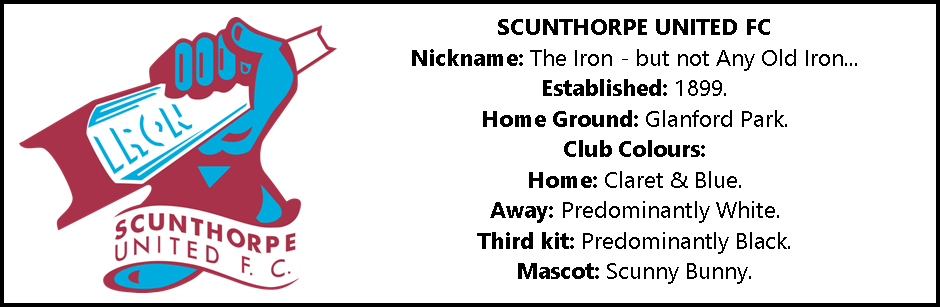
Scunthorpe’s Glanford Park ground can be found 137 miles from the Mazuma Mobile Stadium in Lincolnshire’s third biggest town.
There was a time when Scunny stole our best footballers because they were a bigger club than we were: Garry Thompson and Mark Duffy were both players we could ill afford to lose at the time they departed for Lincolnshire. But since then, the boot has moved to the other foot – at least until Morecambe’s relegation from the EFL last season.
I have a theory – not very original, admittedly – that football teams often mirror the fortunes of the towns that spawned them. Scunthorpe was once a relatively prosperous place, the fortunes of its over 80,000 inhabitants based on the iron works which once abounded in the town. But now, only one steel mill remains – thanks to nationalisation by the current Labour government – and Scunny has fallen on hard times and is subject to many serious social problems.
It is also clearly a hot bed for crime. Doubt it? Then listen to It’s a Fair Cop on Radio 4 and get ex-copper Alfie Moore’s take on the place (it’s genuinely hilarious):
In truth, crime in Scunny is 140% the national average, which is quite alarming.
So is this `The Scunthorpe Problem’?
No it isn’t. `The Scunthorpe Problem’ is one of the unintended consequences of Artificial Intelligence (A.I.) and other internet scanners which seek to clean-up the world wide web by identifying bad, unacceptable or rude words on it – and removing them.
In doing this though, they created The Scunthorpe Problem because they can delete all sorts of seemingly innocuous terms because these seemingly innocent words can sometimes actually hide other rude or even downright crude words which some very Woke, stupid or perhaps religious people might find distasteful or even offensive.
So if you’re planning to look at the healing properties of wild mushroom and hear that shitake growing near scrap metal can be analysed next Saturday in Scunthorpe, be very careful: A.I. could render this sentence literally incomprehensible by removing five key words from it.
But back to the football club. Scunthorpe’s real problem is that they have never been able to replicate the success they briefly enjoyed when Physio-turned-Coach Nigel Adkins took over the management of the team in 2006 (and – come to think of it – neither has he…)
But we get ahead of ourselves…
The Iron played at The Old Show Ground from 1899 (when the club was founded) until 1988. Then – with spooky echoes of the Morecambe experience – they sold the site to Sainsbury Supermarkets and built a new arena at Glanford Park, almost two miles to the west of their former home. And then – just like us – their problems came home to roost when ownership disputes eventually just about wrecked the club.
Scunny began life as members of the Midlands League but had to wait until 1950 to be elected into the Football League’s Third Division North. They won this in 1958 but gradually slipped from the Second Division (in 1964) back through the Third into the lowest tier of the EFL at the time – the Fourth Division – during 1968. Not a lot happened as the club stayed in the two lower tiers for decades after this point until Magic Man Adkins put down his sponge and took over the Manager’s reins in 2006.
He guided United – courtesy partly of a sixteen-match unbeaten run – to win League One with an extraordinary 91 points. But they only lasted one season in the Championship. A year later, though – in 2009 – they were back. The 2008-9 season was a momentous one for the Iron. They reached the EFL Trophy Final at Wembley only to be beaten after extra time; 3-2 by Luton Town. But they were back under the giant arch again at the end of the campaign and beat Millwall 3-2 in the League One Play-Off Final to secure a place in the Championship once more. But Adkins departed for Pastures New at Southampton and the club’s slow but steady demise started to develop from then on. They found themselves in League Two again in 2013 and – despite another stint in League One from 2014 until 2019, slipped back down a Division before falling out of the EFL altogether during 2022.
As a warning to the unwary, they weren’t good enough for National League football either and were immediately relegated to National League North for two seasons. Just a few weeks ago, they won their place in the National League back again by winning the National League North Play-Offs, 2-1 versus Chester City.
Scunny’s problems off the field have been – in their own way – as tortuous as Morecambe’s own in recent times. Unreliable and/or unscrupulous ‘businessmen’ have claimed ownership of the new stadium; threatened to lock the team out of it; demanded an utterly bizarre seven pence a year (sic.) rental; called other people `liars’ in very public slanging matches; described the football team as `Squatters’ and `Trespassers’ and basically used the club as a Cash Cow and a stick with which to beat other people in a way that is far too familiar to Shrimps’ supporters. These disputes seem to have been settled, however and the club appears to have been stable – at least off the field – for the last couple of years. Let’s hope it stays like that – and that ours enjoys a similarly positive outcome – eventually…
I was surprised to see that Morecambe have only played Scunny five times altogether in all competitions: I thought it was more. I was further dismayed to see that the Shrimps have only won one of these games but the Iron have been victorious on three occasions.
But then I remembered…
Against Scunthorpe United, Morecambe have historically nearly always seemed to have failed to turn-up – particularly away from home.
As well as Thommo and Mark Duffy; Alex Kenyon and a couple of others have played for both clubs.
Morecambe will travel to Lincolnshire to play Scunthorpe on Tuesday, 19th August 2025. The home fixture will be completed on Saturday, 17th January 2026.

Solihull can be found about nine miles south-east of Birmingham city centre in its own Borough in the West Midlands. Moors came about as the result of the amalgamation of two rival football clubs – Moor Green and Solihull Borough – just eighteen years ago. Both clubs still live on – in a sense – in the way the new club has taken half of the previous clubs’ names to form their new title and the fact that the new Moors alternate their away kits each season to match the colours of the previous home strips of both Moor Green and Solihull Borough. The latter played in white shirts with red arms; red shorts and white socks; Moor Green (it was actually perhaps surprisingly less green in reality, wasn’t it?): pale blue shirts and dark blue shorts and socks. Additionally, Solihull Moors play at the former home ground of `Boro’ – the fruitlicious-sounding Damson Park – which was built in 1998. This stadium is 147 miles from the Mazuma Mobile Stadium.
In contrast to many of the old Football League stalwarts we have already discussed who have achieved little or nothing in centuries of underachievement between them, Solihull Moors was formed as a dynamic club and have remained so ever since. Unlike the plastic club in Milton Keynes or dodgy-as-hell Gateshead, for instance, the new club came about as a result of the agreed merger of its forebears. Following an arson attack on its own ground, Moor Green started to share Solihull Borough’s ground as from 2005. In January 2007, the two clubs approached the Football Association and asked for permission for an official merger as the new club Solihull Moors. The FA agreed and the Moors adopted Boro’s position in the Conference North. They held their own in this league initially but in 2016 became Champions of the re-badged National League North and were automatically promoted to the senior Division. They came second in this during 2019; third in 2022 and fifth in 2024. But their Play-Off hopes were thwarted, firstly, by AFC Fylde in the semi-finals; Grimsby (after extra time) in the Final at Wembley and – most recently – Bromley at the same venue. In the same season, they also reached the FA Trophy Final but lost again – after penalties this time following a 2-2 draw after 120 minutes – to Gateshead.
So it’s been a matter of so close – but no Damson Coconut – during the eighteen years of the Moors’ existence. But at least they keep on plugging away…
Last season, they finished fourteenth in the National League.
Morecambe have only played Solihull Moors once. This was five years ago in front of an empty stadium by the seaside because of Covid restrictions. The match was an FA Cup Second Round tie. Solihull took the lead and then fell behind to two Cole Stockton goals – one of them an absolute cracker – before former Shrimp Jordan Cranston equalised for the visitors. But the Moors finally ran out of steam and lost 4-2.
As well as Jordan, Alex Whitmore and Andy Dallas have also played for both clubs.
Morecambe will travel to Solihull Moors on Saturday, 13th September 2025. The Moors will return the favour on Saturday, 24th January 2026.
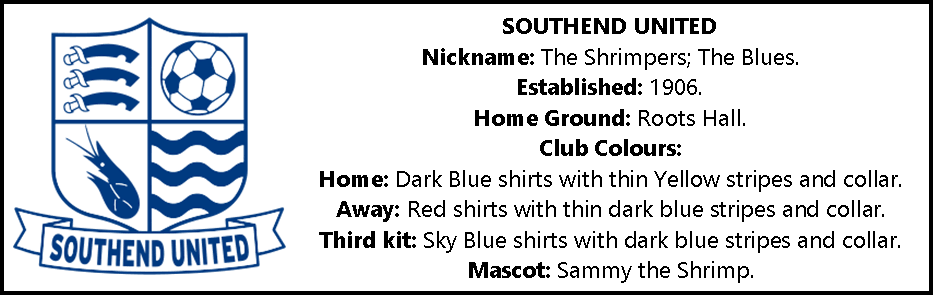
Southend United is not only Morecambe fans’ second favourite club of all time, it is the one which ours is most regularly mistaken for by the BBC and other media outlets that really should know better. Southend probably get this as well – but the other way round.
We are the Shrimps: they are the Shrimpers – how difficult is that?
We also love Southend because they hardly ever beat us – and never at their home stadium of Roots Hall, which is 280 miles from the Mazuma Mobile Stadium on the Essex coast in the south-east of the country. The two clubs have met a total of lucky thirteen times altogether and the only game the Shrimpers have ever won was in Lancashire during 3013, when they walloped the Shrimps 0-3 in an FA Cup match. In the EFL, though, they lost ten out of twelve games and drew the other two. So – if past history is any guide – we really would like to play them every week…
To be serious though, Morecambe has a lot in common with Southend-on-Sea: the coast; the holiday makers; the fairground rides (although we have never had anything to even vaguely compare with Southend’s Mods’ Valhalla: the Kursaal); the piers (ours both sadly gone) but Southend’s still the longest in England)…
The Shrimps also have a lot in common with the Shrimpers:
The dodgy owners; the recent relegations; the threats of complete collapse…
Southend–on-Sea’s current major football club was founded in May 1906 and initially played in the Southern League Division Two. United immediately won this but had to do so again in their second year of existence before they were allowed to progress to Division One. (Which, even if it doesn’t prove anything else, is evidence that Promotion – unlike, say Gravity – is an invention, not a discovery…) In 1920, though, they were elected to the new Football League Third Division South and remained in it when the North and South Divisions were unified during 1958.
1966 was a memorable year: England won the World Cup … and the Shrimpers slipped into Division Four, staying there until 1972. They then yo-yoed between the two bottom Divisions until 1991, when they climbed as high at Division Two (now the Championship), staying there until 1997 until double relegations befell them once more and they ended-up in Division Four again – now re-branded as League Two. But double promotions in 2005 and 2006 saw them back in what was now known as the Championship once more. They only lasted a season and by 2010 were back in a more familiar – and traditional – environment: the lowest Division of the EFL. They managed to climb back into League One but – as is becoming a regular experience for struggling clubs – suffered another double relegation which saw them fall out of the Football League altogether for the first time in 101 years.
This was during 2021 and United had been in deep trouble both on and off the field for some time at this juncture. Their financial problems have sadly been mirrored at our own club as staff wages were not paid and the EFL responded – as they so often do – by pushing the club into an even more perilous state by hitting them with a transfer embargo which meant they could not sign any new players. (Sound familiar at all?) Libel laws prevent me comparing the Shrimpers’ owner at the time to the rogues and chancers the Shrimps have endured in recent times but suffice it to say that in their first year in the National League, United admitted to a debt of almost seventeen and a half million pounds in total. This resulted in widespread protests by fans against the incumbent Chairman; another embargo on the club after missing a payment to HMRC and a Winding-Up Order issued by the taxman.
(Shrimpers’ fans once regularly staged mass protests outside their detested owner’s house. One of their number told the BBC:
“We’re not like Manchester United, we’re not like Chelsea or Liverpool – these are real live fans from every area. We will stick together. If we don’t get the deal done by the league: that’s it, we’re dead. He’s got to sell – he’s got to walk away now.”
Now, I can think of another `detested owner’ of a certain football club who also lives in Essex. Do you think we could sub-contract them to do the same for us?…)
Things looked so bleak that Southend supporters and the Shrimpers Trust began planning for a Phoenix Club to replace the seemingly damned United. More payments to staff and players were missed and at the beginning of the 2023-4 season, Southend players went on strike; refusing to train in pre-season until they got paid. The club also had to find £300,000 demanded by the National League to avoid expulsion from the competition and was given until the end of the campaign to settle all its debts – or face a ten point deduction. With just fifteen players on the books, the ten points were duly deducted in August 2023. On the eve of a National League match against Maidenhead United on the nineteenth of September, Southend had only ten fit players due to injuries and suspensions. Emergency signings were sanctioned and the team went on to actually win the game by two goals to nil. Off the field, though, the financial plight of the Shrimpers grew ever worse and by the end of the season, they had faced a total of nineteen Winding-Up Orders since relegation from the EFL. Despite all the problems it had faced, the club finished ninth in the National League (without the ten point deduction, they would have been sixth and therefore in the Play-Offs.)
But still its financial plight worsened and the National League stuck the boot in by demanding a one million pound bond before sanctioning the club’s continued membership of the competition. The club appealed this potentially catastrophic (and actually objectively absurd) ruling and an FA Arbitration panel broke with convention and finally ruled in their favour.
Despite further Winding-Up Petitions and an utterly tortuous sales process, the club eventually acquired new owners during July 2024. Last season – despite the nightmare of the last five years – the Shrimpers finished seventh in the National League. They made a valiant attempt to get back into the EFL during the ensuing Play-Offs only to lose to Oldham Athletic in the Wembley Final by three goals to two after extra time.
Se we love them even more: Southend supporters and the Shrimpers Trust are an inspiration to our own fans and our representative, the Shrimps Trust: there can be life after the EFL and dodgy owners after all…
I can only find one player who has played for both clubs; each time on-loan and that is the generally under-rated and now Scottish Premiership striker Marcus Dackers.
Morecambe will play Southend for the first time on Saturday, 18th October 2025 in Lancashire. They will then travel to Roots Hall for the return game on Saturday, 14th February 2026.
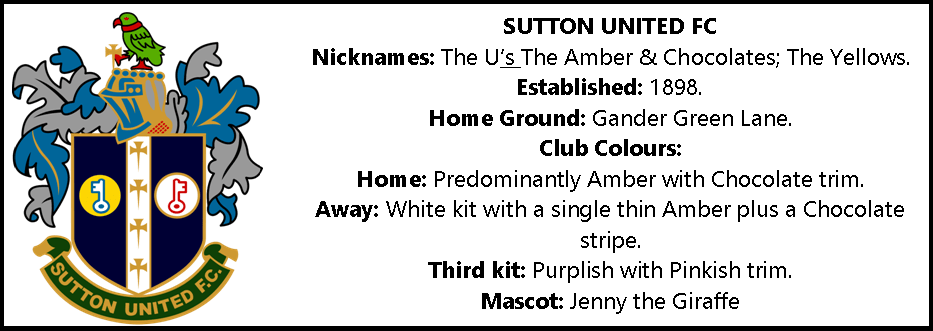
Confusingly, there are two Sutton United football clubs in England: one is based in Sutton Coldfield and plays in the Midland League. But the Sutton United we are interested in was formed in what was then Surrey during1896 as a result of the amalgamation of two other clubs: Sutton Guild and Sutton Association Football Club. The new club initially chose to wear the colours of the latter and the choice has stuck as evinced by their Amber and Chocolate striped shirts. So if Morecambe are the Reds and FGR the Greens, we now know which club completes the Traffic Light sequence in the National League, don’t we?
Anyway – they play at a stadium with the splendidly poetic and evocative name of Gander Green Lane, 273 miles from the Mazuma Mobile Stadium in the south-west of the nation’s capital. Initially – when the term still meant anything in English football – they were an amateur club and they played in the significant (not to say rather snooty) Home Counties Athenian and latterly Isthmian Leagues for much of the Twentieth Century – and won both on several occasions.
But in 1985, they became members of the Football Conference before being relegated back into the Isthmian Premier League in 1991.They won this in 1999; spent another season in the Conference before being relegated back to it again and then being transferred to the newly-founded Football Conference South during 2004. They spent eight seasons in this – with a hiatus of another three years’ sojourn in the Isthmian League right in the middle – before winning the newly re-badged National League South in 2016. Four years later, they also won the National League and went straight into EFL League Two. They only survived three years in the Football League, were relegated back into the National League two seasons ago and finished twelfth in it last season.
United have appeared at Wembley four times – and it has not been a lucky venue for them. They were beaten by the original Wimbledon in the FA Amateur Cup Final 4-2 during 1963 and lost again in the same competition to North Shields six years later by two goals to nil. They then played Bishops Stortford in the FA Trophy during the summer of 1981 – and lost once more by the only goal of the game. During their brief adventure in the Football League, they also reached the EFL Trophy Final in April 2022. They went ahead twice against Paul Warne’s Rotherham United but went down yet again, this time 4-2.
It could be argued that Sutton’s greatest achievement, in all truth, occurred on Saturday, 7th January 1989. On that day, non-league United humbled top-ranked FA Cup winners of just two seasons previously – mighty Coventry City – by knocking them out of the Third Round of the same competition by two goals to one at Gander Green Lane. It caused an absolute sensation at the time and will live on as one of the biggest upsets in Cup history ever to have happened anywhere in the world.
The Shrimps and the Greens Ambers of Gander Lane have only met twice in the past. It was two seasons ago in League Two and Morecambe won both of the fixtures, home and away. In the feisty game in Lancashire last year, though, both teams were subsequently fined for the `mass altercation’ – led by Lee Angol ironically enough – which occurred during the match. Morecambe had to cough-up two Grand as a result; United even more: £2,750.
The recently departed Mr Angol was signed by Morecambe from Sutton last season but I can’t find details for any other players who have worn both teams’ shirts.
Morecambe will entertain Sutton United on Saturday, 8th November 2025. They will then travel to Gander Green Lane on Saturday, 7th March 2026.
 shrimplythebestfootball