The National League Explained (by a newcomer from Morecambe).
Part Four – Tamworth to York City.
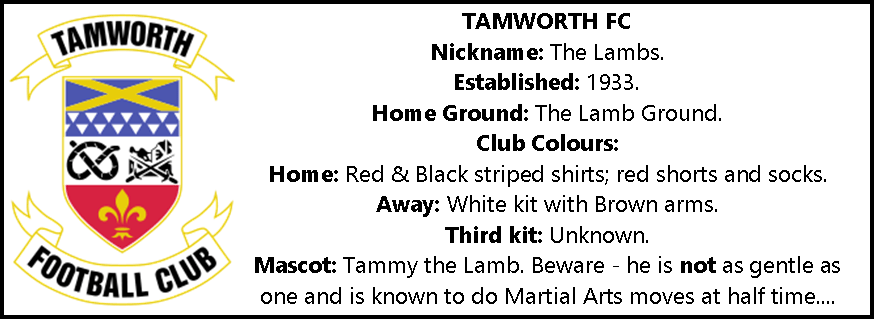
Tamworth FC was founded in 1933 as a result of the demise the small town’s main football team – Tamworth Castle FC. They moved to their current stadium – The Lamb Ground (which can be found135 miles from the Mazuma Mobile Stadium) a year later.
Tamworth was once a small but historic Staffordshire market town which was the capital of Mercia many, many moons ago. It remained fairly unremarkable during the first part of the Twentieth Century but – although not officially a `New Town’, it experienced rapid growth during the 1960s as its population more than trebled from 13,000 people to 40,000 by 1971.
Initially, Tamworth FC played in the local Birmingham Combination but – having become Champions of the Birmingham & District League North after two seasons in it during 1956 – were promoted to spend six seasons in the Birmingham & District League, first in Division 2 for a year followed by five in Division 1. When the Birmingham & District League was re-named the West Midlands League in 1962, it took the Lambs just two seasons to be promoted to its Premier Division. They reached the Second Round Proper of the FA Cup twice at this time and made headlines when they took their first Football League scalp with a 2-1 home win against Torquay United at this stage of the competition in November 1969. Tamworth then won the league during 1972 and transferred their membership to the Southern League Division One North. Then they spent four seasons in the Northern Premier League between 1979 and 1983. But by this time a club seemingly on the up started encountering serious financial difficulties. Home attendances fell to record levels and their Lamb ground became quite dilapidated. Their opening season in the Southern League Midland Division saw the club’s first ever relegation in 1984. They rejoined the West Midlands League (Premier Division) as a result but the move generated changes in the club’s structure and their fortunes on and off the field started going on an upwards trajectory once more. After four years, they won the West Midlands League (Premier Division) to re-join the Southern League Midland Division. Still with me? – blimey, talk about a club that never stays still!
In 1989, they reached the FA Vase (a competition aimed primarily at former amateur football clubs) Final at Wembley and won it against Sudbury Town following a replay at Peterborough. A runners-up spot in the Southern League Midland Division during 2003 was followed by an appearance in the FA Trophy Final at Villa Park in nearby Brum: they lost to Burscough 2-1. However, they then won the Southern League Midland Division a year later with an astonishing 26 point margin over all the others. Their reward was a place in the Football Conference during 2004.
Tamworth then drew at home in a Staffordshire derby against Stoke City in the FA Cup Third Round only to lose the replay after penalties during the 2005-6 season. In January 2007, they lost 0-4 in an FA Cup game against Championship Norwich City which was televised live from The Lamb. Later in the season, thought, they were relegated back to the Football Conference North. They bounded-back again as Champions in 2010 only to slip out again four years later and find themselves back in the Southern League Premier Division Central for five seasons, including two which were abandoned due to the Covid pandemic. They won this division during 2023 and then immediately won the National League North as well to find themselves where they are now.
Phew! – what a journey!
Last season, they finished tenth in the National League. They also beat EFL Huddersfield Town and then Burton Albion in the First and second Rounds of the FA Cup before holding Premiership Spurs to a 0-0 draw at home in the Third. (Tottenham eventually won 0-3 in extra time.)
Once again, I don’t have reliable statistics for head-to-head clashes between the Lambs and Morecambe FC. The best I can do is tell you that they have met five times since 2004 and the Shrimps have won two of them; Tamworth none.
Maybe two or three players have performed for both clubs but probably the most significant of these is former Liverpool and Welsh goalkeeper Danny Ward, however briefly.
Tamworth will play hosts to Morecambe on Saturday, 4h October 2025. They will then travel to Lancashire for a night match on Tuesday, 10th February 2026; KIck-Off at 1945hrs.
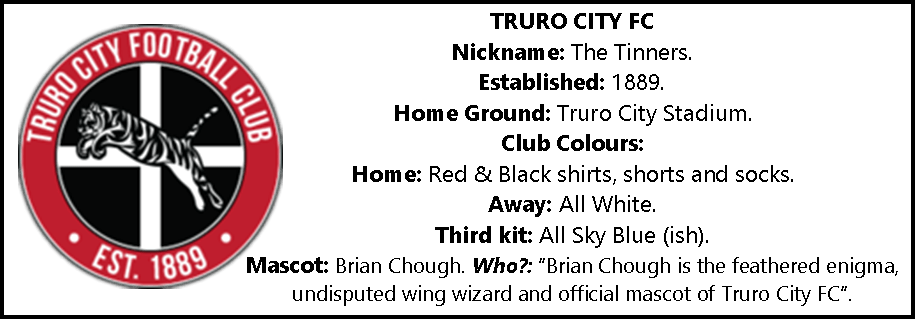
Truro City’s new ground can be found on the outskirts of what would – virtually anywhere else in England – be called Cornwall’s county town. But Cornwall is not a county – it is a Duchy. (Does that make it posher than everywhere else? Or does it imply that its inhabitants have yet to be liberated from Serfdom and are all still Chattels and Villains? You decide – but as you do so, keep in mind Cornwall’s ancient Latin motto: “Muchius Touchius Duchyus” – “We’re very Touchy about the word Duchy!”)…
Whatever, Truro is one of Britain’s smallest cities (the only one in Cornwall) – and it’s main football club can be found 377 miles from the Mazuma Mobile Stadium in the village of Threemilestone, which is a very precise distance to the west of the city centre of the capital of the Duchy and is marked by a milestone. If only I could remember how far….
Anyway, the club initially played in the Plymouth & District League and then the newly-formed Cornwall Senior League, beginning in 1931. As from 1951, they then spent over a half a century mostly in the South Western League and – briefly during the 1970s – the Cornwall Combination. But in the early Twenty-First Century, a wealthy benefactor and his significant investment saw the club enjoy five promotions in six years (four in pole position). They moved progressively from the South Western League to the Western League Division One and then the Southern League Division One West & South; Southern League Premier Division and finally the Football Conference South, which they joined in 2011. Two years later – as the Magic Money Tree disappeared – they went down again one division following Administration; an embargo and a ten-point deduction. This came about as the HMRC issued a Winding-Up order to the club for an alleged debt of over £100,000. It soon got worse: the National League South issued a demand for a £50k bond to guarantee the club’s survival until the end of the season (sound familiar at all?…) which, when the Tinners were unable to pay it, led to the postponement of their game against Dover Athletic on the lucky thirteenth of October 2012. They were saved from expulsion from the competition by two businessmen who jointly paid the bond. But they still got relegated, only to bounce back again to the re-branded National League South for four years before spending another four years back in the Southern League Premier Division.
During this time – in 2014 – they sold their tiny and dilapidated old ground on Treyew Road in the city – where they had been based since the mid-1950s. They moved-out four years later and – to the consternation of many loyal Tinners – began playing a two-hour drive and almost 110 miles away which – to make things even worse – was in a place where both the dreaded Emmets and Grockles – Aar!! – are known to dwell: Torquay United’s Plainmoor in (cross yourselves quickly): Devon! (A Cornishman I once met who was on Missionary Work in London told me that it is no coincidence that the words `Devil’ and `Devon’ start with the same three letters…)
Be that as it may – and very ironically – the two teams have met in the Devil’s own county subsequently and once, there were apparently fifty `away’ fans for every single person who had travelled from over the Cornish border to watch their supposedly ‘home’ game. (Just to rub it in, Torquay have won all four competitive games between the two clubs during the last two seasons even though Truro had the last laugh at the end of the latest campaign by winning the Division.)
Truro moved back to their original home in Cornwall after just one season away. In 2021, they were on the move again – back to Devon. This time, they played a bit closer to home (just over 50 miles) at Plymouth Parkway FC’s ground at Bolitho Park. This proved to be problematic and the peripatetic Tinners found themselves ground-sharing with both Taunton Town FC (just 127 miles away) and then almost 200 miles away {Wales would be closer) at Gloucester City FC’s Meadow Park. They were finally able to return to their home County – sorry – Duchy and Cornwall’s capital for the 2024-25 season. They now play at an all-purpose sports stadium called “Truro City Stadium” – which, incidentally, is named after the town and not after the club. It is a very small ground with only one permanent stand and a total capacity of just 3,600 spectators. Their first match during August last year at their new home was memorable for a bizarre occurrence. The visitors – mighty Dorking Wanderers of the London Suburban Commuters’ Waterloo Line Premier Division or wherever – had to play the match wearing their shirts inside out. This was because their kit was the same colour as City’s. (For the record, Ginkrod – er –Dorking reversed – won 1-2.)
The Tinners reached the First Round Proper of the FA Cup for the first time in their history in 2017 only to be beaten 3-1 by Charlton Athletic at the Valley. But another promotion saw them back in the National League South in 2023. Last term, though, the club finally turned professional and although they were favourites for relegation, they pipped former EFL club and Devonian rivals Torquay United on the last day of the campaign only a few short weeks ago to the National League South title by the tiniest of margins: a goal-difference of just Plus two.
So this will be is not only their first ever season in the National League proper and the highest point in the English Football Pyramid City have ever reached, they are the first ever Cornish club to play at such an exalted level. So Hats Off to them.
The Trophy Cabinet at City’s home ground remains a bit bare though. They have been successful in several local Junior and Senior Cups over the decades but the only one of England’s better-known competitions they have won during their 136-year history is the FA Vase. They beat AFC Totton of Hampshire 3-1 in the Final at Wembley in 2007.
The Shrimps and the Tinners have never met in any sort of competitive football match and I can’t find any details of even a single player who has been employed by both clubs.
I must admit to being totally confused too (it doesn’t take much) by the club’s choice of a Mascot: Brian Chough, which seems to be more Corny than Cornish to me and doesn’t appear to make any sense anyway. `Ol’ Big Head’ Brian Clough spent decades in football working hundreds of miles away from Truro and has no obvious link to Cornwall either that I am aware of. According to Professor Google, a Chough is a sort of bird – in the Western Hemisphere, one of the crow family. The club’s crest seems to feature a leopard, though. So what am I missing? Did someone called Brian Chough once play for them or something? (And please don’t bother repeating the mistake I have just made and look on the club’s website for enlightenment.) It tells us: ` No one’s quite sure how old Brian is’. Really? But it’s accompanied by a picture of Brian (with the squad number 89) and date of birth 1/1/25, which is a bit of a giveaway, isn’t it?… Then it provides what I suppose must be some sort of explanation to the initiated who understand what terms like `tekkers’ and `Giss on, me ansom!’ actually mean – they are completely incomprehensible to a mere Grockle like me.
Do you think whoever wrote this has been on the old Cornish Scrumpy?…
Morecambe will play Truro City for the first time ever in Cornwall on Saturday, 27th September 2025. Truro will then make one of the longest journeys of their season to Lancashire on Saturday, 7th February 2026.

Wealdstone FC is currently a semi-professional club which has its roots in what was once known as amateur football in this country. As we have mentioned previously, amateur football and snobbery have always gone hand-in-hand in England. So it’s appropriate that when they were founded in 1899, they were initially were based in Harrow at the Lower Mead ground, not too far away from the awfully posh school there where young gentlemen from the genteel Home Counties play equally genteel Rugby Union football. (These splendid chaps would not be seen dead in a `professional’ Rugby League shirt because that game is so frightfully rough, common and – shudder – Northern, don’tchaknow? )
Anyway, this snobbery even extends to one of the club’s nicknames: the Royals (for no other reason than they play in Royal Blue, apparently…)
But I suppose this is preferable to being sponsored by Prince Andrew, isn’t it?
Moving quickly on, these particular Royals have had to borrow other people’s palaces for some of their recent existence: after over a century at Lower Mead, they had to ground-share for two decades with other local clubs from 1991 until they finally found a new ground – Grosvenor Vale – in the London Borough of Hillingdon, about eight miles away to the south west (and 243 miles south from the Mazuma Mobile Stadium) only as relatively recently as 2011.
Given our own experiences at Morecambe in recent times, it is worth remembering that dodgy dealings off the field by shady people is not a modern phenomenon. Such dodgy deals very nearly did for Wealdstone when what Wikipedia very tactfully describes as `financial problems caused by boardroom impropriety” led to the sale of the Lower Mead – for housing development, curiously enough. This caused a wee bit of a stramash – to say the least – as some people lined their pockets – but the club was well and truly short-changed. (Stramash? – what am I saying? In the circumstances, I suppose I should describe this controversy as a `Right Royal Bust-Up’…)
Originally, the club played in the Athenian League (with all its connotation of Classical Greece and Byronic Romanticism) and actually won it in 1951. But the Royals chose to transfer to the equally prosaically named Isthmian League during 1964. A year later, they were knocked out of the FA Cup at the First Round Proper stage by those frightful ruffians known as Millwall by three goals to one at the Den but they also won the FA Amateur Cup Final at nearby Wembley, beating local rivals Hendon 3-1. They never won the Isthmian League, though and in 1972, they were off again. Perhaps anticipating that the amateur distinction in English football was about to be abolished by the FA (this ruling was made in 1974), they turned semi-professional and joined the Southern League. (It is a little-known fact that when the England Amateur International team was scrapped in that year, a semi-professional team was created to take its place and this still exists. It is now administered by the National League, not the FA…) But I wander from the point…
Wealdstone won their new competition in 1974 and were rewarded with a place in the Southern League Premier Division. They hardly set the world on fire in this Division but took their first-ever EFL scalp in 1978 when they overcame Hereford of Division Three 2-3 at Edgar Street in an FA Cup First Round replay before beating fellow-Royals, Fourth Division Reading 2-1 at Lower Mead in the next round. Despite only finishing fifteenth in the Southern League Premier, Wealstone became founder-members of the new Alliance Premier League in 1979. They slipped into the Southern League Southern Division in 1981 for a year before immediately returning as Champions. During 1985, they achieved a unique non-league Double: they won the FA Trophy (beating Boston United at Wembley, 2-1) and also won the Alliance League Championship at the same time. If they had done this just two years later, they would have been promoted to the EFL. Sadly for the Royals, though, the Football League was still a Closed Shop and the club soon fell back into the Southern League Premier again after relegation during1988. Down they went again to the Southern League Southern Division in 1992 only to jump ship back to the Isthmian League (Division 3) in 1995. (This move was forced on them by the utterly dire state of their finances. Very sadly, they could simply no longer afford to travel the longer distances required as a member of the Southern League.) Undaunted, they won Division 3 after two seasons; went up again to Division 1 a year later and entered the Isthmian League Premier Division in 2005 where they stayed until 2014, when they came top. This success brought them back to just one step below where they had been the best part of 30 years earlier when they entered the re-named Football Conference South. In 2020, they were Champions and as a result – 35 years after they last reached this exalted position in the English Football Pyramid, find themselves where they are now.
Jolly well done chaps – spiffing effort! Seriously though – Hats Off to them as well: to the considerable credit of everyone associated with the club, they never gave up – even in the very darkest days. And this must give hope to all football fans, wherever they are…
Last season, Wealdstone finished twentieth in the National League.
Morecambe have never come across the Royals before and I can’t find details of anyone who has played for both clubs.
Their first ever encounter will be at the Maz on Saturday, 20th September 2025. Morecambe will then travel to Wealdstone on Saturday, 31st January 2026.
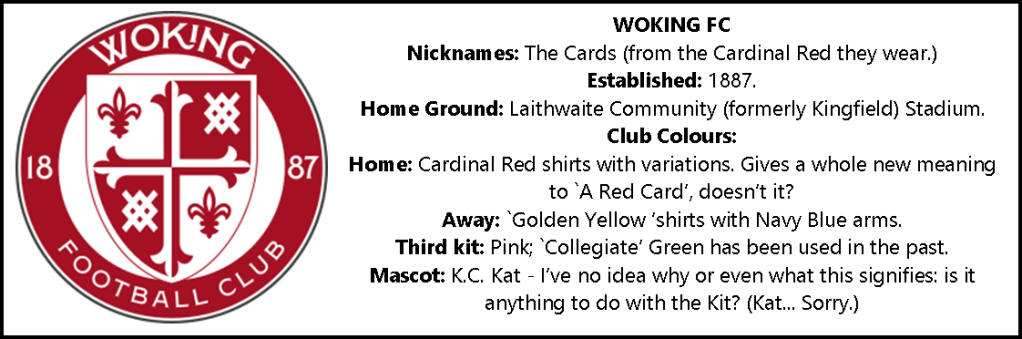
Woking is a rather agreeable commuter town which can be found in Surrey, just over 30 miles to the south west of central London and 258 miles from the Mazuma Mobile Stadium in Morecambe. The football club was founded in 1889 and Woking initially joined the local West Surry League. Like our own club, the football version of Woking initially played at the town’s cricket club. They moved to Pembroke Road during 1907 – only to struggle. But – footballing folklore tells us – they owe their initial salvation to a club most Morecambe supporters (entirely due to the appalling antics of a now-departed but extremely toxic Manager) detest. Yes, it’s Horwich’s least favoured club: a.k.a. Bolton Wanderers. Having battled through five qualifying rounds of the FA Cup way back in 1908, Woking were drawn against these giants of the game at Burnden Park in the First Round Proper. The Trotters hammered them five-nil but were so impressed by the non-league club that they agreed to play a friendly match against them in Woking. The gate receipts from this sold-out game alone ensured that the Cards (a nickname which came about because of the colours they have always worn: Cardinal Red) remained solvent.
As amateurs, they joined the Isthmian Leaguein 1911and remained in various versions of it right up until 1992, when they won it for only the second time. (The first was in 1987: quite a long time to wait for their long-suffering supporters…) The 1992 win saw them promoted to the Football Conference, from which they were relegated into the Football Conference South in 2009 only to bounce back again during 2013. They were relegated again from the re-named National League for a single season in 2018 but have managed to maintain their position in the fifth level of the English football pyramid ever since. Last season, they finished fifteenth in the National League.
Woking moved to their present stadium during 1922. Let’s hope it doesn’t rain when we visit because – just like at Forest Green Rovers – away supporters get wet. (Even though the precipitation is presumably Vegan and probably organic as well at the New Lawn…) But the Laithwaite Community Stadium boasts a feature which a lot of (maybe all) football clubs should adopt: a small portion of the stadium known as Moaners’ Corner. (Just think: we could abolish the Morecambe Fans’ Forum altogether and just use that instead…)
In terms of Cup competitions, Woking won the now defunct FA Amateur Cup in 1958 at Wembley, beating Ilford 3-0 in front of no less than 71,000 spectators. They also share the very impressive distinction with the defunct Scarborough and extant Telford United of having won the FA Trophy more times than any other club: three. They have never lost a Trophy final and beat Runcorn 2-1 in1994; Kidderminster Harriers by the same score just a year later and Dagenham & Redbridge 1-0 in 1997.
Morecambe and Woking have met at this level of football on previous occasions: just over twenty years ago when they were both members of the Football Conference. Finding details of these games has been like pulling teeth but it would seem that the teams met four times and Morecambe lost none of them and won three; the only two I can find any hard facts about being a 2-1 Shrimps‘ victory 2-1 at Christie Park in September 2004 followed by a 2-0 win at the same venue in March 2007, with a brace from Matty Blinkhorn.
Justin Jackson is one of a couple of men who have played for both sides; Marcus Dackers is another.
Woking will travel to Morecambe on Saturday, 30th August 2025. Morecambe will then make the reverse journey on Saturday, 11th April 2026.
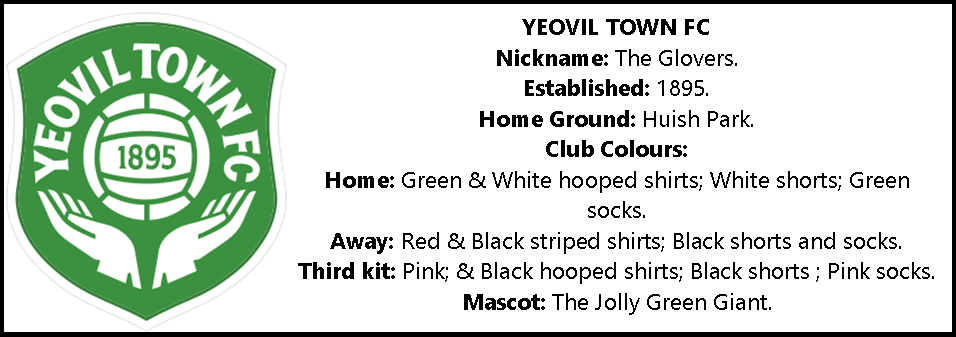
Yeovil Town is one of those non-league clubs which was certainly better organised – and more skilful – than many poor football clubs whose mediocrity was protected – season after pointless season – by the Closed Shop of the Football League for most of the Twentieth Century. They hit the national headlines as long ago as 1949, when they defeated the mighty First Division Sunderland 2–1 at Huish in the FA Cup Fourth Round: a seismic shock at the time. Next round, they played Manchester United at Old Trafford in front of more than eighty thousand people. But Somerset is a long way from the centre of England, where most EFL clubs are situated. And – if only because of the distances involved (their Huish Stadium is 278 miles from the Mazuma Mobile Stadium, for example) the Glovers were never likely to be elected into the Football League. So they had to wait until the MiIlennium had come and gone – 2003 – before finally winning a place in the elite of English football on merit. They won the Football Conference then by an astonishing 17-point margin, accumulating an incredible 100 points. But we get ahead of ourselves…
Yeovil Town FC was founded in 1895 and initially played at a ground simply called Huish. This was famous (notorious?) for the slope of its pitch: it dropped a whole 2.4 metres (eight feet) from one sideline to the other. They bobbed in and out of the Western League and the Southern League (English or Western or Central Divisions) – often winning them – until the 1940s. After the Second World War, The Glovers joined the Southern League, ending up, firstly, in its South Eastern Section in 1959 and then the Southern League Premier Division as from 1960 following re-arrangements of the competition. During 1976, Yeovil came within a few votes of being elected to the Football League – but the Old Boy’s Network closed ranks again and they would have to wait more than a quarter century more before they could finally replace some of the dross which had been clogging the bottom of the Football League for decades. In 1980, the club became founder-members of the new Alliance Premier League and stayed there until 1979, when they were relegated to the Isthmian League Premier Division, which they won after three seasons to return to the re-named Football Conference in 1988. Another relegation followed in 1995 but Yeovil were back in the Conference as Isthmian Champions in 1997. As we have seen, they ran away with this during 2003 and then won League Two as well two years later. By this time, they had been playing at newly-built Huish Park, to which they moved during 1990. The Glovers reached their current Zenith – the Championship – in 2013 but only lasted a year there. By 2015, they were back in League Two and in 2019 came bottom of the entire EFL to return to the rebranded National League, enduring a single season in the National League South during 2023-24. They returned to the National League as Champions and last season, finished eighteenth in the table.
Yeovil won the FA Trophy in 1981, when they beat Stevenage Borough at Villa Park in Brum by two goals to one.
The Glovers have encountered the Shrimps on eight previous occasions – all in League Two. Morecambe won five of these and lost just two. I’ve not been able to identify anyone who played for both clubs.
The fixtures planned for the clubs to meet again this season are at Morecambe on Saturday, 22nd November 2025 and then in Somerset on Saturday, 21st March 2026.
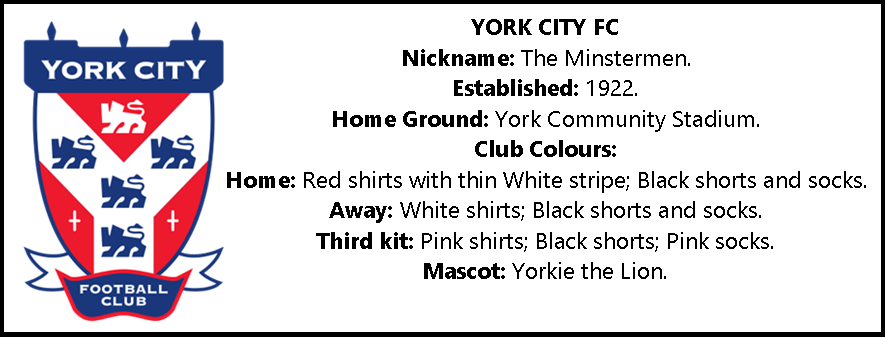
For those Morecambe supporters of a certain age, York City has created an indelible stain on our football consciousness. The first time I saw them was way back in 1968. It was an FA First Round Cup tie at their home ground of the time – Bootham Crescent – and my dad and I set off in our old, green Austin A35 to make what seemed an interminable journey to a thirteen-year-old – as I was then – to support the Shrimps. York was a league club – one of the weak ones who shouldn’t really have been in the top echelons of the English game; Morecambe a lowly ex-member of the Lancashire Combination embarking on a new experience as a founder-member of the brand-new Northern Premier League. But hopes were high of an upset: City were going nowhere but Morecambe Manager Ken Waterhouse was steering his fantastic team to a Senior Cup victory against First Division (top flight) Burnley later in the season: the first time a non-league club had ever won it. Also – extraordinarily enough – the clubs had met only two seasons ago in the same competition. They had drawn 0-0 at Bootham Crescent and then 1-1 in the replay only for the Shrimps to lose by the narrowest of margins – and the only goal of the game – in a third match played in Manchester at Maine Road, with almost five thousand spectators watching on.
Wind the clock forward to 1968 again and Morecambe were one-nil down at half time, when we changed ends with the York contingent – our Skinheads (some of whom I went to school with) growling at theirs and vice-versa. And then huge but very agile Morecambe goalkeeper Lance Millard had a rush of blood, raced out of his penalty area to clear the ball – and missed it. And that was it: a two-nil defeat and a long trudge home through the darkness and the rain.

We were drawn against them anew in the same competition – First Round again – almost twenty years later. The game at York during November 1985 ended in a 0-0 draw. Christie Park was so dilapidated at another time of financial crisis at the Lancashire club that the replay was also played at Maine Road. And penniless Morecambe lost again, this time 2-0, in front of barely more than a thousand fans. So the Minstermen were becoming a bit of a bogey team for the Shrimps.
We all had historical reasons to be worried, therefore, when – almost two decades later on 7th May 2007 – the Shrimps faced York again in the absolutely critical Football Conference Play-Off Semi-Final Second Leg at Christie Park. The first leg at Bootham Crescent had been a bruising encounter after which the Shrimps had emerged with a goal-less draw. But in the second leg, what is probably one of the most pivotal moments in the club’s entire history happened after almost 20 minutes. Young, big, skilful York forward Clayton Morrison had been troubling the Morecambe defence right from kick-off. He looked certain to score at this point and would have unless the Shrimps’ Number One – Steven Drench – hadn’t basically wiped him out in a desperate attempt to thwart him. Both players were injured – the goalkeeper, ironically, really badly as he dislocated his elbow. Morrison – clearly shaken as well as hurt – had little impact from that point onwards and was substituted during the second half. Drench had to be helped off the field, never to be the same player again. Extraordinarily, though, Referee East didn’t send our goalkeeper off – or even book him. At half time, the Ref took the very unusual step of talking to the satellite company which was beaming the game live to the world, so controversial was his decision to allow Scott Davies to replace Drench in the Morecambe goal. He explained that in his view, Steven’s had been a genuine attempt to get the ball so did not deserve a red card. It was a let-off for Morecambe – although they trailed 0-1 to the penalty their stopper had conceded, they still had eleven men on the field, Wayne Curtis headed Adam Yates’ free-kick home to equalise after forty minutes and then scored an outstanding goal to win it during the second half. (Next stop was Wembley; Exeter City and then the club’s first ever season in the previously unavailable Hallowed Ground of the English Football League…)
So – for once and actually their first time ever – Morecambe got the better of their White Rose opponents. Subsequently, Norman Service has been more or less resumed: the two clubs have played eight League Two matches and the Shrimps have only won one of them as opposed to three victories for City.
York have had troubles of their own in the years that have passed since they dropped-out of the EFL themselves in 2016. But we get ahead of ourselves again…
The club was formed in 1922 and initially played in the Midland League at a ground on the outskirts of the City called Fulfordgate. But when the new Third Division North of the Football League was introduced in 1929, City were founder-members. They moved to the more central Bootham Crescent in 1932 and then remained in the Third Division North until the regional Divisions were scrapped and new national Third and Fourth Divisions were created during 1958. The Minstermen were only deemed good enough to compete in the lower of these and that’s where they stayed – often struggling – until 1971. (They had to apply for re-election to the Football League – as progressive clubs such as Wigan; Wimbledon and ourselves were knocking on the door but couldn’t get in – six times during their almost totally unremarkable existence in the Closed Shop security of the Football League before 1971.) In this year, they won promotion into the Third Division for three seasons and then reached the giddy heights of Division Two (now called the Championship) in 1974. But the adventure ended with relegation in 1977 and a slow but steady decline followed. By 1989 they were back in the Fourth Division and in 2004, they fell out of a Football League which they had been distinctly unimpressive members of for three quarters of a century altogether, coming rock-bottom of the Fourth Division. They spent eight years in the Football Conference before a 2-1 Play-Off victory at Wembley against Luton Town – after conceding in just the second minute of the game – saw them return to League Two (as the Fourth Division was now known) during 2012.
They only lasted four seasons. With financial crises threatening to scupper the club altogether, they were relegated to the National League after coming bottom of the entire EFL again in 2016 and went straight out of that as well, ending-up in the National League North for five long years as from 2018.
During their first experience of the Fourth level of the English football pyramid, York won the only trophies of note during their pretty unexceptional previous ninety years and longer. In 2012, they beat Newport County 2-0 in the EFL Trophy Final at Wembley and returned there during 2017 to defeat Macclesfield Town 3-2. (Their first appearance in the Trophy Final – during 2009 – ended in a 2-0 defeat by Stevenage Borough). Last season, York finished second in the National League but were comprehensively beaten in the Play-Offs: three-nil at home just a few weeks ago by eventual winners Oldham Athletic.
In 2021, the club moved to a brand new stadium built by York City Council. The York Community Stadium is 128 miles from the Maz in Morecambe.
York has an enviable reputation as an ancient city with a strong Roman and Viking past. The Shambles; the Castle Museum; Jorvik; the National Railway Museum and the Minster attract visitors from all over the world. But beyond the Chocolate Factory tours and River Foss boat-trips, there is a darker side to the place. Drug abuse and crime are rife in some of the poorer areas of the city and you don’t have to go far beyond the ancient city walls to find places such as Foxwood, Chapelfields and Westfield. Clifton – where Bootham Crescent could once be found – is one of these areas. There has always been a hard-core of pretty thuggish City supporters – the York Nomad Society being one of the unlikely names of one of the club’s hooligan `firms’. The move to the leafy suburbs of Huntingdon – three miles to the north east of the old ground on a new Retail Park – has not meant that this problem has been left behind. The sad fact that the club is still plagued by morons like these was illustrated only too clearly as recently as Friday, 12th July 2025 when a `friendly’ game between York and Salford at the new ground had to be abandoned as both sets of players left the field early. York City’s official website explained why:
“York City Football Club are horrified to learn of allegations of racial abuse aimed at Salford City players in this evening’s pre-season match. Both clubs, alongside the match officials, decided to take both teams off the pitch at that time. York City condemns racism in all forms. We stand with Salford in condemning this behaviour in the strongest possible terms.
The club is now working with North Yorkshire Police to investigate the allegations.
Any supporter found guilty of racial abuse will face the strongest possible sanctions from the club. We would like to thank Salford City for their cooperation in what has been a deeply distressing evening.”
Ironically, some of the players to have performed for both clubs could have been subjected to vile abuse of this sort. They include Vadaine Oliver; Manny Panther; Richard Brodie; Lewis Allesandra; Shaun Miller and Scott Loach: and this is not an exhaustive list.
Morecambe are due to travel across the Pennines to meet York on Saturday, 15th November 2025 and then host City at the Maz on Saturday, 28th February 2026.
National League Population league table:
To get some idea of the potential fan bases we will be up against this season, let’s look at how many people live in the vicinity of the clubs we are going to meet:
- Sutton: 209,517.
- York: 202,800.
- Gateshead: 197,772.
- Southend: 180, 600 (Southend Metropolitan Area: 323,000.)
- Braintree: 155,200.
- Solihull: 126,577 (Solihull Borough: 216,700.)
- Rochdale: 111.261 (Borough of Rochdale: 224,100.)
- Carlisle: 110,300.
- Woking: 103,900.
- Hartlepool: 92,600.
- Halifax: c.90,000.
- Scunthorpe: 81,286.
- Boston: 70,500.
- Tamworth: 67.355.
- Yeovil: 50,176.
- Borehamwood: 41,223.
- Aldershot: 37,226.
- Morecambe: 34,768.
- Truro: 18,766.
- Brackley: 16,195.
- Eastleigh: 137,000 (Swaythling: 13,763).
- Altrincham: 12,931.
- Wealdstone: 11,394.
- Forest Green Rovers (Nailsworth): 5,732.
National League Average Attendances (2024-25 season) league table:
Another clue to the spending power (bums on seats means money in the bank) of the clubs we will be facing this season is how many people went through the turnstiles at their home grounds last season. Here are the averages:
- Carlisle United (League Two): 7,425.
- Southend United: 7,339.
- York City: 6,143.
- Scunthorpe United (National League North): 4,118.
- Hartlepool United: 3,797.
- Morecambe (League Two): 3,363.
- Yeovil: 3,215.
- Sutton United: 2,652.
- Rochdale: 2.552.
- Aldershot: 2,413.
- Woking: 2,330.
- Eastleigh: 2,243.
- Boston United: 2,126.
- Altrincham: 2,122.
- Forest Green Rovers: 1,840.
- Truro City (National League South): 1,814.
- FC Halifax Town: 1,744.
- Wealdstone: 1,602.
- Solihull Moors: 1,431.
- Gateshead: 1,416.
- Tamworth: 1.306.
- Boreham Wood (National League South): 1,216.
- Braintree Town: 1,160.
- Brackley Town (National League North): 887.
 shrimplythebestfootball