
Morecambe National League North 2026-27. A quick Guide to the Opposition. Part One.
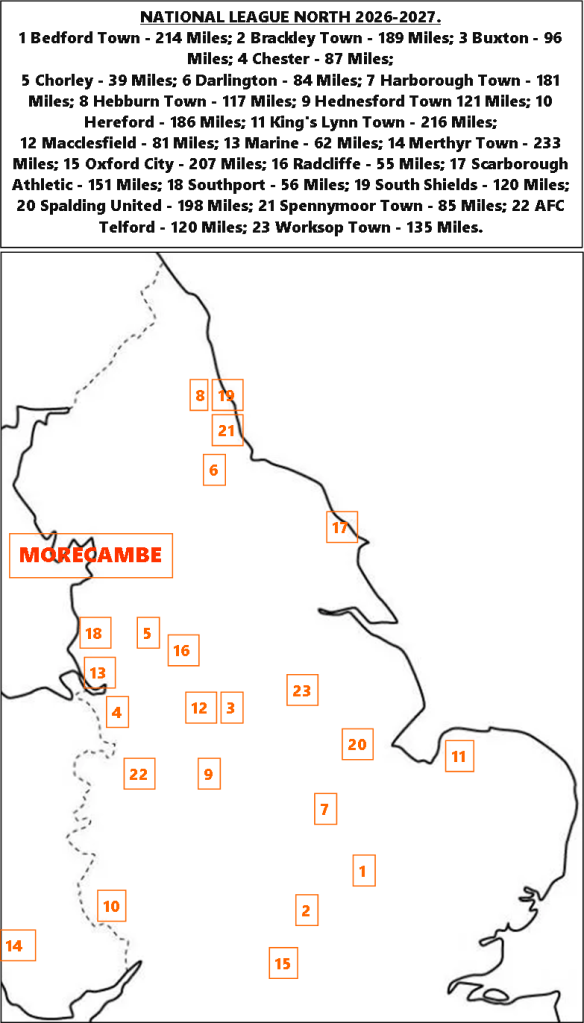
Here’s a map of the territory Adam Lakeland and his team will have to cover in the next nine months or so in a so-called `regional’ league:
So who are the people we are going to meet again or for the first time ever this term?
Bedford Town’s stadium – the New Eyrie – can be found 214 miles away from Morecambe in the county town which bears its Shire’s name.
Bedford is a place famous for its massive Balloon Sheds from a time when British airships such as the absolutely huge R-101 were seen as state-of-the-art alternatives to the German Empire’s deadly Zeppelins. Hydrogen-filled dirigibles are now a thing of the past – partially because of the fate of the R-101, which burst into flames on its maiden flight in France during 1930, killing 48 0f the 54 people it was carrying. But the enormous sheds these things could once be found in can still be seen at Cardington to the south-east of the town centre: you can hardly miss them.
For people of a certain generation, Bedford Motors was an iconic brand manufacturing all sorts of commercial vehicles – from vans to huge trucks and buses of all shapes and sizes. Ironically, though – and just as Lancaster bombers weren’t actually produced in our neighbouring city – I don’t think there was ever a manufacturing plant in the town: these things were all built in nearby Luton.
But Bedford is also famous as both the home town of John Bunyan – writer of the famous religious tract The Pilgrim’s Progress – and the place where this non-conformist was locked-up for twelve years in the County Jail as a result.
The town is also well-known for brick-making (resulting in the London Brick Company importing masses of Italians to do the work, giving Bedford the largest per capita population of Italians anywhere in Britain at one time) and the lace industry – all trades which virtually no longer exist in post-industrial Britain. But Bedford remains a pleasant, fairly prosperous Home Counties market town.
Its currently major football club was founded as a result of amalgamation of other teams such as Bedford Association in 1908. They played at London Road initially before moving to the Queens Park ground, just north-west of the town centre later in the year. This had been the home ground of a Queens Park club but Bedford Town didn’t stay long; moving close-by to another stadium with the same name by 2011. The new ground was tiny and even in the 1920s, players were still having to change in the adjacent Horse & Groom pub. Facilities gradually improved to the point when – during the 1965-66 season, 18,407 people were crammed into it to watch an FA Cup game against Everton. (Town lost 0-3.)
Going back to their early years, the Eagles first of all competed in local leagues – the Northamptonshire which morphed into the United Counties League – and then the Southern League as from 1945, once the Second World War ended. They won the title in the 1958-59 season. But in those far away days, that’s as good as it got for any non-league football club south of Birmingham. The Southern League was the senior one in that part of the country and the Football League one step above it was a closed shop. The bunch of reactionaries who ran their little fiefdom from their headquarters in Lytham St Annes jealously guarded even its most hopeless and underserving members year after pointless year even when teams like the Eagles offered new blood and a more competitive competition – but were deliberately kept out.
So Bedford – in common with ours and the majority of other football clubs in England at the time – just had to continue to paddle its canoe in minor leagues with its future ambitions totally stymied by the very conservative and utterly staid English Football League. These old fossils preferred mediocrity but certainty to risky changes which might lead to anarchy and – god forbid – perhaps even revolution on the streets of Britain in the future as a result of the unbridled effect of unknown Forces of Change who they saw it as their purpose in life to suppress at all costs.
So – faced with a choice of setting-up the Bedford Town Popular Front to fight a guerrilla war against the enemy in Lytham St Annes or trying another tactic – in the two decades between 1955 and 1975, Bedford instead applied to join the elite in the EFL no less than eighteen times. Only Yeovil Town has made more applications (twenty). And only the Glovers have been more unsuccessful: none of these 38 bids in total ended in success. On the field, though, Bedford overcame EFL clubs in the FA Cup: beating Watford 3-2 in the 1955-56 seaon before drawing 2-2 at Arsenal’s Highbury in the next round only to narrowly lose the replay 1-2 against a supposed giant of the game that is yet to win the European Cup. The following season, they won again against EFL opposition, overcoming Norwich 2-4 at Carrow Road this time. But when Town won its own league a couple of years later and applied for Football League membership, it received not a single vote. Ah – the good old days!
In 1982, the lease Town had on its Queens Park ground ran out and the club went bust. Seven years later, though, supporters re-formed a new incarnation of the club which initially played on public parks in the Queens Park area of the town. They moved to their current ground in Cardington during 1993 and Bedford Town has played there ever since.
Initially, the new club joined the South Midlands League. They were promoted after their second season to the Isthmian League Third Division and were eventually promoted again to the Premier Division of this league as they gradually fought their back to where they had ended life two decades earlier: they were further promoted to the Southern League Premier Division at the end of the 2000-2001 season. They then reached the Play-Offs which would have qualified them for the new Conference League South but failed to get to the final before finally succeeding in 2005 only to be relegated back again after finishing bottom of the table after their first season. Further relegations between the top and lower divisions of the Southern League then followed but at end end of the 2024-25 season, they were promoted to where we find them now: the National League North.
This time around, they have come within touching distance of having a local derby to compete in the National League North. If `The Pirates’ – Real Bedford (not to be mistaken for Real Madrid) – had managed to overcome Spalding United in the Southern League Premier Division Central Play-Off Final, they would have won a place alongside Town in the National League North. Unfortunately for Real; they lost 4-2.
This part-time professional club with its first team of plumbers; teachers and accountants – or whatever else it is that they do – finished eighteenth in the National League North last season.
The internet doesn’t show any fixtures beteen the Eagles and the Shrimps from the past but A.I. is not to be trusted.
Dave Robert’s iconic Morecambe team beat them 0-1 at Queens Park in the quarter-final FA Trophy tie on the way to eventual victory at the old Wembley Stadium back in 1974. This game has gone down in the annals of football history in that it is reputed to have featured the very first streaker ever to have been spotted at any English football ground.
Next season, we will entertain Town at the Halo on Saturday 17th April 2027 at 15:00hrs. The first meeting will be in Bedford on Saturday 5th December 2026 at 15:00hrs.
The only player I can trace who has turned-out for both clubs is Bedford native Rene Howe. This gentleman is memorable – in my mind at least – for constantly trying to hoodwink referees by diving and feigning injury when he wasn’t loudly bawling-out his team-mates using language which would not be broadcast-able on Radio 4 for a start…
What’s Brackley famous for?
The Town Council tells us that it was founded in the Iron Age by a Chieftain called Bracca (hence Bracca-leah: a meadow on which this bloke once founded a settlement).
It boasted several Roman villas after that and was on the winning side in the English Civil War. Well played, chaps!
Oh – and it has a railway station too: Brackley Central.
Oh dear. This isn’t actually true.
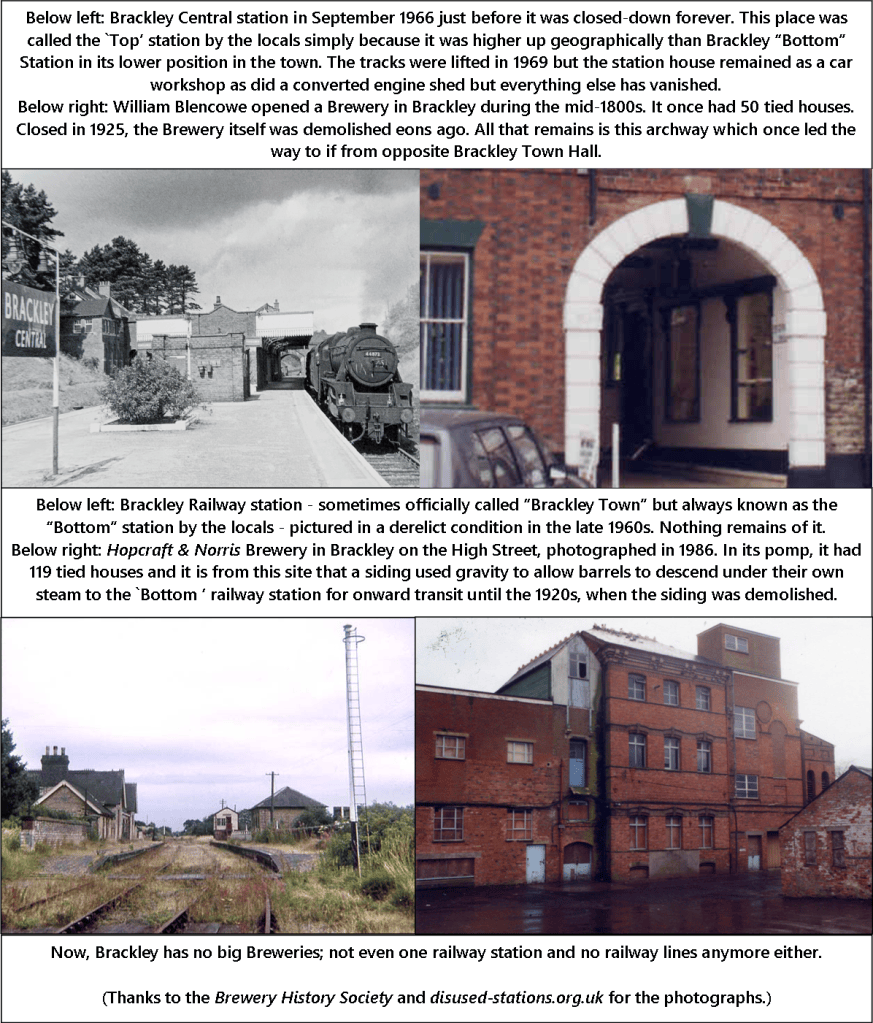
Brackley Central (`Higher’ to the locals) was closed in 1966 by the infamous Dr Beeching as the former Great Central line between London Marylebone; Manchester and Sheffield which it was part of had several major arteries axed altogether by the inspiration for the ‘Fat Controller’. (I’ve made that bit up – but one of the most hated men in Britain was rather rotund, to be brutally honest…).
Another railway station, Brackley Junction – the geographically lower one referred to as the `Bottom station’ by the locals – had been built much earlier on the Buckinghamshire Railway line. It doesn’t exist anymore either and no trains now stop at the small market town.
And that’s about it… Brackley remains a small rural town in Northamptonshire of just over sixteen thousand people which once became prosperous on the basis of the wool trade provided by the sheep farming that was centred on the locality.
Ask your average football fan which teams play at St James Park and you will usually be told: “Newcastle United” followed by the more enlightened among us with “Exeter City”. But another St James Park – Brackley Town’s home turf – can be found precisely 189 miles south from the Halo Stadium in deepest, darkest Northamptonshire, close to the Oxfordshire and Buckinghamshire borders. Brackley Town – known as “The Saints” simply because of the association with the name of their stadium – was founded eons ago in 1890 and not a lot happened during the first century or so of their existence. There were regular promotions and relegations in the Southern; Hellenic; United Counties and various other leagues until they were finally promoted to the National League North during 2012. Two years later, they reached the First Round Proper of the FA Cup for only the second time ever but took their first EFL scalp with a replay win over Gillingham by the only goal of the game following a 1-1 draw at Priestfield.
The club won the FA Trophy at Wembley eight years ago by beating Bromley 5-4 after Extra Time and penalties once the game ended 1-1. This success was followed by lots of near misses as far as winning promotion to the National League was concerned, losing on four occasions in the Play-Offs to Harrogate Town in 2018; York City in 2022; Kidderminster Harriers a year later and then Boston United in 2024. But at the end of the season before last, the Saints managed to win National League North outright and last season’s campaign would mark the beginning of the club’s adventure in the highest ever position in the English football pyramid they have ever inhabited.
Sadly for them, it ended in tears when they ended-up fourth from the bottom of the table and were immediately relegated. Having said that, though, they did better than we did and ended-up a place above us in the Legion of the Damned. In the only head-to-head meetings between the two clubs so far though, Morecambe got the upper hand, winning by two goals to nil home and away during the last two months of 2025.
We shall renew that acquaintance next season at home Saturday, 12th September 2026 at 15:00hrs. Morecambe will then travel to St James Park on Saturday 16th January 2027 and kick-off at 15:00hrs.
Perhaps surprisingly – given Brackley’s status as relative minnows over the last few decades and the fact that the two clubs’ paths had never crossed competitively until last year – there are a few players who have played for both clubs, most notably Justin Jackson and the outstanding Carl Baker.
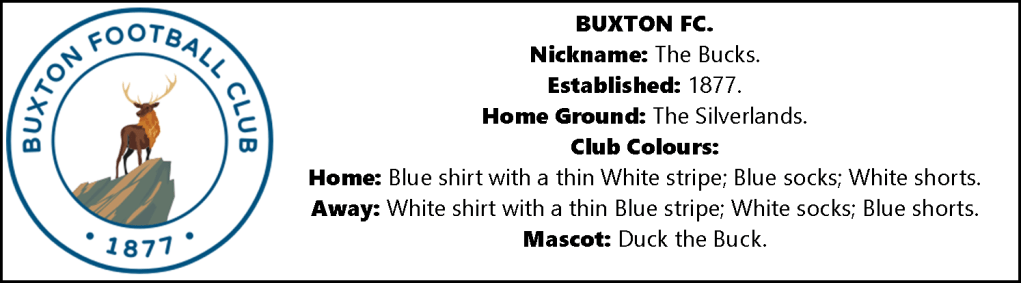
Buxton is a really agreeable Spa town to be found in the middle of the Peak District National Park in rural Derbyshire 96 miles south-east of Morecambe.
Often described as `the Bath of the north’, it is a prosperous place with some beautiful Georgian buildings and few of the social problems or poverty to be found not too far away in Greater Manchester to the north-west or places like Derby itself or Nottingham to the east.
As is the case with so many football clubs (including our own); Buxton’s was an off-shoot of the town’s cricket club. Founded in 1877, the Bucks initially played in the Combination as from October 1877 at the cricket club’s Park ground but came bottom at the end of the 1895-96 season and transferred to the Manchester League.
They played at various venues in the town after moving from the Park but finally settled on their current Silverlands stadium during 1884. (This remains the loftiest English Association football ground at 310 metres [1,020 feet] above sea level.) So – in at least once sense – Buxton FC can always look down on the rest of English football clubs. (No prizes for guessing, I’m afraid – but what’s the second highest? Answer at the end of this entry…)
The Bucks won the Manchester League in 1932 and joined the better quality Cheshire County League as a result.They became Champions in 1973, which earned them a place with Morecambe in the relatively recently established Northern Premier League.
The Bucks’ very first game in their new surroundings was against the Shrimps on August 11th 1973: Morecambe won 4-1 at Christie Park.
The Derbyshire club finished bottom of the Premier Division of the NPL in 1997; were relegated to the First Division and then came bottom of that too in their first season to be banished to the Northern Counties East League.
They won this in 2006 to return to the First Division of the NPL and were immediately promoted back to the Premier Division as Champions.
At the end of the 2021-22 season – during which time they were beaten 0-1 by Derek Adams’ League One Morecambe in the FA Cup Second Round in a game that was televised live on the BBC – they won the Premier Division of the NPL and were promoted to the National League North as a result.
Last season, they ended-up fifth in the table only to be knocked-out in the Play-Offs by the narrowest of margins in the semi-finals: South Shields won 1-0.
(In case anyone wonders why the club’s Mascot has the name it currently possesses, the Bucks helpfully posted the following on Facebook:
“Meet Duck the Buck, our new mascot from the 2024/25 season. As part of a recent internal marketing review, it was decided that Bucky, our current mascot, was creating too much brand confusion amongst those not familiar with the club’s nickname.”
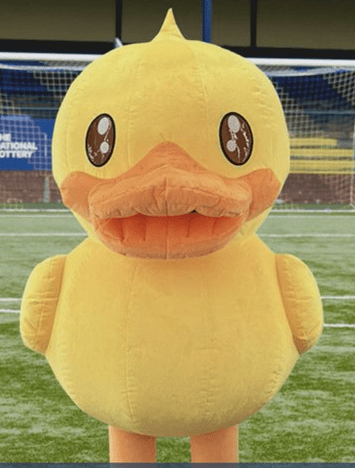
So that’s cleared that up nicely then: now, they presumably just think: “Buck the Duck? What the…”)
Morecambe have met Buxton in the past – as we have just seen – in both Northern Premier League and FA Cup fixtures. How many times and what the other scores were, though, I haven’t a clue and A.I. is absolutely no help…
Next season, we will travel to the Silverlands on Saturday 13th March 2027 for a kick-off at 15:00hrs. We will have already entertained the Bucks at the Halo on Saturday, 5th September 2026 at 15:00hrs.
Last season’s giant of a goalkeeping Coach at Morecambe – Jon Stewart – was poached from Buxton, for whom he was once a player. Joe McGee and, oddly enough – one Adam Buxton – have also enjoyed spells at both clubs.
(BTW – as I believe modern parlance has it – the second highest stadium above sea level in the English Football Pyramid is apparently the Hawthorns; West Bromwich Albion’s home ground. If this turns out not to be true: please blame A.I., not me….)
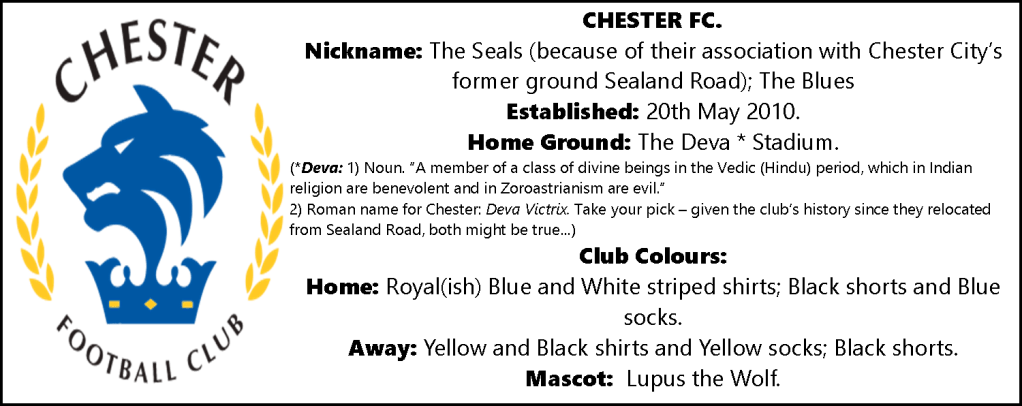
So what do we know about Chester apart from the fact that it is 87 miles away from the Halo Stadium to the south? This ancient walled city is on a par with places like York; Durham and Cambridge as one of the most historic places to be found anywhere in England. It also firmly sets itself in a historical context with its references to particularly its Roman past.
The football club, for example, plays at a ground named after the Roman Goddess of the adjacent River Dee – `Deva’ – and has a mascot – `Lupus’ – which means `Wolf’ in Latin.
`Chester’ – like `Caster’ – signifies the presence of a fortified Roman settlement in English place-names: Manchester; Winchester; Lancaster etc- and the original Roman Deva Vitrix (as Chester was called by them) was a fortified town.
Even centuries after the Romans had gone, Chester continued to be a bastion of English power in the border country close to the Welsh border. The unhappy and frequently violent relations which have existed between `Cestrians’ (natives of Chester) and their Welsh neighbours is still reflected in the mutually antagonistic relationship between fans of Wrexham FC and those of the Seals. In Morecambe’s first-ever away game in the EFL, the taunts by those among us aiming to wind-up the home crowd that Wrexham supporters were peasants; lived in a dump – or sought intimate relations with even quite ugly sheep – all fell on deaf ears. But when our contingent suggested that Wrexham was `Just a bus stop in Chester’; the Welsh segment of the stadium went absolutely berserk….
The Welsh connection has also caused practical – and really serious – problems for the club which are probably unique in football – and social – history. Part of the Deva Stadium is actually built on Welsh soil and the club found themselves on the receiving end of the ire of both the Welsh government and Flintshire Police in January 2022 for failing to respect Covid regulations which were different to those that would apply to the part of stadium on English soil. The long-term tensions between the city and its closest neighbours is also apparent in a statute still in force which dictates then any Welshman to be found within Chester’s City Walls after sun-down should be killed. So we need to remind Ben Williams to get on the team bus promptly after we play them on their own patch…
Chester is a beautiful city with many visitor attractions such as its Cathedral, the intact city walls; Market; the Eastgate Clock; boat trips on the river and the nearby Zoo. There are a lot of High-End shops, reflecting its status as the County Town of affluent Cheshire. A lot of money has been spent on re-development around the Cathedral in recent years and I think it’s fair to say that Chester has bucked the trend of increasing desolation and empty shops which characterises so many towns the length and breadth of Britain.
Morecambe and Chester FC share the unwanted distinction of falling from on high into relative obscurity in the English Football Pyramid during recent years. Part of the price they have both paid for this slip down the leagues is having to qualify to play in the First Round of the FA Cup.
Last season, for the first time in almost twenty years, Morecambe had to compete in an FA Cup Third Qualifying Round match. Ashvir Singh Johal’s hopeless team entertained Chester FC, ran rings around them for much of the game but drew one goal each when the visitors scored right at the end of the contest with the last kick of the match. In the replay, Morecambe were out-played; out-muscled and out-thought by a part-time team much fitter and more determined than our collection of badly-performing full-time shirkers and misfits. We finally lost by two goals to nil and our display was shameful and utterly shambolic – it should have been totally unacceptable to the ownership. But this turned-out to be just one of countless humiliations the Shrimps would experience under the alleged `leadership’ of the utterly clueless pet of the owners in what still seems to be a Panjab Warriors’ experiment with our club.
Chester, though, have become accustomed to even worse humiliations than ours.
The original Chester FC was founded in 1885 and played in the Combination at several locations until moving to Sealand Road in 1906. They won their league in 1910 and were promoted to the Lancashire Combination Second Division as a result. They became Champions of this, too, at the first time of asking and transferred to the Cheshire League during 1919. They were Champions of this three times before being accepted into the Football League’s Third Division North in 1931. When the Football League abandoned its regional divisions during 1958, Chester were placed in the Fourth Division. In 1975, they were promoted to the national Third Division. They were relegated back again in 1982 and renamed themselves Chester City a year later.
After slipping out of League Two during 2000 into the non-league wilderness that cronyism had at times protected them from during their unremarkable decades as a Football League club since 1931 (seven applications for re-election in 1954, 1955, 1961, 1962, 1963, 1968 and 1984 as clubs like ours were deliberately kept out of this Closed Shop by the EFL), City fought its way back again in the 2004-5 season.
But who can forget the time when – at Christie Park – a shameful bit of play-acting by one of our own led to a Chester forward being sent-off for a head-butt which never happened and City lost a tie in which they had been on top? This happened on 7th December 2002 when Morecambe was an authentic non-league club and the Shrimps came through in the F.A. Cup by three goals to two.
I also have a particular memory of the performance for them by a certain crazy-looking very muscular player with a shaved head and a Rottweiler mentality at Christie Park when he was almost able to turn a losing position into a draw for the Cheshire club single-handedly with a simply phenomenal goal and a dominant performance in mid-field. This was none other than a man who would go on to be a Shrimps‘ legend: Kevin Ellison. The game was a League Two fixture which happened on Saturday 14th February 2009 and Morecambe finally won 3:1 in a season which would end in relegation out of the EFL for the second time for the Seals (a nickname, I probably should have already mentioned that came about as a result of their former stadium on Sealand Road.)
This loss of Football League status sparked a financial crisis for Chester which had already been exacerbated by a typically unsympathetic EFL with a transfer embargo. Facing a ten-point deduction for going into administration, City found themselves seven million pounds in debt. As the HMRC used the Courts to enforce a CVA (Company Voluntary Agreement); City’s 10 point deduction became 25 and when they tried to re-start life as a new company altogether, the FA intervened to prevent them playing their first game as a member of the Football Conference in 2009 at Grays Athletic.
Unable to fulfil their first few fixtures as a new non-league club, things got even worse during January 2010 when their players went on strike having not been paid and the Conference reacted by suspending the club altogether. Following a vote by other members of the league, Chester was expelled on 26th February 2010, with its assets valued at just one pound sterling and a points total of minus three right at the bottom of the Conference.
Their application to join the Welsh League was immediately rejected and the rump of a once proud club found itself without any league to play in at all by Summer 2010 until they were finally accepted by the Northern Premier League Division One. Since then, they have managed to battle their way back to the National League only to be relegated again in 2018, when they found themselves in serious financial trouble once more.
But they rallied again – helped by former Manager and Liverpool legend Ian Rush plus Michael Owen among others – and the season before last, they were denied membership of the National League proper once more only by a 2-1 defeat by Scunthorpe United in the NL North Play-Off Final at Glanford Park.
They were frustrated anew last season when they finished the campaign in seventh place in the table but lost 2-1 in the quarter finals at relatively nearby Macclesfield – where they played their home games for two years in the hiatus between leaving Sealand Road and playing at the Deva Stadium between 2000 and 2002.
So when we think we’ve had a hard time as Shrimps’ fans, we have not been alone and the generosity of Chester fans less than a year ago as they paid for travel to away warm-up matches for our club as we teetered on the brink of extinction ourselves will never be forgotten by Morecambe supporters. Bury and Chester will always hold a very special place in our hearts.
Altogether – according to 11v11.com – the two clubs had met seven times in various competitions in the past prior to the two FA Cup games last season. This sequence began with a 0-1 win for Morecambe at Sealand Road as a non-league club against Fourth Division City in November 1961. This match was watched by 7,965 fans and marked the Shrimps’ first ever victory over a Football League club. Since then,11v11.com assures us, Morecambe have apparently won all of them until the FA Cup reverse last season in Cheshire. Can this be right?…
If so – can the sequence be re-established next season when the clubs meet on Bank Holiday Monday 31st August, 2026 at 15:00hrs at the Deva Stadium? The reverse fixture will be played at the Halo on Saturday 20th March 2027; kick-off 15:00hrs.
Apart from Our Kev, several other players have performed for both clubs, chief among whom are the sensational Stewart Drummond, goalkeeper Tony Thompson and Wales Youth International Marcus Dackers (on loan to both clubs from Salford City).
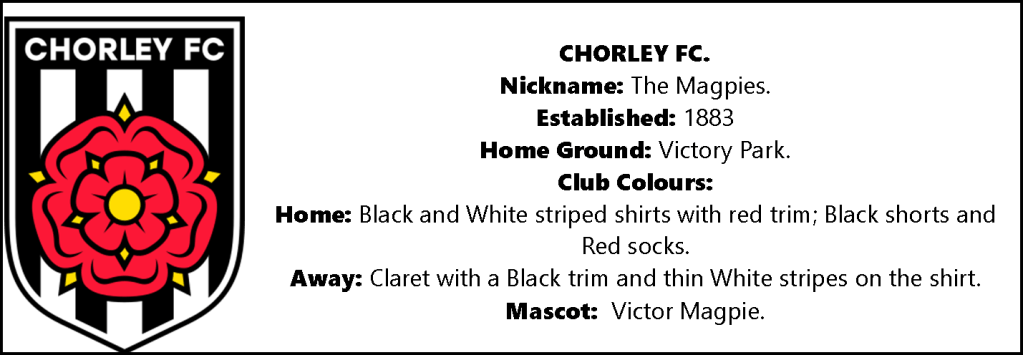
Well – what do we know about Chorley?
Like us, it is a town in Lancashire and can be found 39 Milesaway in the south of the county. It is famous for its eponymous `cakes’, which are actually pastries with a few currants in them, best eaten with butter spread thickly to relieve the inherent dryness according to the Egon Ronay guide. Or was it Wayne Ronay?…
Anyway, the place has few other claims to fame – Astley Hall and Park is a country pile nearby but not where pop star Rick comes from, disappointingly or otherwise. Preston England Temple is a religious building with an unusual spire; the entire exterior fashioned from eye-wateringly expensive Olympic white granite from Sardinia. This thing can be seen from literally miles away on its site right next to the M61 on the western side. It is the home of an American Evangelist group who call themselves the Church of Jesus Christ of Latter-Day Saints, but are better known as Morons – sorry – Mormons. They declare themselves to be On A Mission in England and are proud that their first converts were baptised in the River Ribble – hopefully not shortly after a spill by United Utilities, which could fill their holes – and their souls (as a Blues song yet to be written puts it) with something rather less welcome than hole-iness. Forgive me: holiness…
Whether they are known to be keen adherents of the Latter-Day Chorley Football Club as well is something I frankly do not know.
Chorley FC started life as a Rugby Union club but adopted the Association form of the game in 1883. They joined the Lancashire Junior League in 1889 and shortly afterwards the Lancashire Alliance which they won in 1893. A year later, they transferred to the Lancashire League and became Champions of that as well in 1897 and then 1899. They had been playing at Dole Park until this date and chose this moment to unsuccessfully apply for membership of the Football League for the first time in May 1899. This is a feat which – try as they might – they are yet to achieve.
The change of a Millennium saw the club playing at the Rangletts Ground, to which they transferred their previous Grandstand and even the advertising hoardings which could be seen at Dole Park. The Lancashire League was restructured as the Lancashire Combination during 1903. It had two Divisions and Chorley were placed in the lower one: B. After just a year at their new ground, Chorley was evicted and moved to nearby St George’s Park. The club ended the 1914-15 season at the bottom of Division B but the Magpies were saved from relegation by the outbreak of World War I. Once it ended, the Lancashire Combination was re-structured into just one Division and in 1920 the club moved for a final time to another new ground. To celebrate British success against Imperial Germany two years earlier, this ground was dubbed Victory Park. They celebrated by becoming Champions of the Lancashire Combination during 1920 – a feat they were to repeat eleven times by 1964.
Just after the Second World War ended, Chorley inflicted Morecambe’s heaviest ever defeat at Victory Park; winning a 1946 Good Friday contest by fourteen goals to one in the Lancashire Combination. And before you ask, Ashvir Singh Johal wasn’t even a twinkle in his mother’s eye way back then so we can’t blame him for that one at least.
In 1969, Chorley joined Morecambe as founder-members of the Northern Premier League but only lasted a single season before joining the Cheshire League. They re-joined the Northern Premier League during 1982 and won it in 1988, the prize for doing so being a place in the Football Conference (now called the National League.)
They fell out of the new competition in 1990 and slipped down into the lower tier of the Northern Premier League during the early years of the Twenty-First Century before a three year stint in the upper Division as from 2011.
They were promoted to the National League North in 2014. Five years later, they got within spitting distance of the EFL again when they won promotion to the National League: the highest position in the Football Triangle in England that the club had occupied since 1990 and the nearest they have ever come to entering the Football League.
It didn’t last: they were back in the National League North at the end of the 2019-20 season, coming rock bottom with a truly pathetic haul of just 26 points (as opposed to Ebbsfleet United, who were also relegated but with 42 points on the board). Last season, what is still a part-time professional club ended the season in fifteenth place in the table.
So Chorley’s history is frankly not a lot to write home about. They have beaten less than a handful of EFL teams in the FA Cup and have never reached the FA Trophy final, let alone won it.
Off the field, Chorley FC hit the headlines for all the wrong reasons three years ago. They were the victims of financial fraud by two club officials: during March 2023. An Ian Daniels and a Philip Haslam were convicted of stealing over £50.000 from club funds and were both imprisoned. What is it about football clubs and dodgy characters?…
Chorley has had some famous players on its books at times in the past – Paul Mariner; Tommy Lawrence and Frank Worthington, for example – have all worn the Black & White striped shirt of the Magpies. Players who have performed for both Morecambe and Chorley include Lee Molyneux; Jack Sampson and Kenny Myers, for whose services the Shrimps paid £12,000 to the Magpies in 1997. Is this the Shrimps’ record transfer fee?
Anyway – time to ask Artificial Intelligence to identify previous encounters between the two clubs. Let’s pick its electronic brains about a specific date:
“AI Overview
No official league match between Morecambe FC and Chorley FC took place on April 7, 1969, in the Northern Premier League. During the inaugural 1968–69 season, Morecambe and Chorley did not play each other in league competition.
The two clubs spent that particular season in completely separate tiers of non-league football.”
Oh dear. Looks like the following is a forgery then, nobody – including me – witnessed what it describes and the details it contains are entirely false:
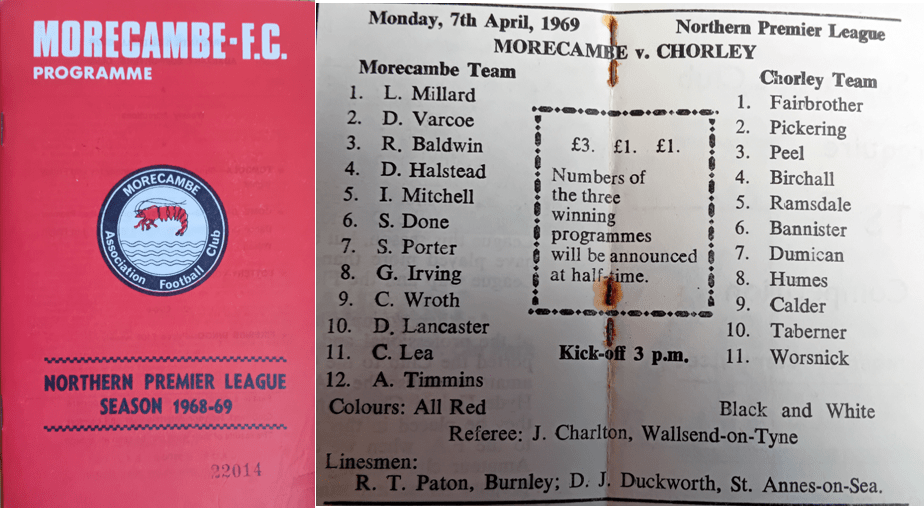
Don’t trust A.I.: as the old song puts it: it ain’t necessarily so… In reality, the game ended 2-1 to the Shrimps. At the end of the Northern Premier’s inaugural season, Morecambe were third in the table. Chorley ended-up next to bottom and were relegated back to the Lancashire Combination.
Morecambe have played Chorley many times in the past but I can’t pretend to provide you with an accurate record of these. Neither can anyone else, seemingly. Soccerbase, for example, told me this when I consulted its obviously less-than perfect archives: “Chorley have never played Morecambe – please select another”. Suffice to say that this is not true. Their first meeting was a Lancashire Combination fixture at Morecambe Cricket Club’s ground Woodhouse Lane on 23rd October 1920 during Morecambe’s inaugural season. The Magpies won 1-2. We’ve already mentioned the Shrimps’ record defeat but their biggest victory over Chorley happened at Christie Park on 28th February 1967 in the same league – Morecambe won 7-1.
Old acquaintance will be renewed next season when Morecambe will travel to Victory Park on Boxing Day, Saturday 26th December 2026, for a kick-off at 15:00hrs. The reverse fixture will take place on Easter Monday 29th March 2027 at 15:00hrs.
We start again with Darlington FC tomorrow.

