Morecambe National League North 2026-27. A quick Guide to the Opposition. Part Two.
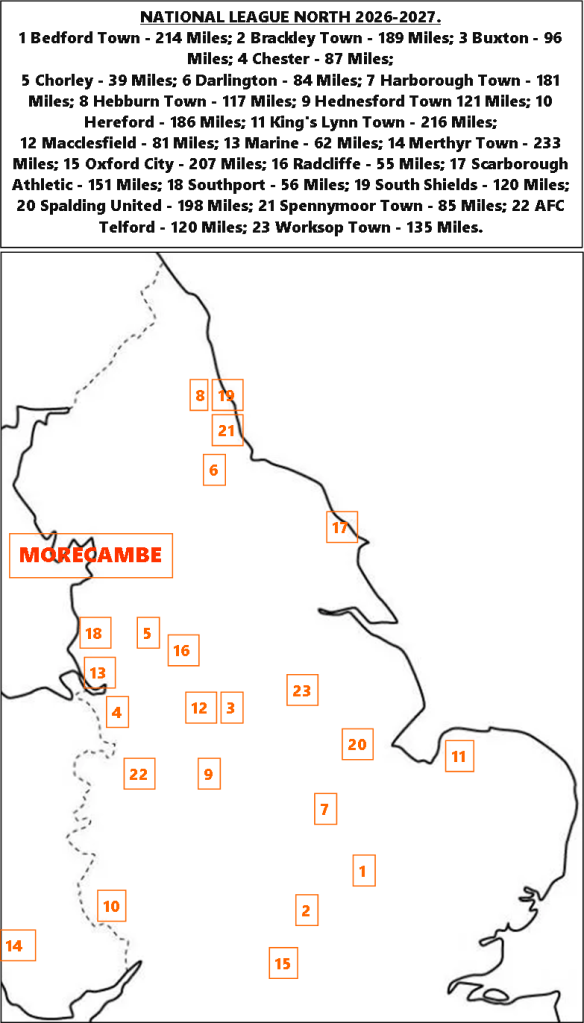

Darlington can be found 84 miles north-east of Morecambe in County Durham almost on the other side of the country.
A bewilderingly large number of places including Liverpool and Manchester have claimed to be the Midwives responsible for the birth of the railway industry not only in Britain but internationally.
Darlington, however, has a better claim than most. Opened in 1825, the twelve-mile-long track between the town and Stockton-on-Tees was designed by Robert Stevenson to be the first one in the world to offer public transport provided by steam locomotives.
The entire enterprise was underwritten by local Quakers and gave the railway its nickname of The Quaker Line.
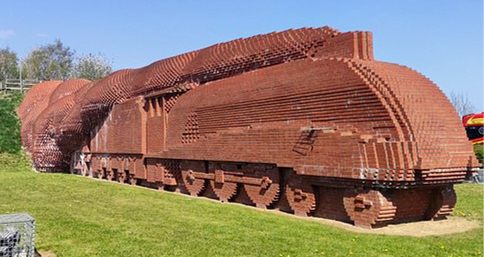
Railways have dominated the history of the town and anyone who has driven around the A66 ring-road will be familiar with Scottish artist David Mach’s astonishing Train Sculpture to be found there outside Morrison’s supermarket, who – under its original ownership – sponsored it in the first place. This extraordinary creation is formed of an astonishing 181,754 red bricks which portray the A4 Pacific class Mallard – the fastest steam locomotiveof its time and possibly ever – billowing smoke behind it as it emerges from a tunnel in a hillside.
The beautifully-kept Georgian Darlington Hippodrome (built in the style of Morecambe’s Winter Gardens) offers more culture to Darlingtonians – or, in their case, simply `Darlings’. There is a market; a plethora of independent shops (unusual in these Internet Shopping days) and the town is a generally tidy little place well worth a visit in my own humble opinion. But…
Durham Constabulary tells us:
“In the year ending December 2025, the crime rate in Darlington was higher than average for the Durham area.”
This criminality has not been centred solely on the town. In recent years – in a story so absurd that it sounds like someone has simply invented it – Darlington Football Club was taken over by a convicted criminal who – right under the noses of the English Football League (EFL) who, as always, did absolutely nothing to stop it happening – drove it to oblivion.
So there are two bookends as far as the history of the club is concerned. It was founded by Quaker idealists who believed in honesty, integrity, altruism and a simple way of living. At the other extreme, it was wrecked by a man who always indulged in selfish, dishonest and totally unscrupulous behaviour as he lived a conspicuously ostentatious lifestyle.
The founders must be still spinning in their graves.
So where do we start in untangling this mess?
The club has the nickname `the Quakers’ because- as we have seen as far as the railway alone was concerned – people of that faith had a big influence in post-industrial and industrial Darlington.
A Quaker family called Pease owned the ground that `Darlo’s’ base for most of its life – Feethams – was built on as soon as it was established in 1883. The plain Black & White strip it still plays in was also inspired by Quaker ideals of simplicity and lack of ostentation.
Contrast this with their flashy, foul-mouthed safe-breaker Chairman with his big cars and even more grandiose ideas for a club which he personally brought to the edge of ruination – and beyond.
Darlo were founder-members of the Northern League in 1889 and won it in 1896 and 1900. The club made the momentous decision to become professional in 1908 at a time when most football clubs were proudly amateur and moved to the North Eastern League, which they won in 1913. They had already turned heads by beating Football League First Division giants Sheffield United during the 1910-11 FA Cup campaign. The Quakers had started this in the First Qualifying Round and finally played eleven games before being beaten 3-0 by Swindon Town in the quarter finals.
However, the club ran into financial trouble after the First World War. Many other clubs were in the same boat as the human toll taken on professional footballers – as virtually a whole generation of Englishmen was wiped-out in the trenches of Flanders and elsewhere – had a profound effect on post-war Britain. The club was saved as it was basically swallowed-up by local rivals, the Forge Albion. Their Chairman settled the Quakers’ debts and paid for a new stand to be built at Feethams as what was effectively a new club in all but name still played as Darlington FC.
Further successes on the field saw the club, which had just won the North Eastern League, elected to the newly-formed Football League’s Third Division North in 1921.
They won this as well and were promoted to the Second Division in 1925.Their encounters with teams like Wolves; Nottingham Forest, Chelsea and Fulham as equals didn’t last long though and Darlington were relegated again in 1927.
Little changed for the club until long after the Second World War had come and gone. They made history by playing at Newcastle’s St James Park in November 1955 in the first FA Cup tie ever to be lit by floodlights. The Quakers had drawn at Brunton Park but won the second round replay 3-1 against Carlisle United.
Three years later, they drew an FA Cup tie 3-3 at Stamford Bridge against Chelsea but then walloped the then First Division club 4-1 at Feethams. By this time – with regional divisions in the EFL scrapped – Darlo were members of the Fourth Division along with clubs such as Watford, Crystal Palace and Coventry City.
Floodlights were installed at Feethams in 1960 but whoever was responsible didn’t do a very good job. An electrical fault started a fire in the West stand, which then burnt to the ground.
This bad fortune was eventually to be repeated on the field.
Darlington became one of the Basket Cases which the reactionary EFL should have allowed more dynamic clubs such as Macclesfield; Wigan: Barnet or ourselves to replace in the Fourth Division – but wouldn’t let in until 1987. In the ten years between 1969 and 1979, Darlington had to apply for re-election to the Football League on no less than five occasions because they kept ending-up in the bottom four of the Fourth Division. They should have been booted-out first time of asking. But the always reactionary EFL preferred the hopeless to the unknown and resolutely allowed the Dead Wood among its ranks to keep on floating rather than allow any New Blood into a moribund league badly in need of a transfusion.
So the Quakers staggered on, surviving more financial crises until they were promoted to the Third Division for two seasons in 1985. Normal Service was soon resumed, though and the club suffered successive relegations: back to the Fourth Division in 1989 and then, finally, out of the EFL altogether at long last in 1990.
It would be easy to say that little changed after that, but Little actually changed the fortunes of the club: They bounced straight back and the rejuvenated team immediately won the Fourth Division Championship in 1992 only for the Manager who had driven them forwards – former Aston Villa and England striker Brian Little – to leave and them to slip back into Division Four once more. They blew a chance to return to the higher Division in 1996, when they lost the Play-Off Final at Wembley to Hereford United. This is what the club’s official website tells us happened next:
“In 1997 the east stand at Feethams, which had stood for many years, was demolished and a new one built in its place, but soon after the chairman, Mike Peden, resigned. Local businessman George Reynolds took over, paid off the club’s debts and started construction of a new 27,000 all seater ground elsewhere in the town.”
That sound pretty good, doesn’t it? There follows a glaring gap in the narrative which completely ignores the role Mr Reynolds played in the future of the Quakers and simply mentions in passing that `crowds slowly dwindled, and within months the club was put into administration’.
Maybe they are still in denial about what actually went on…
Perhaps they don’t have space on their website to tell the whole story…
We shall return to the George Reynolds interlude in due course.
Chairman George’s legacy to the club was to leave it with a White Elephant of a Stadium and a mass of debt which even more enlightened Chairmen and owners who tried to save the Quakers ultimately failed to do. They managed to struggle out of Administration in later 2004 after Mr Reynolds had departed and actually reached the League Two Play-Offs in 2008 only to be beaten by Rochdale. The following year, despite a bright opening to the season, the club went into Administration for a second time.
This was the Kiss of Death for the club: points were deducted by the as always totally unsympathetic EFL; players left and the Management team finally went with them.
In 2010, they were relegated from the EFL for the second time. The unrelenting bad news was interrupted by an FA Trophy win at Wembley (at the third time of asking) in May 2011, when the Quakers beat Mansfield one nil with a last-minute goal. The club’s website tells us:
“Unfortunately the win was not a springboard for success, and by the turn of 2012, the club was back into administration for the third time. After overcoming several difficult hurdles and negotiating for many hours, a supporters group took control of the club with the aim of making it stable once again, but the FA controversially ruled, despite an appeal, that Quakers should be demoted from the Conference back to the Northern League — an unprecedented drop of four divisions.”
The Reynolds Arena had never been financially sustainable and Darlo started playing as Darlington 1883 (a suffix referring to their original incarnation which was quickly dropped) at Bishop Auckland’s ground, Heritage Park, twelve miles away to the north-west. And from here, the long grind from the Northern League where life had originally started for them began anew.
They ran away with the new league in their first season and then took just two years to gain promotion from the Northern Premier League First Division North to its Premier Division. They also won this at the first attempt.
On Boxing Day, 2016, the club moved back to Darlington to share the town’s Rugby Union Club’s Blackwell Meadows ground – and they are still there.
Last season, they finished ninth in the National League North.
Morecambe and Darlington have met six times in League Two. The Quakers have won just one of these; the Shrimps three. Players who have featured for both clubs include Neil Wainwright; Ben Hedley and Adam Campbell.
We shall be visiting the rugby ground in Darlington on Tuesday 16th February 2027 for a 19:45hrs kick-off. Prior to that, we shall host the Quakers onTuesday 27th October 2026 with a kick-off also at 19:45hrs.
Ironically, the Darlington (formerly Reynolds) Arena is now also the home of another Rugby Union club: Mowden Park (average gate about one thousand fans and frequently fewer.)
It also regularly features Car Boot Sales and the occasional concert. Fans of 1980s chart music might have been at the last one on August 8th 2026: Level 42 were the headliners, with Marc Almond; Heaven17; Haircut 100; Go West and Jaki Graham also featuring.
So now, let’s return to a gentleman who – as we have seen – has been basically airbrushed out of the club’s official history as their website portrays it.
This literally Larger-than-Life character (with his huge beer gut and infamous Bobby Charlton-like comb-over) could have been plucked from such gritty north-eastern dramas as Get Carter – or, perhaps even more appropriately, O Lucky Man:
Darlo Chairman George Reynolds.
If you don’t already know this story, put the kettle on and then settle down with a nice cup of tea to read something so utterly mind-boggling that if you made the whole thing up, nobody would believe you.
George Reynolds was 61 when he took over Darlington Football Club in1997. The EFL in their infinite wisdom decided in their Preston Ivory Tower that – naturally – having completed their extensive vetting processes – George was a `fit and proper’ person to be a Chairman of one of their clubs.
We all know how this works – as evinced by our own experiences with the lovely Mr Jason Whittingham. So do Bury Supporters. And Macclesfield’s:
Basically, the overpaid halfwits in Preston will pass anybody as a `Fit and Proper’ person because they don’t have the commitment, the integrity or the intelligence to do the vetting process properly. And of course, there’s no question of any impropriety as far as the EFL is concerned in this matter, is there? Bungs and other inducements are totally unknown in professional football in this country, aren’t they? If you’ve any doubt about this – just ask the supporters of original `Crazy Gang’ Wimbledon…
So what had the man so disingenuously described as a `local businessman’ by the club’s current website made his money from?
He owned a company that manufactured kitchen worktops – and made a fortune from doing so.
But George Reynolds had also served a four-year term for safe-breaking during the 1960s. He had also been in prison for six months for burglary in 1970 followed by another spell inside during 1976 for theft.
He claimed – in the `Rags to Riches’ version of himself that he missed no opportunity to tell anyone who would listen – that he was a burglar only because if he hadn’t stolen other people’s belongings, his own family would have starved. How very heroic. But apparently, the EFL had no problem with any of that. Maybe they would have thought differently if it had been their own safe George had cracked; one of their own houses he had broken into or themselves personally he had robbed…
Whatever – Mr Reynolds was a convicted safe-breaker, thief and burglar with a reputation for indulging in thuggish behaviour as well: this street-fighter from the slums of Sunderland prided himself on being an authentic tough guy. The Daily Telegraph described him in 2021 as “the most feared man in football since Colonel Gaddafi bought a slice of Juventus.”
But apparently this was exactly the sort of man you need at the sharp end of a football club.
Because the Football League apparatchiki in Preston clearly had no objection of any sort to this reality and Mr Reynolds duly became Chairman George.
When he actually took on this mantle at the club, his behaviour didn’t change. This is what the BBC told us in 2007:
“He was renowned for confronting journalists on their own doorsteps, and publicly warning fans that he would go to their homes if they criticised him or his family. George Reynolds famously said that his detractors could “expect confrontation at home or at the ground. People are all right in groups until you knock on their front doors at twenty past two in the morning. If anyone has a go at me, I find out where they live and go and knock on the door. They don’t like that. As soon as I do that, they ring the Police.”
But the man himself couldn’t understand why this caused such a negative reaction with journalists and the club’s supporters.
“Why should they be scared of me? I’m 67… so who’s the coward?” said Reynolds. He added, “The fans can be very temperamental at times.”
He had his own very special remedy for this. When he was still Chairman of the club, George Reynolds made this statement:
“Never listen to the fans or the manager ‘cos they never get it right.”
As a result, it would seem that he personally chose the team on occasions. At other times allegedly – his second wife (or was it his third: his advice about spouses was to change them regularly `like you would a washer-dryer’) Susan did so too.
I remember reading somewhere at the time that she did this on the basis of how personally attractive she found the individual players. In any other context, you’d have to dismiss this claim as possibly misogynistic – or simply not credible. But in the context of the Reynolds era at Darlington FC, it simply can’t be dismissed so breezily. Matthew Beard of the Independent wrote the following about this woman during 2002:
“Not even the imaginative scriptwriters of Footballers’ Wives would have dared to guess what was to follow when the flamboyant spouse of Darlington’s millionaire chairman stood up to address the football club’s supporters and staff.
After a series of poor results for the third division side, Susan Reynolds, the second wife of reformed safe-cracker George, had decided it was time to tell a few home truths in front of the first team and several hundred fans.
Reading from a prepared script, Mrs Reynolds, who is 24 years younger than her husband, kicked off a tirade by branding supporters and the local media a let-down and accusing one director of being a “backstabber”. More than half an hour into the rant, in which Mrs Reynolds’ remarks were as spiky as her Prada heels, she unleashed the verbal equivalent of a studs-up tackle, accusing the players of throwing games as they languished in mid-table.
Having already accused the team of being money grabbers, she treated the stunned audience to her pet theory behind last Saturday’s 3-1 defeat at home by lowly Torquay United. She said: “It isn’t unknown for games to be thrown deliberately at this time of year, by way of favours.”
It was, at the end of the day, a snub too far. The fans jeered in disgust and the players, who had been ordered by the chairman to attend the “Fans’ Forum” stormed out, led by Craig Liddle, the captain.
Mr Reynolds, whose chipboard empire has helped to bankroll the club since he bought it in 1999, was in no mood to placate the fans or his team. After his wife’s outburst, the chairman, 66, who is one of Britain’s wealthiest men, threatened to abandon the club and turn its modern stadium into a bullring.
He added later: “Susan spoke the truth – and if she hadn’t, I would be looking for a new wife. She meant the players were not trying 100 per cent and that is how they were throwing matches, from not trying hard enough.
“I have got top players here earning £120,000 a year, and top surgeons don’t get that. But the fans are watching players who just aren’t trying. If these players don’t like what I or my wife has said, they can f*** off.”
Many of them took his advice. But Chairman George carried on with his hare-brained scheme to abandon Feethams and build a brand-new stadium on the Darlington Ring Road which could hold 25,000 fans: about ten to fifteen times more than usually came through the Quakers’ turnstiles on match days. It was an act of absolute insanity: the sums would never stack-up. But, with characteristic modesty, he named the new ground The Reynolds Stadium and, once it was luxuriously finished (with features such as marble bathrooms), abandoned Darlington’s home for the previous century altogether.Feethams was left to gradually rot away and become the target of arson attacks until the entire space was flattened and new houses were built upon it in 2013.
Back at the new ground, though, things weren’t going well for Darlo either on the field or off it. On it, he infamously appeared wearing a fake ball-and-chain and a mock prison suit complete with arrows during 2001. Two years later, the man who carried a Business Card which stated “Managing director, chairman, gentleman, entrepreneur, adventurer, maker of money and utter genius’’ published a memoir which was called Cracked-It. But he hadn’t: as the sparse crowds diminished, the team kept losing. As we have seen, Chairman George blamed the players.
So in a move worthy of fellow-traveller Donald Trump, he threw his toys out of the pram, said that his genius and foresight wasn’t appreciated and announced that he was going to relinquish the Chairmanship and thus abandon all responsibility for his own literal folly – plus the huge debt (about five million pounds at the time and rapidly getting bigger) which his catastrophic ownership of the club had caused.
Whilst he was still club Chairman, though, the police – acting on a tip-off – stopped him on July 14th 2004 and found half a million pounds in cash stashed in the boot of the top-of-the-range Mercedes he was driving. He was arrested and held overnight in police custody, suspected of money laundering.
The local Northern Echo tells us that George couldn’t understand the fuss his arrest had caused. Didn’t everybody drive around with £500,000 in loose change rolling around in the back of their cars?:
“Mr Reynolds declared: “They can do what they like, they know and I know I am whiter than white.”
The application, under the Proceeds of Crime Act, involves £500,000 in banknotes, which were recovered by officers after Mr Reynolds’ car was stopped in an intelligence-led operation at High Etherley, near Bishop Auckland, County Durham. The money, he said, was deposited in the Co-op bank in Darlington from where on Monday he withdrew £500,000 from the account.
“I have always dealt in cash and the money was legally transferred to me with all relevant payments made on it such as Stamp Duty.” He added: “The money is mine and I am perfectly entitled to take it out if I wish. The police described it as a large amount of cash but for someone like me who is used to dealing in millions it is small.”
Just before his trial for tax evasion during 2003, he told the media:
“I have not the slightest doubt that I will be cleared of this allegation.”
He then pleaded guilty, having presumably spoken to his lawyers in the interim. George Reynolds was jailed for a further three years for attempting to defraud the HMRC of £650,000. The local paper added:
“In 2002, he even declared the only money he received was his old age pension – a sum of £4,697, of which he owed £14 in tax.
In fact, he led a lavish lifestyle.
The court heard he splashed out on:
* A luxury yacht in Spain
* His mansion in Witton-le-Wear, County Durham
* Two Rolls Royces with personalised number plates.”
Having effectively destroyed Darlington Football Club, George was not particularly repentant. In fact, he was very far from it:
“I took Darlington because it was a lame duck. I’ve built £30m of stadium, and then they have the audacity to have a go at you. If I turn the clock back, I probably should have looked into getting Sunderland instead of Darlington. It’s like Robin Hood. They made out how he was a wonderful person, and really he was a villain… Sometimes I find that the bad guys are the good guys.”
So who were the bad guys? According to ex-Chairman George, the police were. He continued to be in trouble with them even as a really elderly man:
“In 2019, aged 83, he was found guilty of harassing a Durham county councillor following a row over planning permission for holiday cottages he was building near Bishop Auckland.”
Later, he was taken into custody for failing to respect the terms of a Tagging Order and locked-up for a further two weeks. He responded thus:
“When I was jailed for a four-stretch, I never made a single complaint, I pleaded guilty and I took it on the chin like a man. I did my porridge. Now I have been shouting for nine years about one night in a cell because I know there has been a great miscarriage of justice and a police conspiracy.”
The only crime he had ever been guilty of, according to the man himself, was this:
“In the north of England it is a very serious offence to be successful, ambitious and to work hard. When you reap the benefits, like a Rolls Royce, people think, ‘what’s he doing? – he’s nothing but a criminal!’ I am dyslexic, backward and illiterate, according to a school report, but I have more common sense than them. I am street wise. I know the difference between right and wrong.”
Obviously.
George Reynolds passed away in the Covid era on the unlucky-for-some thirteenth of April 2021, aged 84.
There is an old saying about only the good dying young. I couldn’t possibly comment but let’s give a man who some people in the north-east (particularly in Sunderland) still think was the greatest thing since sliced bread the final word:
“Me Mam always told me that if I fell into the river, I’d come up with a fish in each pocket.”
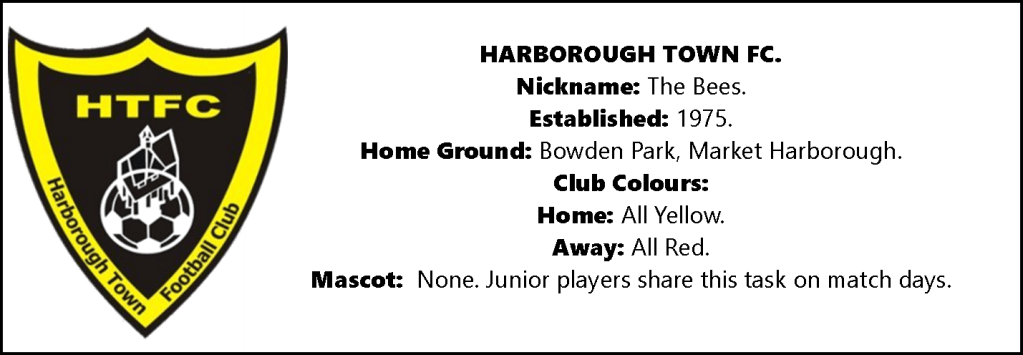
I suppose the first question to ask about this club is: where is it?
The answer is: in the rather agreeable small Leicestershire town of Market Harborough. We can find this a mere 181 miles south of Morecambe on the edge of the Northamptonshire border in what is supposed to be a regional `Northern’ League. Maybe the `North’ element of `Northamptonshire’ was the clincher for this…
Whatever, the club wasn’t in any sort of northern league last season – we will be meeting them for the first time ever on the basis of Harborough becoming Southern League Premier Division Central Champions last time of asking. This is what their very politically-correct website tells us about them:
“Harborough FC is the realisation of the merger of Harborough Town Juniors, Harborough Spencers and Harborough Minis in 2007, which created one club for all ages, gender and ability for the Market Harborough Community.
We are based in Market Harborough, South Leicestershire where are our impressive facilities cater for all of the clubs teams. The club became an FA Charter Club in 2004 and through consistent development has achieved FA Charter Standard Community Club Status which is the highest accolade currently available and recognises best practice, on going development and positive impact within the local community. The club currently has teams that include Minis, Girls, Junior, Youth, Ladies, Inclusive, Senior and Veteran sides.
Harborough Town Juniors were formed in 1975, running two teams from U11 to U16. After initially playing at Symington’s, they developed facilities on Northampton Road in the 1990s. However, there was a desire to have senior football for the youngsters to move on to, consequently they formed links with Spencer United, and in 2007 they merged with Harborough Spencers, as they had become called. In the early 2000’s Harborough Minis had been formed to cater for U11s, and in 2007 they joined the merger to create Harborough Town FC
Former players at the club have included Richard Stearman (Leicester City FC + England), Chris Carruthers (Northampton Town FC, Bristol Rovers FC + England), Tom Fielding (Leicester City + Mansfield Town) and Martin Johnson (Leicester Tigers FC, England + British Lions). The club has also over recent years seen a number of players, boys and girls, progress into Centre of Excellence and Elite squads at local Professional Clubs and it is rewarding to hear of their individual progress.
Harborough Town FC is a company limited by guarantee # 09608591 (There are no shareholders).”
They list their honours so far thus:
“Southern League Champions 2025-2026; Southern League Play-Off semi Finalists 2024-2025; Northern Premier League Midlands Division Play-Off Winners 2023-24; United Counties Premier Division South Champions 2021-22; United Counties Champions Cup Winners 2021-22; Hinchingbrooke Cup Winners 2021-22; Northamptonshire Combination Premier Division Champions 2009-10; Leicester & District Mutual League Division Five Champions 1977-78.”
Wow! This is clearly one of the New Kids on the Block in exactly the same way we once were as a non-league club. The Bees have not taken any large scalps in the FA Cup nor won the FA Trophy but – given time – who knows what they might achieve?
We will meet them for the first time ever at Bowden Park on Saturday, 15th Aug, at 15:00hrs. The home game will take place on Saturday 19th December 2026, at three o’clock in the afternoon.
Do we share any former players? A.I. tells us that Lee Tomlin was a “Veteran English midfielder and former Premier League player (who) had a brief spell at Harborough Town and later managed National League side Morecambe”.
Well – I never knew that. It must be true, though: A.I. is never wrong, is it?
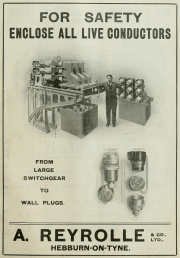
Reyrolle was once the biggest employer in the north-east of England. With a workforce of 12,000 people, it produced electrical switchgear for Power Stations all over the planet at its huge site (over 18 acres) in Hebburn, just to the east of Newcastle-upon-Tyne on the other side of the river. The rump of the company – 90% smaller than in its heyday – was acquired by Siemens during 2005. It now makes nothing but is used for testing electrical products and administration for the multinational company.
So what’s this got to do with the National League North?
Reyrolles once had its own football team and this has morphed into Hebburn Town FC. The company’s works team was founded in 1912 and initially played in the Jarrow & District Junior League, Second Division. By 1959, it had also been a member of the South Shields Combination League; Wearside League (twice); Tyneside League; Northern Combination (twice) and North Eastern League. During 1986, the club re-named itself Hebburn Reyrolles and two years later became plain old Hebburn. They became Hebburn Town FC in 2000, at which time they were members of the Northern League.
Hebburn Town bounced around various Northern League divisions for years after this and their major achievement was to win the (former amateur) 2020 FA Vase in May 2021 by beating nearby Consett 3-2 at Wembley in front of empty seats in a game delayed for a year by the Covid pandemic. Hebburn also joined the Northern Premier League Division One East during 2021. They then went on to win promotion to the Premier Division in 2024 and their reward for doing this was immediate further elevation to the National League North. So this is the highest position the Hornets have ever reached in the English Football Pyramid and all we can do is wish them well. With mighty Newcastle United only five miles away to the west on the other side of the Tyne; Gateshead even closer and nearest local rival South Shields the same distance away to the east, they will do well to prosper. Their average home gate last season was about 400 people (615 when they beat Lancaster City 4-1 in March 2026) and their website reflects the club’s relative penury: it is extremely basic with none of the information I have just imparted. Leading scorer and Golden Boot winner from last season’s successful campaign with 26 goals (10 more than anyone else managed) Darlington native Gary Martin has also been released for whatever reason. So the club faces an uphill struggle this coming term. This will include travelling to the Halo Stadium on x and will welcome Morecambe (where the visiting contingent of Shrimps’ supporters will probably out-number the home ones having covered 117 miles to do so) on Saturday 3rd April 2027 at 15:00hrs. Hebburn will have already travelled to Morecambe on Saturday 2nd January 2027 for another 15:00hrs kick-off.
These matches will mark the first time the two clubs have ever met.
The only player I can trace who had been on both teams’ books was Tyler Brownsword, who played 20 minutes for Morecambe’s first team as a member of the Academy during March 2019 and then moved to Hebburn – for whom he never actually performed – in 2024.
What do we know about Hednesford?
It is a town in Staffordshire 121 miles south of Morecambe on the fringe of the West Midlands. It describes itself as `the gateway to Cannock Chase’ on which can be found features such as the German Military Cemetery (where nearly 5000 casualties of the First and Second World Wars who fought for Kaiser Bill or Adolf Hitler but died in Britain as downed airmen, captured U-Boat crews or other classes of Prisoners of War have been interred since 1967) and the coal seam which runs under the Chase itself. Hednesford is yet another former industrial town which the deliberate destruction of the UK coal industry by `Iron Lady’ Margaret Thatcher and the transfer abroad of mills, factories, foundries and a host of other enterprises which once made Britain self-sufficient and provided meaningful and frequently skilled employment for so many people. With the coal mines gone and even the Brickworks which was once owned by a Pit Company (Cannock Chase Colliery Co); the ghosts of a once vibrant working town lives on only in such terms as `The Pitmen’ as the town’s football club is still known.
Hednesford Town came about originally as a merger of two other clubs: Hill Top and the Red & Whites. They were based at the Anglesey Hotel, which still exists on Anglesey Street as a Grade II Listed building as the local Wetherspoon’s under its original name: Hedgeford Lodge. I’m sure a number of us will visit it…
The club were founder-members of the Birmingham & District League in 1889 but only stayed in it for its first season. After that, the club played only friendly matches until it joined the Walsall & District Junior League (which soon dropped the Junior bit) during 1894. They transferred to the Birmingham Combination in 1908 and won it two years later. They regularly came bottom of this before they folded altogether in 1938 but a new version was playing in the Birmingham & District League again just in time for World War Two. During this, they became West Midlands (Regional) League Champions 1940–41 against reduced opposition. They struggled again after the war before finally re-joining the Birmingham Combination. The Pitmen won this in 1951 and then re-joined the Birmingham & District League… zzzzzz…
And so on and so forth backwards and forwards in various regional leagues with not a lot to show for it apart from the occasional local cup success.By 1972, they had joined the Midland League before coming bottom and joining the West Midlands (Regional) League five years later. They won the Premier Division of this in 1978 and – after coming second in 1984, joined the. Southern League Midland Division. They became Champions of this league’s Premier Division in the 1994–95 season and also won its Championship Trophy in the same year. They were FA Trophy Winners in 2004. Their yo-yo existence continued with triumphs and failures until finally, they found themselves in the Northern Premier League West Play-Off Final last season. They beat Congleton Town 2-0 in front of their own supporters in this to end up where they are now.
Among players who have featured for both clubs can be found Adam McGurk; Lee Colkin and Sean O’Connor. Morecambe and the Pitmen will meet for the first time in Staffordshire on Saturday, 7th November 2026 at 15:00hrs. Hednesford with then travel to the Halo on Saturday, 6th February 2027 at 15:00hrs.
Hereford is a nice little market town best known for a number of things beginning with `M’: a Market; a Map and a Museum (of Cider). It is the County Town of Herefordshire and its Cathedral holds the ancient Mappa Mundi – Map of the World – which was produced at a time (seven hundred years ago) when the existence of American and Australian continents at least were not known to the cartographers, who almost certainly thought that the Earth itself was flat. Hereford – set among the rolling fields of a distinctly rural location – is one of the main centres of the cider-making industry in Britain and its Museum celebrates this fact.
As a predominantly ethnically white town, Hereford has a reputation for intolerance against outsiders and disputes with the Traveller Community as well as the owners of Eastern European-style shops in the town. You can sense this if you simply walk around the place, as I have done several times in the past. Hereford natives overwhelmingly voted for Brexit, since which time tensions there have apparently increased, with the football club playing a leading role in attempting to encourage a more tolerant attitude amongst its fans at least. On 26th January 2026, the club released the following statement following reports of racist chanting in the away crowd during a game at Merthyr which had nothing to do with their Welsh surroundings:
“At Hereford FC we pride ourselves on offering a warm welcome to everyone and we will continue to do that moving forward. Incidents like this will not be allowed to define our great club, and we will not shy away from taking the robust action necessary to ensure that, whenever an issue arises, our entire fanbase is not tarred by the actions of a small, mindless minority.”
The BBC adds:
“In September last year, two people were banned after an FA Cup tie that had to be abandoned following reports of racist abuse from the crowd. Players left the pitch after about 67 minutes of play between Hereford FC and Sporting Khalsa at the Guardian Warehousing Arena in Willenhall.”
Two Hereford fans were banned by the club as a direct result of this incident, where abuse was aimed by Bulls supporters at the players in the opposition team, many of whom have an Asian heritage.
To turn to more positive things as far as English football history is concerned, Hereford United hold an almost unique place in it. On Saturday, 5th April 1972, Southern League United hosted then First Division (the equivalent of the current Premier League) Newcastle United in a Third Round FA Cup replay at the club’s very basic ground, Edgar Street. The Magpies’ iconic and loud-mouthed England star and Centre Forward – Malcolm MacDonald – boasted before the match that he would personally score a hat-trick against the minnows. But he didn’t – he scored just the opener, which turned-out to be Newcastle’s only goal of the game. We must remember that Newcastle had already failed to beat Hereford at St James’ Park: the game there had ended 2-2 after the visitors had taken the lead after just seventeen seconds. It is a little-known fact that Hereford Full-Back Roger Griffiths had broken his leg during the replay but manfully played-on until being replaced by Ricky George, who was to score Hereford’s winning goal in Extra Time. In the meantime, one Ronnie Radford had equalised with one of the most astonishing goals ever to be broadcast on UK television. In the 85th minute, on a mud-heap of a pitch, he hit a simply unstoppable shot from fully thirty yards into the top corner of the net despite international goalkeeper Ian McFaul’s valiant efforts at full stretch to keep it out. It was a strike which seemed to gather momentum from the moment Ronnie struck it and it has been rightly endlessly replayed on the television ever since. As a result, Radford became a household name and Hereford United was suddenly the name on all English football fans’ lips. Their reward was for the old fossils at the Football League to engineer a situation at the end of the season where third from bottom of the old Fourth Division, Barrow – stuck out on a peninsular which was geographically difficult for other League clubs to get to – were booted out of the League altogether to be replaced by the FA Cup television stars.
The club – proving yet again that many non-league clubs were actually stronger than those protected by the Closed Shop bastion of mediocrity – the Football League itself – won the Fourth Division at the first attempt and got to the dizzy heights of the Second Division (what is now called the Championship) in 1975, having been Champions of the Third Division (League One) as well.
After that period, though, United struggled for a lot of its history as a Football League club. In 1997, they were relegated out of the EFL, having come rock-bottom of the pile. They fought their way back in again during 2006 and even gained promotion to League One in 2008. They lasted only one season there and during 2012 found themselves back in non-league football all over again.
A combination of bad management, characteristically non-existent regulation by the EFL and dodgy dealing at the club saw them expelled from the National League in June 2014. Accepted back into the Southern League, the club was wound-up by the High Court in December 2014 with debts of £1.3 million following a Petition launched by former Manager Martin Foyle, who had resigned after failure by the club to pay him or his squad earlier in the year. He did this with the blessing of most of the Bulls’ fans, who had arranged a boycott of United by this time. So Hereford United – formed initially ninety years earlier in 1924 – was no more.
But fans rallied and created a new club – Hereford FC, which started playing in the ninth tier of the English football pyramid in the Midland League Premier Division during 2015.Still playing at Edgar Street (186 Miles from Morecambe) and supported by four thousand plus crowds (larger than many EFL clubs could manage at the time), Hereford rapidly progressed to the Southern League; firstly in the First Division and then Premiership and were promoted to the National League North in 2018. Since their reincarnation, Hereford have got to the final of both the FA Vase and FA Trophy but lost on both occasions: 4-1 against Morpeth Town in the former competition in 2015 and 3-1 to Hornchurch in the latter during 2021. Last season, the Bulls stayed in the National League North by the skin of their teeth on goal difference alone: they were level on points with relegated Curzon Ashton just above the Legion of the Doomed in twentieth position.
The iconic Craig Stanley and Tom Barkhuizen have played for both Morecambe and Hereford in one of its guises over the years. The Shrimps have yet to play Hereford under its new branding but fortunes against the former club were mixed, including a very disappointing loss to them in a Conference Play-Off semi-final of 2006, when a United side featuring Stanners squeezed home with a winning goal scored in extra time of the second game.
Morecambe will face the new-look Bulls for the first time on Saturday 17th October 2026 in Lancashire, k.o. 15:00hrs. The reverse fixture will be played on Saturday 9th January at 15:00hrs.
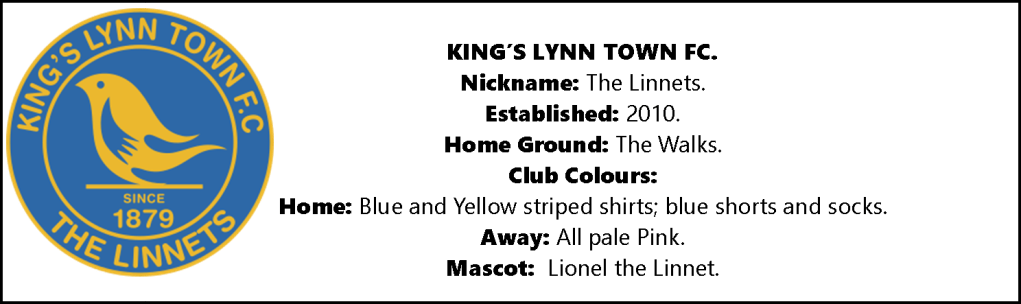
King’s Lynn Town is another Phoenix club which has arisen from the ashes of the original one. Plain old King’s Lynn FC went bust in 2009 with debts of £77,000 after being founded in 1879. Fans immediately set about forming a new club and initially called it Lynn Town. It was admitted to the Premier Division of the United Counties League and became runners’-up in its first two seasons. As a result, it was promoted to the Division One South of the Northern Premier League during 2012 and was immediately elevated again to the Premier League as Champions. Three years later, they were transferred to the equivalent division of the Southern League, where their geographical location – 216 miles south of Morecambe – tells us they should still belong. The geographical Musical Chairs continued in 2019 when a Play-Off success saw them placed where they are now – in the National League North.
The relative new club have never won any major trophies but Morecambe fans will be interested in the occasion when they came nearest to gaining promotion to the National League proper in 2024. The new Manager they had just appointed was taken-on to change the fortunes of a club whose trajectory was in a downwards direction and he took them to the Play Offs, where they lost 1-0 to Chorley in the quarter-finals with someone called Sam Walker the Captain of the team. This is what his Manager had to say of his own personal ambitions just two short years ago:
“I want to keep progressing and get better. I am not an ex-pro and not a household name, but honestly, a lot of big name former players have been given opportunities to manage in non-league and have not achieved half of what I have done in the game. I say that without arrogance but with belief as I know I am good at what I do. I am honest, humble, hard-working, and incredibly driven. I want to manage in the Football League one day. I believe the higher you go, the better the resources and the better the players, which helps you implement your ideas even more.”
Who was this ambitious and confident young chap? It was none other than our current boss, Mr Adam Lakeland…
With Adam departed for Halifax, King’s Lynn stayed in the National League North by the skin of their teeth on goal difference alone last season in nineteenth position just above the Legion of the Doomed. Curzon Ashton had the same number of points but were relegated simply on this flimsiest of bases.
Players who have performed for both clubs include impressive Full-Back Zak Mills and goalkeeper Archie Mair.
Morecambe will encounter the new incarnation of the Norfolk club when they entertain the Linnets on Saturday, 21st November 2026, at 15:00hrs. They will make the long journey southwards on Saturday 30th January for a kick-off at the Walks at 15:00hrs.
Tomorrow, we continue our exploration of the National League North by looking at our old pals Macclesfield.

