Morecambe National League North 2026-27. A quick Guide to the Opposition. Part Three.
I once wrote an article about Macclesfield Town for the D3D4 website when they were formally expelled from the National League during 2020 with debts of over half a million pounds: Farewell to Macclesfield Town – you will be missed. This is part of it:
“I first came across the Silkmen in 1968. Then, the first attempt by football clubs which existed between Birmingham and the Scottish border to challenge the monopoly run by the Football League from its offices in Lytham St Annes had begun. The cream of the Lancashire Combination; Cheshire County League (including the north Wales club Bangor City); North Regional League (from the north-east of the country); Midland (which included, strangely enough, Scarborough) and West Midland League came together to create a new Northern Premier League. Morecambe were among the five teams from the Lancashire Combination to inaugurate the new competition. They did reasonably well too – ending-up third in the table. But the truly outstanding clubs in this new league were the two which ended-up above them: Wigan Athletic and Champions Macclesfield Town. Morecambe ended-up on 46 points; Wigan on 48. But Macclesfield led the way with a truly spectacular sixty. Both Wigan and Macc were better clubs both on and off the field than many in the Football League at the time and it remains a scandal that the organisation now known as the EFL deliberately kept teams like these out of their own closed shop year after dreary year until as recently as 1987.
I can remember as if it was yesterday sitting in my bedroom with my ear shoved-up against an old Three Band valve radio (Short; Medium and Long Waves with exotic places like Copenhagen, Hilversum and Prague marked on the dial) listening out for the non-league football results early one particular Saturday evening in what I think was the second season of the NPL. My own club – Morecambe – had travelled to Moss Rose to face Mighty Macc on their own patch – and my hopes were high. John Morrell – remember him? – was going to give a summary of the match once the result had been broadcast. But I don’t remember a word he said as his voice went in and out of the ether on Medium Wave. Because I was still in shock after hearing the score: Macclesfield Town six; Morecambe nil.
Nobody beat the Shrimps by a margin like that – it was unheard of. But Macclesfield were a club which would have beaten most teams in the hermetically-sealed Divisions Three and Four of the Football League way back then – given the chance. But back in the day, that chance still lay years away into the future.
And so we move on to 1995, when the great Sammy McIlroy led the Silkmen to the top of the Football Conference and promotion to the hallowed ground of the Football League itself – at long last. But guess what? The League still wouldn’t let them in. Moss Rose wasn’t up to Football League standards. Well – you might say – rules are rules and other teams such as Stevenage and Kidderminster Harriers also failed to reach the Promised Land on the same criterion. Very True. But if the Moss Rose wasn’t up to scratch, how come the Football League had sanctioned Chester City to play all their Division Four matches there five years earlier because their new Deva stadium wasn’t ready for use? Arsenal memorably played City in a League Cup tie at the Moss Rose in September 1990, for example. So how does that work? The answer is that it doesn’t: it stinks – but elitism, cronyism and the whiff of corruption have always been hallmarks of the EFL.”
I went on to comment on the shady dealings by Macclesfield’s extremely dodgy Chairman – Amar Alkadhi – which had basically caused all the problems the Sikmen were beset with at the time:
“The problem, it seems to me, is that the EFL has an unwritten Mantra and it’s this:
“We don’t have the ability – or perhaps even any interest – in implementing our own rules against individuals upon whose behaviour the ultimate success or failure of all the clubs supposedly under our control depends. Instead, it is more expedient – and far easier from our point of view – to apply sanctions to the clubs themselves rather than regulate the nefarious activities of their owners. Regulating the nefarious activities of their owners requires a certain amount of both intelligence and integrity. We pride ourselves that both intelligence and integrity are features which are completely absent in our organisation.”
Is this an exaggeration? An unfair sweeping statement? I think not.
Macclesfield Town were relegated from League Two – having finally made it there, second time of asking under the leadership of Sammy McIlroy during 1997 – in 2012. They got back again during 2018 and most football fans would salute the way in which Sol Campbell took them from a disastrous position at the bottom of the EFL to safety on the last day of the season just over a year ago. But already, the financial vultures were gathering around the bleached bones of the Cheshire club. The fans’ response to this was to set-up the Silkmen Supporters Trust, blaming the mis-management of the then Chairman for the woeful state of the club’s finances and its repeated failure to pay staff and players alike. Tellingly, it made the following statement about the role of the EFL in the unfolding tragedy at the club:
“We don’t understand their apparent impotence when facing a similar scenario to that that has stricken other north-west football clubs including Blackpool, Bolton and Bury and still they do not appear to want to or be able to act against seemingly irresponsible owners of football clubs in a timely or efficient manner.”
The EFL officially responded with this statement:
“The League has been working with the club, ensuring players and staff were paid utilising centralised payments, while also taking the appropriate action in accordance with its regulations. The club is set to appear before a disciplinary hearing later this month to answer charges of failing to pay its players when required and we will continue to operate this dual approach as we seek to find a long-term sustainable solution for Macclesfield Town.”
In due course, the EFL predictably indulged their Manta once more – the bit that says: it is more expedient – and far easier from our point of view – to apply sanctions to the clubs themselves rather than regulate the nefarious activities of their owners. The EFL never seriously considered a `long-term sustainable solution for Macclesfield Town’. Instead – and all too predictably – it punished the club with a sanction which effectively meant that it would not have a long-term future at all. It deducted points from the Silkmen, waiting until the season had been finished by the Coronavirus crisis to inflict the final, fatal blow. A further points deduction saw the club fall to the bottom of the EFL and then through the trapdoor into the National League. Two weeks ago, as the EFL, the Professional Footballers Association and the National League itself did absolutely nothing to intervene, HMRC cut off its own nose to spite its face. If Macclesfield wasn’t in a position to pay it any back-tax, their brilliant solution was to make sure that the club was placed in a position where it wouldn’t be able to trade anymore and by doing so, potentially tackle this problem. Macclesfield Town was thus wound-up as a business and yesterday faced oblivion when they were unceremoniously kicked out of the National League as well.”
It’s ironic that our own club was to follow a very similar fate as a rogue Chairman who the EFL had sanctioned as a `right and proper person’ even after he had personally overseen the destruction of Premiership Rugby Union Club Worcester Warriors.
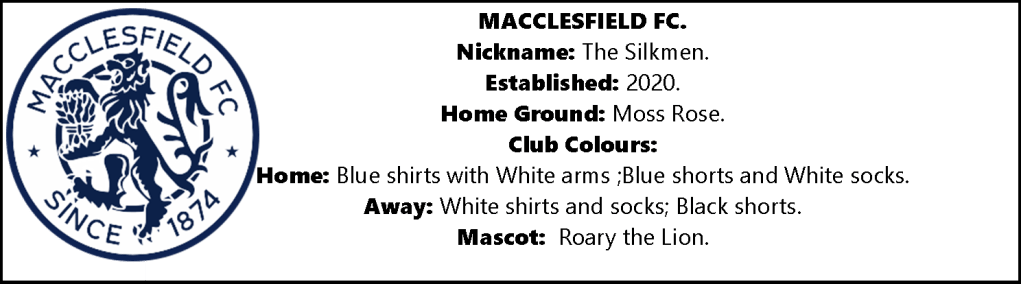
In reality, though, Macc’s fate was even more brutal than ours. They are yet another club which has had to start all over again right at the bottom of the English football pyramid. Under the management of Robbie Savage and others, they have fought back from the North West Counties League to the National League North and even got as far as the semi-final of the FA Trophy, which the original incarnation of the club won the first time this was possible in 1970 and again during 1996.
Last season, Macclesfield finished fourth in the table but were beaten by ultimate winners Kidderminster Harriers 3-1 in the semi-finals of the Play-Offs.
Morecambe and the Silkmen in their original guise have met loads of times in the past in the Northern Premier League and League Two. The game at Moss Rose on Tuesday 24th November at 19:45hrs will be the first-ever meeting between the new-look Macc and Morecambe. Our home game against the Silkmen will take place on Tuesday 26th January 2027 with a kick-off at 19:45hrs.


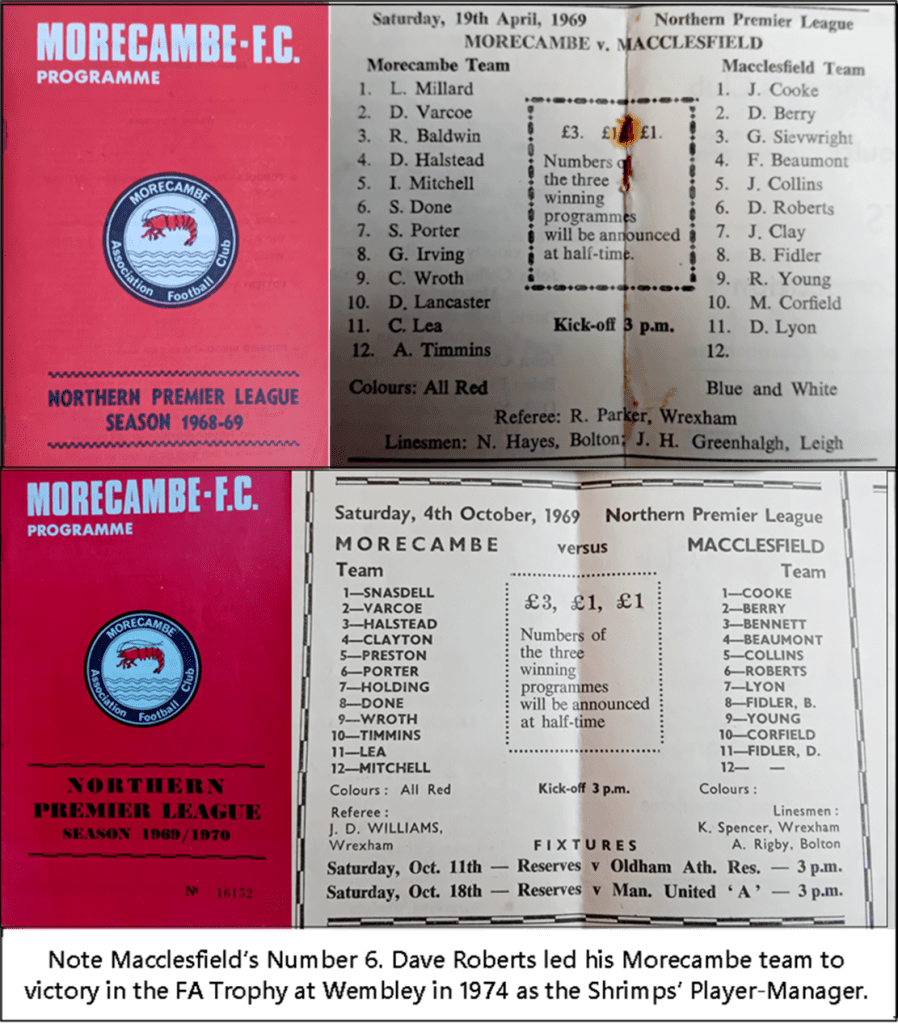
Apart from the overlap between legendary Managers Sammy Mac and Dave Roberts, a lot of other people have performed for both clubs. Among the current crop of Shrimps players, Paul Lewis and Elijah Buckley-Ricketts have turned-out for both sides. Elijah has taken a leading place in the new club’s history book by scoring the only goal which dumped Premier League Crystal Palace out of the FA Cup last season: Wow!
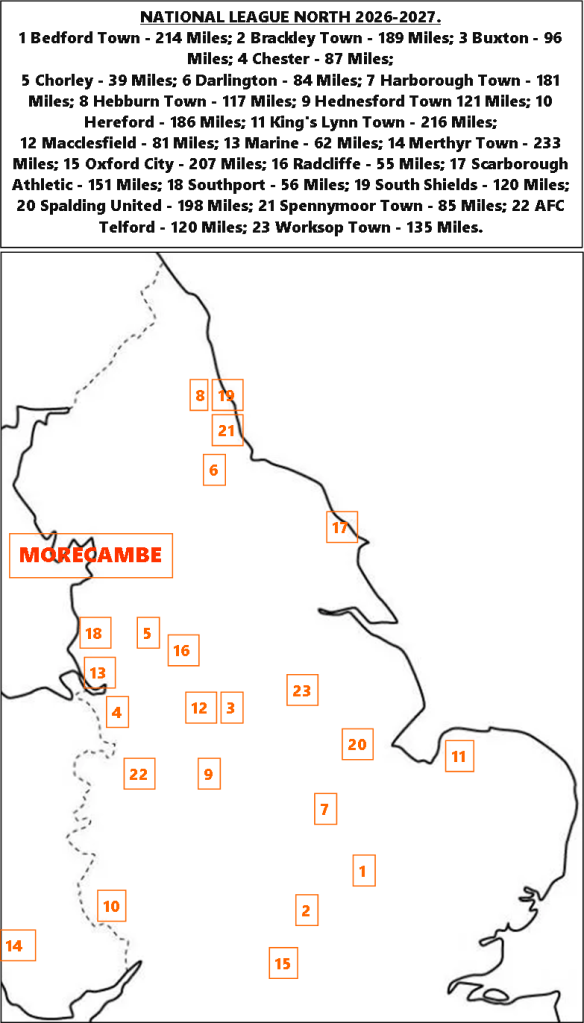
Morecambe FC owes a massive debt of gratitude to a club to be found in Crosby, 62 miles away to the south. This is Marine FC. In 1995, the club from Merseyside won the Northern Premier League and, with it, a place in the National League’s fore-runner, the Football Conference. But they were denied entry because their home ground wasn’t up to the standard required for Conference clubs. Morecambe’s Christie Park was – and, as Runners-Up, the Shrimps took Marine’s place to begin a roller-coaster ride which saw them in League One just five short years ago.
Marine’s official club website tells us:
“The club was formed in 1894 by a group of local businessmen and former college students, taking its name from the Marine Hotel close to the River Mersey sea front at Waterloo, seven miles to the north of Liverpool, where the founders met. They moved to their present ground The Marine Travel Arena (formerly known as Rossett Park) in 1903.
Marine quickly made an impression on local football, winning numerous titles in the I Zingari League and the Liverpool Combination. Their greatest success as an amateur team in this period culminated in an FA Amateur Cup Final appearance in 1931/32, when they lost 7–1 to Dulwich Hamlet in front of a 22,000 crowd at West Ham United. In 1946 they went close again by reaching the semi-final. In 1935/36 they moved to the all-professional Lancashire Combination and enjoyed limited success before moving to the Cheshire County League in 1969/70. In 1972 Roly Howard was appointed first team manager and completed 1,975 competitive games over a 33 year period before retiring at the end of the 2004/05 season. He was recognised by the Guinness Book of Records as the longest serving manager in world football as Marine enjoyed its most successful period winning some 30 trophies.
The Club relinquished its amateur status and became professional in 1974. Three Cheshire League Championships were won in five seasons before progressing to the Northern Premier League in 1979/80. They have twice been Champions (1993/94 and 1994/95) as well as twice being runners-up and have won the League Cup on four occasions (1984/85, 1991/92, 2002/03 and 2015/16) which is a league record.”
Wikipedia adds:
“In 1999, the magazine FourFourTwo included a monthly feature on the club, sending Michael Hann to follow them for an entire season. In 2001, Marine were the subject of a six-part television series for Granada TV, titled Marine Lives. The series included footage of former player Jason McAteer returning to visit the club.”
The club suffered its first-ever relegation in 2019 – dropping from the Northern Premier’s top division – which they had inhabited for forty years consecutively – to the First Division. In 2021, they raised £300,000 after an FA Cup tie against Tottenham was broadcast live from their ground, which was devoid of spectators due to the Covid pandemic. The money was spent wisely and, just a year later, they were back in the top division of the Northern Premier League but didn’t stay long this time. Two years ago, they finally won promotion upwards with a 1-2 away win at Macclesfield in the Play-Off final to enter the National League North. Last season, Marine finished in twelfth place.
Morecambe have met Marine countless times in the Northern Premier League and other competitions in the past. Here’s an example:

The last time they met was when Derek Adams’ men faced Marine in a friendly at Rossall Park a year ago at a time when the very future of the Shrimps was in doubt. The game ended in a 2-2 draw.
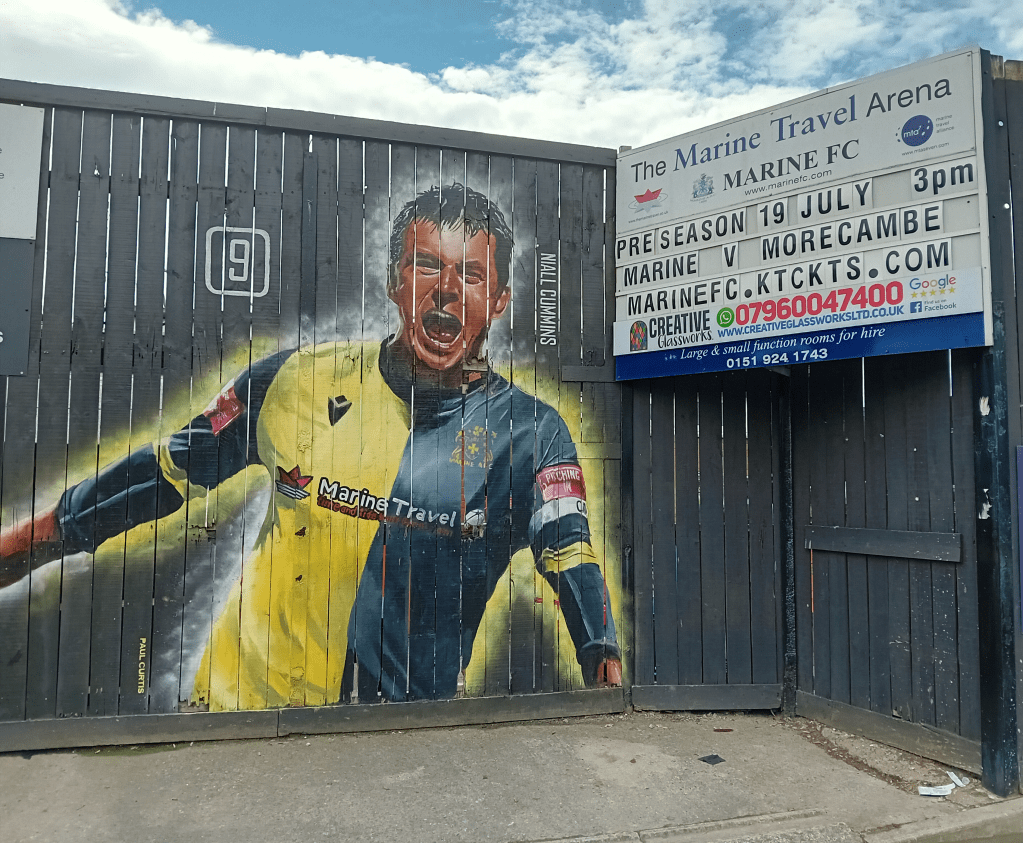
They will meet again on Monday 28th December 2026 at 15:00hrs at the Halo. The reverse fixture will take place on Good Friday 26th March 2027 at 15:00hrs.
Players who have been employed by both clubs include John Coleman, Dean Willard, Freddie Price and Ash Hunter.
Merthyr Tydfil is a town in the south Wales valleys to be found 233 miles south from Morecambe. It is famous for several iconically Welsh things such as coal; steel and slag heaps – the infamous Aberfan (where 144 people including 116 children died as a saturated spoil heap collapsed and engulfed the school there during 1966) shares the same valley and is just five miles away. Merthyr also has a perhaps unexpected claim to fame. The BBC tells us:
“Men from Merthyr Tydfil, including ex steelworkers desperate for cash during the town’s industrial decline, went to a local research centre to volunteer as medical guinea pigs. Little did they know the trial they were agreeing to take part in helped change the world.
At the start of the 1990s, drug company Pfizer was testing a compound called Sildenafil UK-92,480 in an effort to treat high blood pressure and angina. It contracted medical studies out of a research house in Merthyr Tydfil and recruited local young men to test it.
Idris Price was one of the men who signed up to test the new drug in 1992. At the time he was going from job to job having been laid off in the local steelworks.
“If I was short of money, I’d go down this place called Simbec,” Idris said. “The money from the trial was very important to my family as we had nothing in those days. It allowed us to get in extra food and instead of having two bags of coal for the fire, we had five. It was actually a doddle, easy money which came in handy.”
But when the trial was over, unforeseen side effects from the drug proved the “lightbulb moment” for Pfizer.
“Volunteers started coming forward and saying ‘it’s a little embarrassing, but I’ve noticed I’m getting more erections than usual – and the erections are a lot harder than usual’,” said Dr Pete Ellis, Pfzier’s former discovery and development lead.
Sildenafil UK-92,480 was marketed as `Viagra’ It hit the shelves in the USA and UK in 1998 as the first approved oral treatment for erectile dysfunction in a blaze of publicity and quickly became the fastest selling drug in history with annual sales peaking in 2008 of almost $2bn.”
Traditionally, Wales has been considered to be a Rugby (Union) playing nation. That has changed in recent years with the relative success of the country’s soccer team and Merthyr Tydfil has its own club in the shape of Merthyr Town. It started life in 1908 and – along with Cardiff City; Newport County and Swansea Town – played in the English Southern League, Second Division. During 1920, the club became a member of the English Football League by default as all members of the Southern League became the new Third Division as northern English clubs were uninvited and completely overlooked. In its new, exalted surroundings, Town struggled right from the off. Having repeatedly come bottom of the table, the club failed to be re-elected in 1930 and then failed altogether in 1934, when it went bust.
It started life again after the Second World War in 1945 as Merthyr Tydfil FC. They became members of the Welsh League and soon found themselves back in the English Southern League all over again. The new club was initially really successful, winning the Championship repeatedly as well as several Cup competitions. In 1987, following another Welsh Cup success, they played one game in the European Cup-Winners Cup, losing narrowly to Italian team Atalanta. Two years later, their sixth Southern League Championship saw them promoted to the Football Conference. They lasted six years before relegation back to where they had come from. But once again, the Martyrs went bust.
They started all over again a year later in the Western League without a ground of their own but moved to Penydarren Park in time for the 2010-11 season. They were promoted once again back to the Southern League in 2012 and finally won it once more in 2025. Their reward was promotion to the National League North. Last season, the club finished eighth in the league.
Merthyr Tydfil is not just a place name. In Welsh, it actually means something. Merthyr is synonymous with `Martyr’; Tydfil is a woman’s name. This particular woman was Tydfil, the daughter of Christian Welsh King Brychan Brycheiniog. (Whether or not he was related to the more famous Noggin, I really cannot say.) The unfortunate woman was murdered by pagans quite some time ago (480AD) and was elevated to the Sainthood for her (literal) pains. You don’t mess with those Druids, Boyo (even though Druids are strictly non-violent by nature and Welsh people’s use of the term `Boyo’ is limited solely to irony – or the English imagination.) But that’s why the club’s nickname is `The Martyrs’.
Morecambe will be making the long journey to Penydarren Park on Saturday 24th October 2026 at 15:00hr s. They will then entertain the Martyrs on Saturday 20th February 2027. Kick-off at 15:00hrs.
Apart from Oxo Cubes, what is Oxford famous for? Oxford Blues who apparently like rowing. Oxford Bags – or trousers for posh boys. The classic Morris Oxford car of days gone by. And Philby, Burgess, MacLean, Blunt and the lesser-known John Cairncross, all very posh boys from St Antony’s College who admitted spying on behalf of the Soviet Union during the 1960s. The treachery of Sir Anthony Blunt and Cairncross’ was hushed-up for years by their pals in the British Establishment because they remained basically Jolly Spiffing Chaps. Even though Burgess and Blunt – very ironically the Surveyor of the Queen’s Pictures – were blatantly gay at a time homosexuality was a crime in Britain and many less well- connected men in particular were in prison for this reason at the time. But other more `ordinary’ people have been hanged for a lot less than what the so-called Oxford Five got up to on behalf of Uncle Joe Stalin. These splendid fellows probably played rugger too: a proper toffs’ game, unlike Common As Muck `soccer’. But the City of Oxford – perhaps surprisingly – supports two relatively senior soccer clubs, only one of which plays in a Blue strip.
Oxford City can be found in the leafy green suburb of Marston, north east of the famous `dreaming spires’ of the University city and 207 miles south east of Morecambe. It is one of the oldest football clubs in England and predates the upstarts United (whose Kassam Stadium can be found about equi-distant from the town centre to the south east) by nine whole years, being founded in 1882. Initially, it played on Brasenose College land at the Whitehouse Ground with St Matthew’s Church on one side of it and the White House pub on the other. The club was evicted by the College which owned its ground during 1988 in a quite acrimonious dispute which led to it having to resign from the Isthmian League and then the actual demise of Oxford City altogether for a couple of years. The site of the original ground has been built over and is now known as Hodges Court in honour ofthe scorer of the first goal in City’s FA Amateur Cup success of 1906.
Not a lot had happened since their inception until City won this prestigious trophy. The club joined the leading southern amateur Isthmian League in 1907. They then found themselves increasingly playing in the shadow of Headington United – which morphed into Oxford United during 1960. In order partly to try and compete with their increasingly more illustrious neighbours, City abandoned its amateur status in 1949. Thirty years later, it became a Limited Company and it is a little-known fact that England World-Cup winning Captain Bobby Moore was the Manager of the club between 1979 and 1981: his first purely managerial job. He was paid a quite staggering £14,000 salary plus a £5k signing-on fee, in itself the cost of a really decent house in Morecambe at the time. His assistant was former West Ham team-mate, Harry Redknapp who later had something to do with the England team as well, I believe. At that time, City were still based at the by now quite ramshackle Whitehouse Ground. The experiment with the former England Skipper wasn’t a success and City were relegated at the end of his first season in charge. He left after the second one.
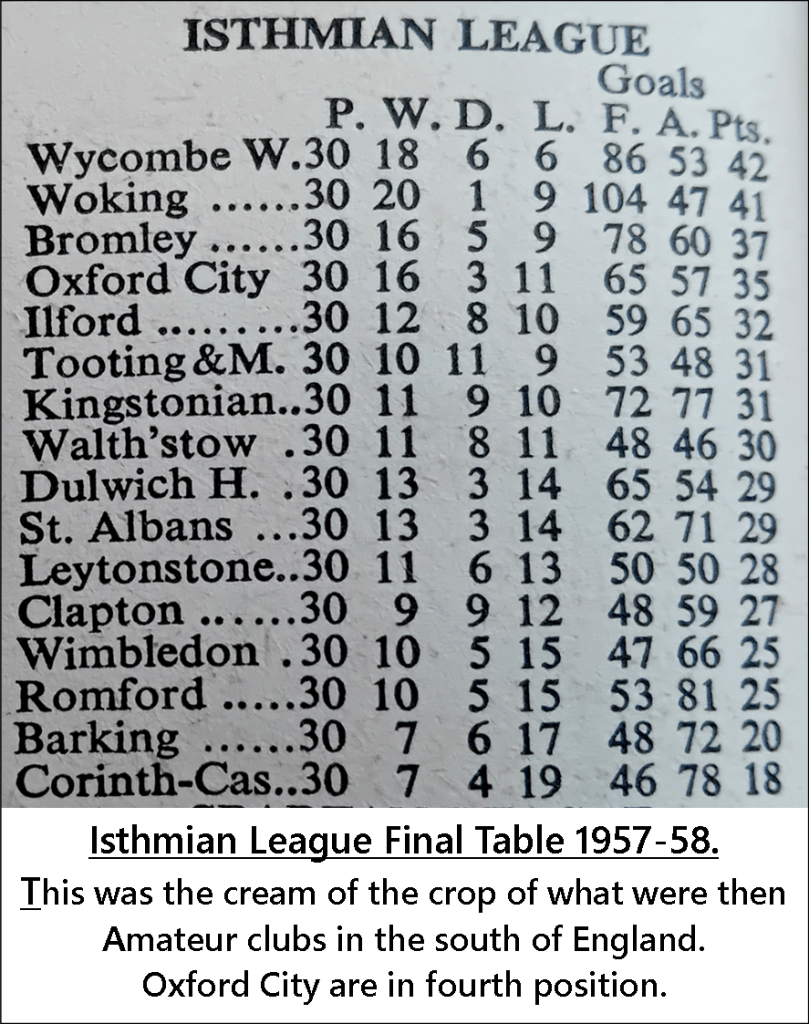
Nothing much happened then until City were evicted from their long-term home in 1988. Rivals United had been in and out of the EFL and then back in again by this time and the Hoops had become very much The Poor Relations. But the rump of its loyal fan base started to organise and a new incarnation of the club was created to join the South Midlands League Division One during 1990, playing at a venue called Cutteslowe Park. City won the new competition first time of asking and by 1993 had re-located to current stadium Court Place Farm (also known as Marsh Lane) in 1993, when they also re-joined the Isthmian League. 2005 saw them relegated again for a single season but by 2007, they were members of the Southern League First Division and a year later had won their way into the Premier Division of this competition. At the end of the 2011-12 season, they defeated AFC Totton in the Play-Off Final to win their place in the Conference North – the highest position in the English football pyramid that the club had achieved at that point. They were saved from relegation when Vauxhall Motors resigned from the Football Conference in March 2014. When the Conference was subsequently re-branded the National League, Oxford found themselves in the initial Southern version of the renamed lower divisions. They won their way into the National League proper via the Play-Offs at the end of the 2023-24 season but were immediately relegated again and placed in the National League North as the Musical Chairs concerning regions and availability continued. Last season, they ended-up seventeenth.
Morecambe have never played Oxford City in any competition and their game on Saturday 26th September 2026 at 15:00hrs at Court Place Farm will be their first ever meeting. Their second in the league will be in Lancashire on Saturday, 23rd January 2027, at 15:00 hrs.
Not many players have been employed by both clubs but Ludwig Francilette is an exception.
Oh – and Oxo Cubes were not really invented in Oxford – I told a Big Lie when I claimed that. They are a German import and were created by the chemist Baron Justus von Big Lie – sorry – Liebig – during 1910…

Radcliffe is a small former industrial town in Greater Manchester which can be found 55 miles south of Morecambe. Wikipedia tells us this about the creation of the original club, Radcliffe Borough:
“The club was formed on 24 May 1949 at the Owd Tower Inn in Radcliffe by Jack Pickford and a committee of 17 and became a member of the South East Lancashire Football League. It had two players (Tommy Entwistle and Bert Nutter), £1.2s.6d (£1.12½p) in the bank, and no ground, but arranged to lease a field off Ashworth Street for two years. In 1951–52 the club moved across Eton Hill Road to a pitch on Betley Street leased from the Earl of Wilton. The following year the club turned the pitch 180 degrees parallel with Bright Street which became the name of the ground.”
The Earl of Winton isn’t a pub, I hasten to add – it’s a person. During the 1950s the club changed allegiance to the Manchester League before joining the Lancashire Combination in time for the 1963-64 season. They lost their home ground when the Earl decided to sell-up in 1966 and found themselves playing at a venue owned by the long-defunct Manchester Corporation Transport Department: the White Horse sports ground on Middleton Road. They then moved to Radcliffe’s current ground at Stainton Park, to which they were able to transfer the stands which still existed at Bright Street.
Just staying in the new league was a struggle for Boro until things started to improve in the late 1990s. They won the NPL in the 1996-97 season but their reward – promotion to the Conference North – lasted only one season. They continued to struggle and relegation and failure in relegation Play-Offs followed before new ownership saw improvements at the ground, including a new main stand and promotion from the Northern Premier League First Division – which they had slipped back down to into – to the main division during 2019. Having dropped the term `Borough’ from their title in 2018, Radcliffe finally won the competition again in 2023-24. Their reward was promotion to the National League North. Last season, they ended-up in lucky Thirteenth position.
The stupendous Jordan Slew and Alie Sesay are two players who have performed for both clubs.
The only previous meeting I can find between the clubs is when, Lawrence Bland and Derek Quinn tell me, they played in the Lancashire Junior Cup First Round at Christie Park on 20th January, 1968 in front of 1100 spectators. The Shrimps won 2-1.
They will meet again when Morecambe travel to Stainton Park on Saturday 22nd August 2026 for a 15:00hrs kick-off. The Boro will then travel to the Halo on Saturday 6th March 2027: kick-off at 15:00hrs.
Tomorrow is time for another episode of the
Sensational Shrimpleton Saga – don’t miss it.
We start our look at fellow National League North clubs again on Friday with a look at Scarborough Athletic…

