Morecambe National League North 2026-27. A quick Guide to the Opposition. Part Four.
Morecambe and Scarborough have a lot in common – slightly faded seaside resorts to which Working Class people from all over England and the larger Scottish cities used to flock in the past. Then flights to exotic places such as Benidorm and Tenerife became affordable to the general public back in the 1960s and 1970s. As a result, people stopped visiting in large numbers and both towns fell into a steady decline for the next few decades. Scarborough, though, is considerably bigger than Morecambe – about 62,000 people in the town and nearly 100,000 in the parliamentary constituency as opposed to just 35.000 maximum in the town on the Irish Sea Coast. Scarborough also has a distinctly split personality: its two bays representing the way it has sustained itself over the years. South Bay is where the hotels, amusement arcades and other trappings of a traditional English seaside resort can be found. The now virtually defunct but once thriving fishing fleet and the communities which once manned these boats clustered around the far less gaudy North Bay.
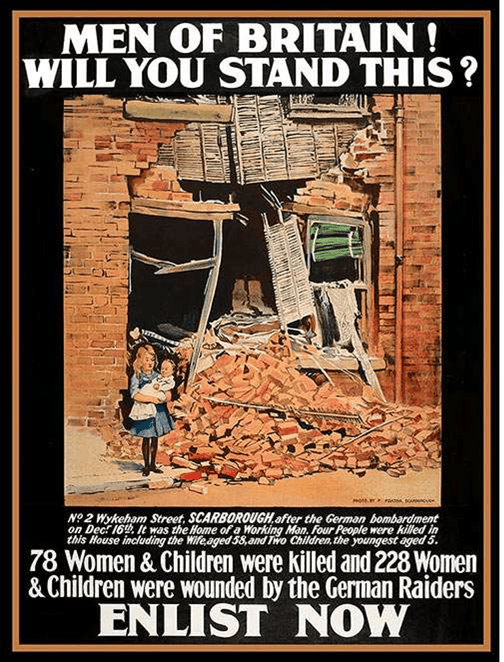
Overlooking what was once known as The German Ocean, Scarborough has also played a historically significant part in resisting raiders and invaders from Scandinavia and greater Germany. The ruined Twelfth Century castle sits atop a cliff which has been – at various times in the past – an Iron Age settlement; a Roman Signals Station and then a Watchtower against Viking raids. During the First World War, seventeen Scarborians died as three of Kaiser Bill’s battle fleet deliberately targeted residential areas of the town and bombarded it on December 16th 1914. It caused absolute outrage at the time: wars were supposed to be fought between armies or navies; not against defenceless civilians.
But one other thing the two towns share concerns their football clubs. J.B. Christie gave our club a piece of land at Roseberry Park – later renamed Christie Park in his honour – where a Covenant stated that it could only be used for sporting purposes in perpetuity. That obviously worked really well although I’m not sure `Shopping at Sainsbury’s’ was one of the activities recently featured at the Commonwealth Games. A similar Covenant also covered Scarborough’s Athletic Ground, where the original Scarborough FC (founded 1879) once played. In time, it became the McCain Stadium. The site is now occupied by a rival supermarket to Sainsbury’s in the shape of Lidl. (So maybe Competitive Shopping is a genuine `sporting activity’ after all…)
When Morecambe moved from Christie Park to its new ground, the local Council did not intervene. But at Scarborough, the traditionally Conservative Council apparently felt a civic responsibility to uphold the Covenant on the Athletic stadium. So when the original cub lined-up a deal with a property developer to sell the ground for sufficient money to wipe out its own debts (reputedly about two and a half million pounds at the time) and secure enough spare cash to build a new stadium elsewhere, the elected representatives of the local people stepped in. And one of England’s oldest football clubs went bust. Scarborough FC was founded in 1879 but simply disappeared in 2007.
Whatever the Council’s intentions actually were at the time, the repercussions for the club – and therefore the town itself – were dire. The stadium became derelict. Arsonists targeted the decaying stands after two of them were sold and shipped to Rugby League Featherstone Rovers who – very ironically – are currently no longer with us either. The populace lost a Football League club – and had nobody else to support.
So who really benefited from the Council intervention?
I have no idea.
(Actually, I do: individual Councillors who wanted a slice of the action might have preferred to see the club disappear altogether rather than fail to make a profit out of its sorry state. But I can’t prove this very cynical thesis. If you can, please let me let me know…)
So at this point, we look at a depressingly familiar scenario as far as so many ex-EFL clubs are concerned.
Locals came together to plan and organise a new club. It started life as a member of the Northern Counties East League in 2007. It won this in 2009 to be promoted to the Premier Division and then went up again to the Northern Premier League First Division during 2013. Five years later, they were promoted again to the Premier Division of the NPL and – following the Covid pandemic – went up to where they are now – the National League North – in 2022. So life has gradually got better and better for the latest iteration of Scarborough. Last season, they ended-up sixth in the table. They then fell at the first hurdle in the Play-Offs when they were beaten 4-2 by Buxton.
Richie Bennett is the only player Iam aware of who has played for both clubs.
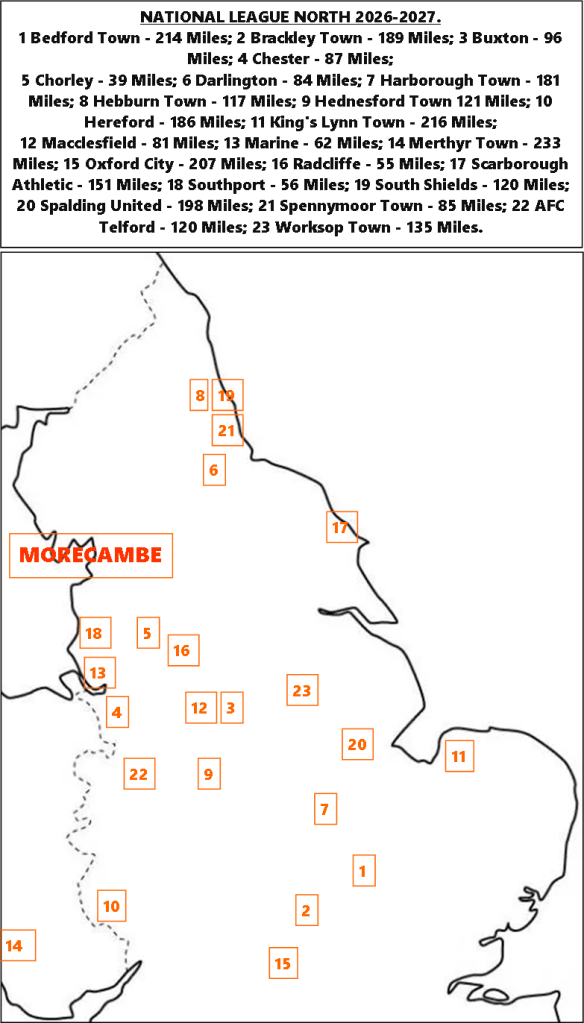
Morecambe will host Athletic on Saturday 31st October 2026 at 15:00hrs. The Shrimps will then travel 151 miles to Scarborough on Saturday 13th February for a kick-off at 15:00hrs.
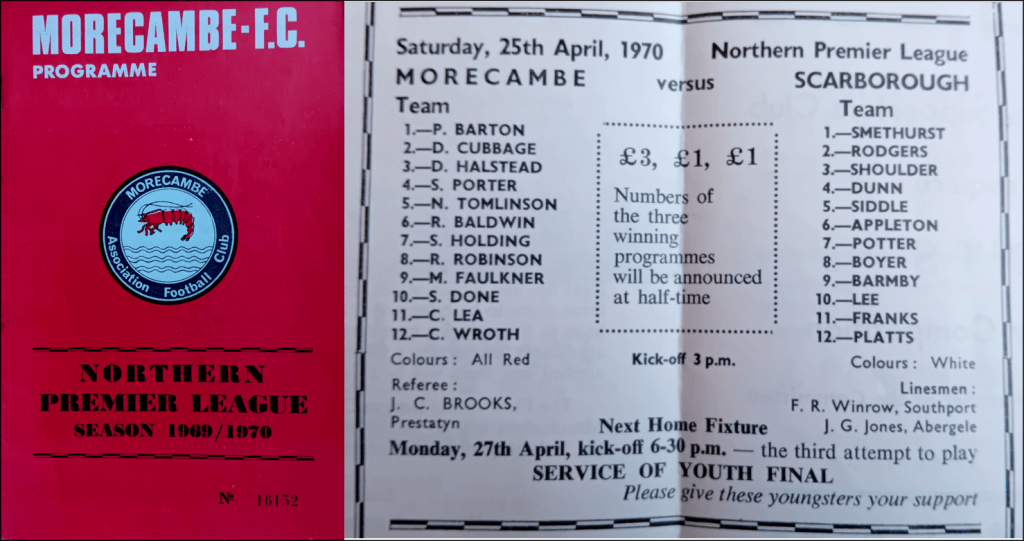
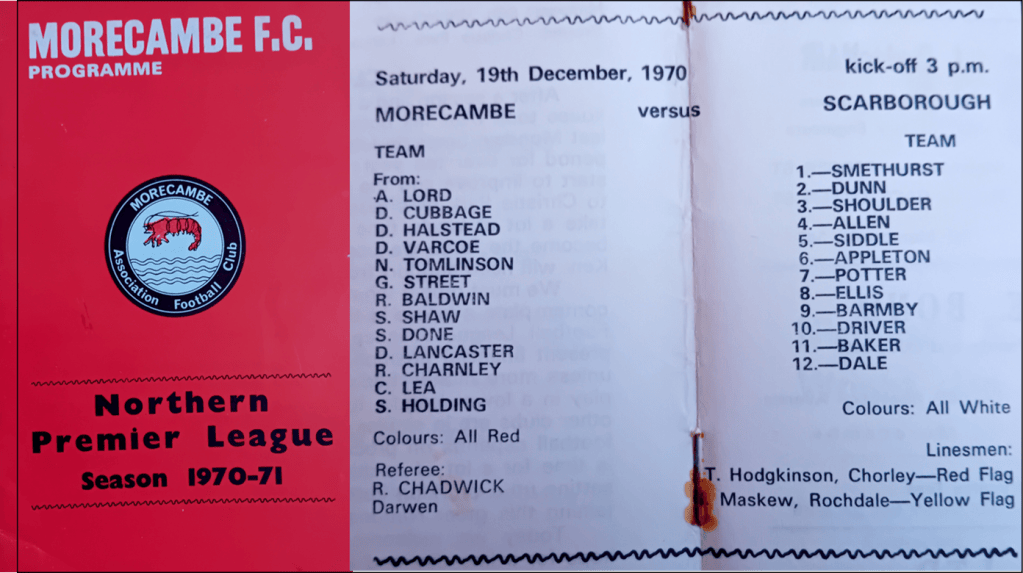
Here’s a reminder of happier times for the original Scarborough’s supporters:
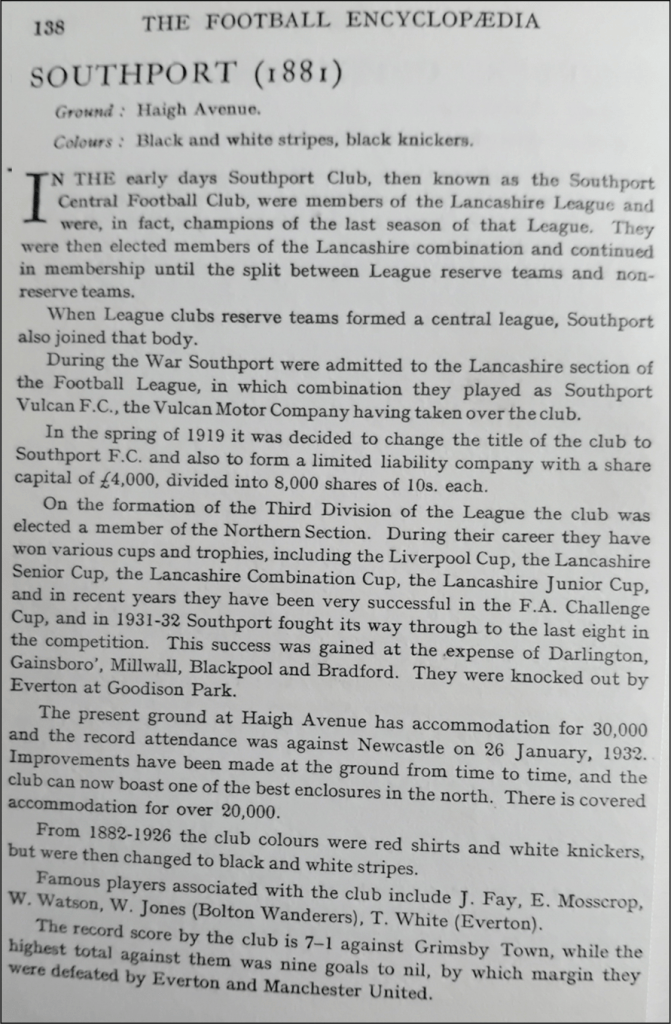
Let’s cast our minds back the best part of a hundred years. If we had bought a very serious and rather scholarly book called The Football Encyclopaedia (subtitled A Historical and Statistical Review of the Game of Football since it became a National Sport) in 1934, we would have seen the following, complete with its arcane use of the word `knickers’:
Staying with this historical theme, this is the entry for Football League Third Division North Southport as published by the News Chronicle & Daily Dispatch Football Annual of 1957-58:
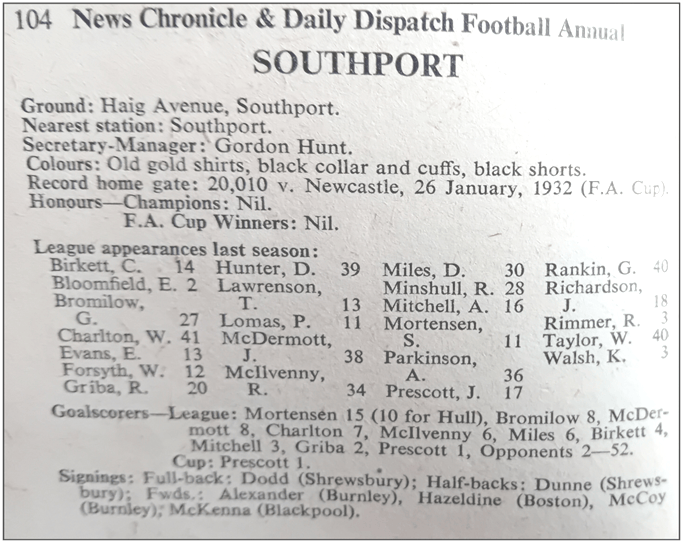
(And yes – that is Stan Mortensen; former Blackpool and England star who ended his career at Lancaster City, believe it or not.)
So how have things changed in the intervening years?
Some things have stayed the same: their home ground, for example. But a club founded as Southport Wanderers and then Southport Central’s most significant experience since these tomes were published was one their supporters would definitely prefer to forget. Southport remains one of virtually a handful of Football League clubs which failed to be re-elected by their peers when that Fiefdom was a Closed Shop – which was for the entire Twentieth Century right up until 1987. In 1978, they had come next to bottom of the Fourth Division for the third year in a row. Pressure was increasing on the Football League dinosaurs in their Lytham Headquarters to allow in new blood and members of the Northern Premier League (which Southport were about to join) in particular were increasing the clamour for change. One of its better clubs in the shape of Wigan Athletic replaced them and whereas Wigan went on to win the FA Cup and reach the pinnacle of English Football as a member of the Premier League, Southport basically stagnated.
During 1998, the club reached the FA Trophy Final at Wembley but lost to Cheltenham Town by the only goal of the game in front of 10,000 supporters from Merseyside. By this time, they had been members of the Football Conference North for five years. In 2003, though, they slipped back into the Northern Premier League once more. Bouncing straight back into the re-named National League North, they won this at the first attempt and entered the uncharted waters of the National League. They returned to the full-time professional outfit they had been in the Football League at this time but were relegated again in 2007 and became part-time professionals once more. Since then, they struggled back to the National League in 2009 via the Play-Offs and have had significant ex-Shrimps players at the helm of the club in the shape of John Coleman and, latterly, Jim Bentley. Before Jim arrived at Haig Avenue, the Sandgrounders suffered yet another relegation in 2017 into the place they find themselves currently. Last season, Southport ended-up eighteenth of the twenty-four clubs which made up the National League North.
As well as Messrs Coleman and Bentley, many players have performed for both clubs. The outstanding one is Carl Baker but Jordan Slew and Kevin Ellison are just two examples of several others.
Morecambe will travel the 56 miles to Southport on Tuesday, 8th September 2026 at 19:45hrs. The return fixture at the Halo will be played on Tuesday, 23rd February 2027 at 19:45hrs.
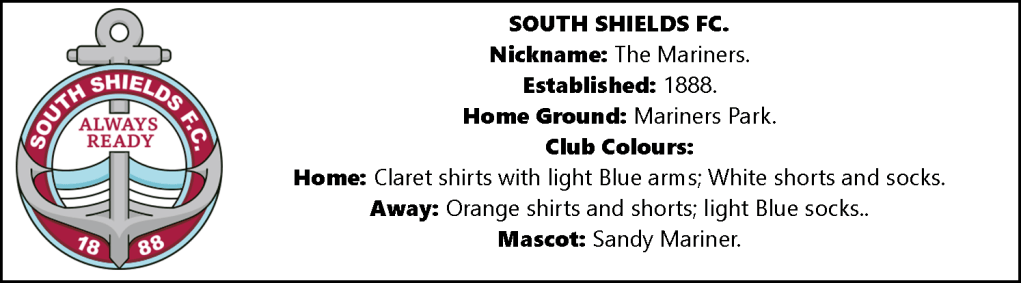
South Shields is a club with a quite extraordinary history. By rights, they should certainly be far higher up the football pyramid in England then they currently find themselves. Perhaps more importantly, they put local rivals Gateshead to utter shame: these doppelgangers have stolen the club’s identity not just once, but twice in the past.
There have been three incarnations of South Shields to date. The original one was founded in 1888 as South Shields Adelaide United. This club was created as a Boys Team initially and was centred on the long-disappeared Adelaide Terrace in the town, initially playing at a simple ground close to Hartington Terrace. The club grew steadily, however and was invited to join the Football League during 1919. Facing financial problems, this incarnation of the club migrated lock, stock and barrel to the town just to the west down the River Tyne and played as Gateshead until 1960, when it was – very unusually – booted out of the Closed Shop of the Football League to the advantage of Peterborough United. When the failed club folded altogether in 1973, the second iteration of South Shields was also imported from the town to be known henceforth as Gateshead United.
Undaunted, hardcore Mariners supporters set up a new, third, version of their club. Deprived of the large and impressive ground Simonside Park (25,000 capacity and with pylon floodlights from Sunderland’s Roker Park ) which had been gifted to the old club – it initially had nowhere to play.
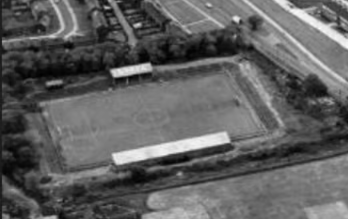
It settled on a Council-owned pitch at Jack Clark Park in the town. The new club joined the lowly Northern Alliance and, having won it in 1976 moved to the Wearside League and won this too – first time of asking – in1977. Plans to join the Northern League were constantly hampered by the club’s lack of a proper home ground though. They played as from 1992 on a ground owned by a cigarette filter manufacturing company – Filtrona – in Jarrow and have been there more or less ever since. They were exiled in 2013 after a dispute with the landlord and played at Eden Lane in Peterlee in front of a handful of fans but returned to the ground two years later as the owner of the time bought it. During 1995 they were finally promoted to the Second Division of the Northern League and were soon promoted to its First Division but only survived in it until 2000. They struggled after this and faced both a possible return to the Wearside League and being locked out of their own ground during 2006. New ownership saw the club rally once more though and fight its way back into the First Division of the Northern League. In 2017, they won the FA Vase at Wembley by beating Cleethorpes Town 4-0 in the final. Finally, in 2018, the Mariners were promoted to the Northern Premier League and were able to compete at exactly the same level as the club which became Gateshead United over forty years after South Shields Mark II had jumped ship from the town. The club became fully professional in 2021 and – with former Sunderland striker Kevin Phillips at the helm – won the NPL title in 2023 and was rewarded with promotion to where they are now: the National League North.
Last season, they finished second in the table with 95 points; a whole eight more than third club Kidderminster. Crucially – and arguably unfairly too – the Harriers then beat them on their own patch in the Play-Off Final by two goals to nil to pip them to promotion to the National League.
Footballers who have played for both South Shields and Morecambe include Lewis Alessandra and Adam Campbell.
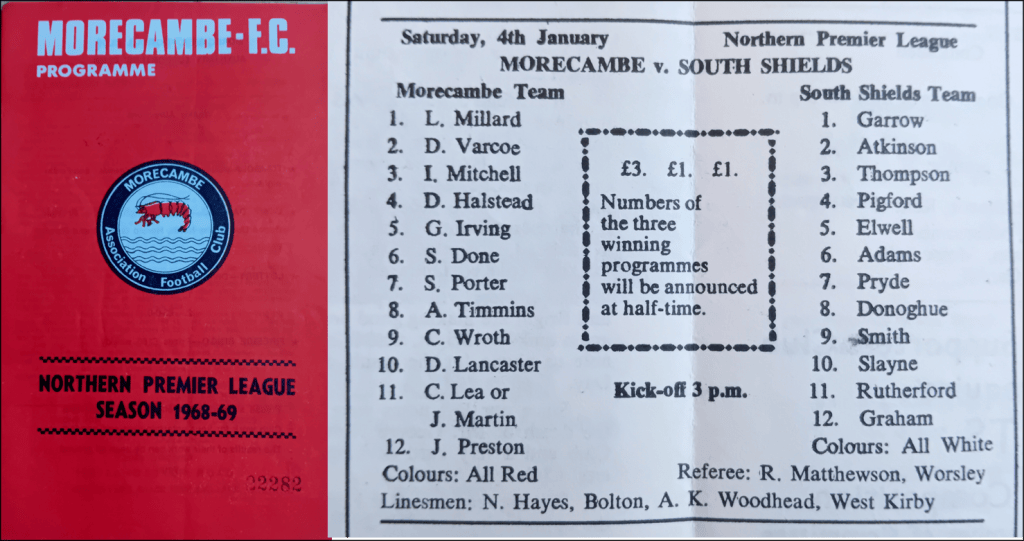
Morecambe have never played the latest version of South Shields but beat the second one 2-1 in an FA Cup tie at Christie Park way back in 1961. They have also encountered each other in the Northern Premier League:
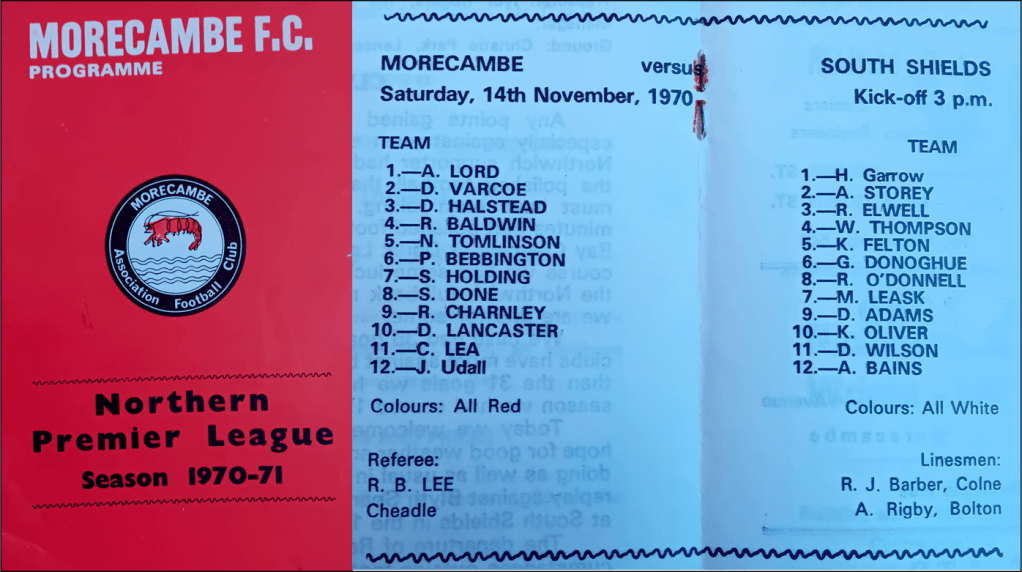
The Shrimps will travel the 120 miles to South Shields on Tuesday 18th August 2026 for a match which will start at 19:45hrs The return fixture will be at the Halo on Tuesday 9th March 2027 at 19:45hrs.
What’s the first thing that springs to mind when you hear the word `Spalding’?
For those of us of a certain vintage, it means sports gear – mostly tennis – as surely as Adidas, Wilson and Nike do these days. But don’t be fooled – Spalding was stuff conceived in Chicago and manufactured in the USA.
So if Spalding isn’t to be found anywhere near the southern Canadian border: where is it?
It can be found in rural Lincolnshire, 198 miles from Morecambe. Spalding is a market town of just over 30,000 population. This is what the town’s principal football team has to say of its own history:
“For decades it has been documented that Spalding United FC was formed in
1921, but recent research into club history has revealed that in fact, its existence goes back
much earlier!
A chance sighting of an early team photograph on social media prompted some Investigation and evidence gained shows that the club was formed back in 1905 following the amalgamation of the Fulney Institute and Victorias clubs was confirmed at a meeting in a local hostelry when it was decided that the name should be Spalding United FC.
A committee was formed and the home ground as to be the Low Grounds, but references were also made of games being played on Pinchbeck Road (Black Swan Field) which is now known as The Sir Halley Stewart Playing Field.
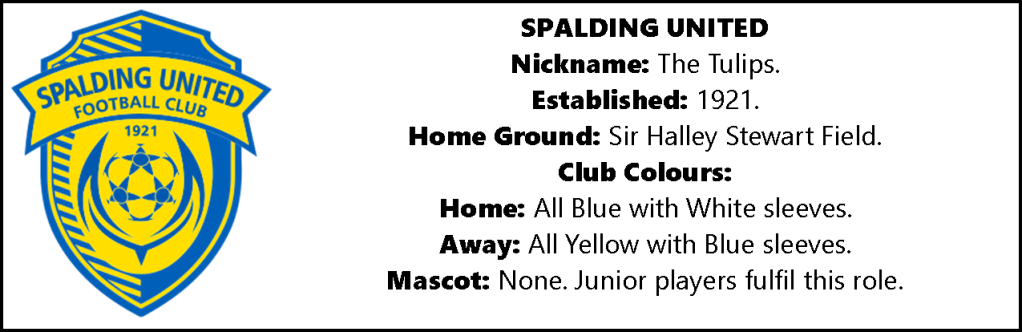
Spalding United were nicknamed ‘The Tulips’ because of the town’s association with the bulb growing industry. The club was formed in 1921 but the town did have football in the guise of Spalding Thursday and Spalding Town prior to that. They have always played at the same Sir Halley Stewart Playing Field venue, although it was originally known as the Black Swan Field.
In the early days the club played in the Spalding & District League but progressed to the Peterborough League. Their first honours came in 1933 when they won the Lincolnshire Junior Cup. The feat was repeated in 1938 and they progressed to senior level and won the Lincolnshire Senior B Cup in 1951. Further progress followed with success in the Lincolnshire Senior A Cup in 1953.”
Since the 1950s, the club has been a member of the United Counties League; Eastern Counties League; Midlands League and then the Southern League. It hasn’t been plain sailing and the club has suffered several relegations over the years. In 2004, they found themselves in the Northern Premier League for two seasons before new spells in the Southern League and then the United Counties League again. Ten years later, they were back in the Northern Premier League once more. Musical Chairs continued until last season, when they were Southern League Premier Division Central Runners-Up. United beat Real Bedford 4-2 in the Play-Off Final to earn the exalted position they hold now: the National League North.
The Shrimps have never played the Tulips in any competition. The two clubs will meet for the first time on Saturday, 28th November 2026 at15:00hrs in Lincolnshire. Spalding United will then travel to the Halo on Saturday 24th April 2027 for a late kick-off at 17:30hrs.
Spennymoor is a town in County Durham eighty-five miles north-east of Morecambe which was once synonymous with heavy industry. It can be found about eight miles south of the county town and has a population of about 20,000 people.
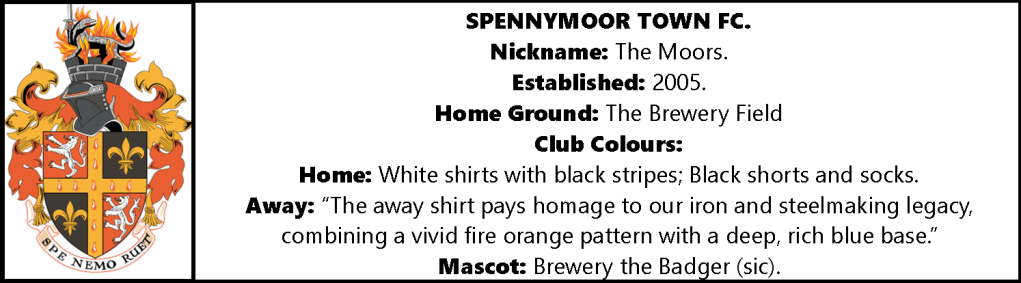
The latest incarnation of Spennymoor Town was founded in 2005 following the failure of our old friends from Northern Premier League days Spennymoor United – who had gone spectacularly bust earlier in the year. United were quite a force in non-league football back in the day when the north-east region in general was a productive industrial area producing coal and steel and all sorts of manufactured and chemical products. The regional Northern League there was one of the strongest of the one-time amateur leagues to be found anywhere in England.
The club was founded in 1904 as a result of the merger of the original Spennymoor Town and Weardale Ironopolis. Ironopolis briefly played in the Football League a long time ago but were the works team of the huge steelworks once to be found in Tudhoe, which can be found at the northernmost end of Spennymoor. It was here that Sir Henry Bessemer established his ground-breaking method of producing high-quality metal in the massive steelworks which took up masses of space in what had once been a rural village.
But the demise of so many regional industries since the 1970s has been reflected by the reverse in fortunes of the club. Spennymoor United were relegated for the first time in their then almost century-long history in the year 2000. Things got even worse when their uninsured Clubhouse was burnt to the ground in an inferno which it took five fire appliances to control on Christmas Day 2003. This immediately deprived the club of key income (c.£2,000 a week in lost takings even all that time ago) and proved to be its death-knell: deprived of the financial resources to complete the campaign, United were forced to resign from the Northern Premier League top division actually during the 2004-5 season with only 33 games completed.
Once they had gone bust, local rivals Evenwood Town put in a bid to take-over United’s suddenly defunct home ground. Evenwood is ten miles to the south west and what effectively became the merger of the two clubs did not go down well with many of its own supporters. They saw it as basically a Milton Keynes/Wimbledon takeover as their club and position in the Northern League was basically shifted lock, stock and barrel to The Brewery Field in the territory of a rival north-eastern tribe.
(Evenwood Town had started life in 1890 and had a distinct history all of its own which lives on with a shadow club that still plays at their old Welfare Ground in the Crook & District League, sharing its facilities with the Cricket Club which uses the same space. All the stands which could be found there have been demolished but their second-hand floodlights – ex-North Shields FC – incongruously still remain.)
The controversial `new’ Spennymoor Town club won the Northern League Division Two division in 2006–07. Spennymoor then won the Northern League’s top division no less than four times before finally joining the Northern Premier League in 2014. In the meantime, Town had won the FA Vase during 2012–13, beating Tunbridge Wells 2-1 at Wembley.
Spennymoor then won two automatic promotions via the play-offs to reach the National League North by 2017. Last season, the part-time professional club ended-up tenth in the table.
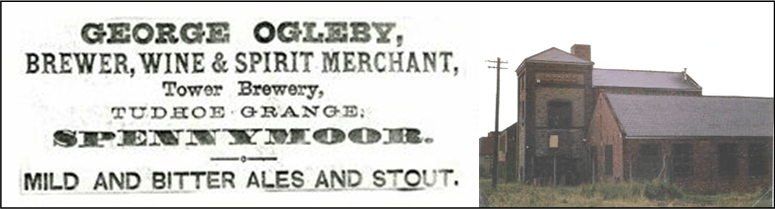
Now, seeing the name of the club’s ground – The Brewery Field – and its curious choice of a Mascot: Brewery the Badger, I put two and two together and got five. I assumed the Beer-making establishment referred to was the Badger Brewery. But that particular extant brewery can be found in Blandford Forum, Dorset. It turns out that the name of the ground refers to the long-defunct Tower Brewery in King Street in the Tudhoe Grange part of the town which would once cater for the thirsty workers from the swelteringly hot local steelworks.
Ironically, it was the very nature of that plant which led to the demise of the brewery: it used water from local wells which became so polluted by the industrial nature of Spennymoor in the middle of the Nineteenth Century that it was shut-down by the local authority as unfit to drink as long ago as 1877. It re-opened in 1883 when Scottish Brewer Patrick Bruce Junor arrived from Durham and found an uncontaminated remote water supply with which to produce his own range of beers. Junor’s had between 25and 50 tied houses, some of which still exist and the football club’s own community pub – the very smart Moors Tavern – is almost certainly one of them and probably the original Taphouse. The Brewery ceased production again in 1901 and was then used as a depot by a larger conglomerate of north-eastern breweries, including Vaux ofSunderland, which once owned the Brewery in Kendal before it was transformed into an arts centre. The Tower Brewery was demolished in 2003 after serving as a car repair bodyshop for many years and the only sign of it that remains is the Brewery Field which was once attached and on which Spennymoor Town still play.
Morecambe drew its first match of the new campaign 2-2 with Spennymoor at the Halo on Saturday, 8th August 2026. They will travel to County Durham for the reverse fixture on Tuesday 8th Dec, 19:45 kick-off.
Brian Healy is a player who has performed for both clubs: after three years at Spennymoor United in the 1990s, he played for the Shrimps before moving on to Torquay United, who were then in the EFL.
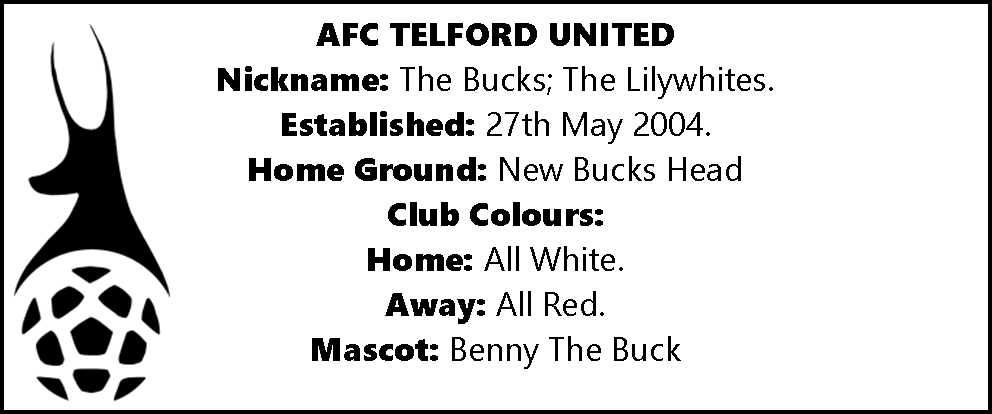
The Morecambe website tells us the following about the Bucks:
“They play their home matches at the New Bucks Head, a stadium capable of holding more than 6,000 supporters.
Telford enjoyed several seasons in the National League during the 2010s and lifted the Conference North title in 2013/14. After narrowly missing out on promotion in 2023/24, they secured a return to National League North last season through the Southern League Premier Central play-offs.
Managed by Kevin Wilkin, the Shropshire side are renowned for their passionate fanbase and strong home support, making trips to the New Bucks Head one of the division’s toughest assignments.”
Sounds a bit daunting, doesn’t it? Telford is actually a so-called `New Town` – like Skem; Kirkby or Harlow in the south – built to house former inhabitants of city `slums’. Its population multiplied rapidly as former villages such as Wellington and Oakengates were linked together by new housing schemes and concrete ring roads during the 1960s. Initially called Dawley New Town, it was re-named after famous engineer Thomas Telford in 1968.
The original club was founded as long ago as 1875. Five years later, it was known as Wellington Town. It became Telford United during 1969. The following year, they lost 2-0 to Macclesfield in the first ever FA Trophy Final but won it in 1971, beating Hillingdon Borough 3-2. They continued to be moderately successful and were members of the Football Conference when the club went bust with debts of four million pounds in 2004.
AFC Telford United immediately replaced the old club and started life in the Northern Premier League, Division One. They beat Kendal Town 2-1 in the Play-Off Final at the end of their first season as a new club and were rewarded with promotion to the NPL Premier Division. They left this for the then Conference North after again qualifying via the Play-Offs, where they finally defeated Witton Albion 3-1 in the Final. In 2010, they reached the promotion Final of this competition as well and were promoted to the Conference Premier after beating Guiseley by three goals to two. However, their upward trajectory came to an end in 2013 when they came bottom of the league and were relegated back to the Conference North. They bounced straight back only to be immediately relegated anew. They came bottom of the re-named National League North in 2023 and ended-up in the Premier Division Central of the Southern League. Once again, Telford worked its magic in a Play-Off Final and were promoted back to the National League North after beating Kettering 4-2 in 2025. Last season, they finished eleventh in the table.
By far the most famous player to have played for both Morecambe and Telford is Jim Bentley, who has also managed both clubs. Current Morecambe squad member Elliot Newby has also played for the Bucks in the past.
The clubs have met six times before in the past with them both winning three. Morecambe will entertain AFC Telford United on Friday 28th August 2026 at 19:45hrs. They will then travel the 120 miles to Telford on Saturday 27th February at 15:00hrs.
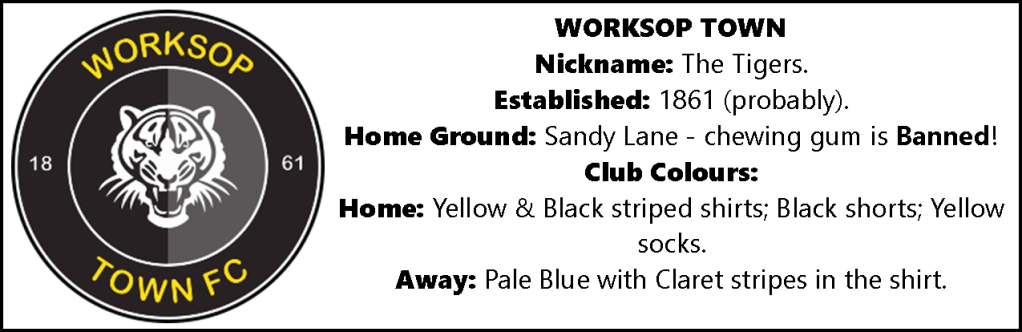
Worksop Town claim to be `the fourth oldest football club in the world’.
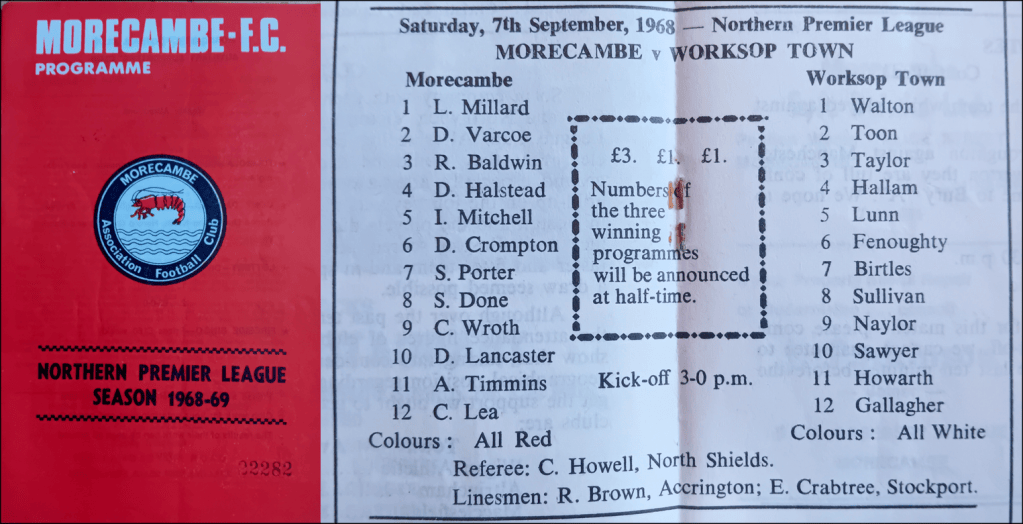
I first heard of them when they were founder-members of the Northern Premier League with Morecambe in 1968. I first saw them play on my fourteenth birthday at Christie Park but I can’t remember the score but I fear that Worksop won:
Worksop can be found 135 miles south of Morecambe on the edge of Sherwood Forest in Nottinghamshire. Worksop Town was founded – according to the club – in 1861 but Wikipedia claims there is no evidence to prove it played prior to 1875. By 1892, though, it was competing in the Sheffield & District Football League. It then featured in the Sheffield Association League before eventually settling on the Midland League. After the First World War, the club merged with Manton Athletic – which is a parish in the town – to become Worksop & Manton Athletic. This club was disbanded in 1930 when it withdrew from the Midland League. A new iteration of Worksop Town then lasted another ten years in various local leagues before again being wound-up during World War Two. Worksop Town Athletic came along to replace them and by 1956 were back in the Midland League. They left this in 1968 to join Morecambe and other leading non-league clubs to form the Northern Premier but came bottom in the inaugural season and were relegated back to where they had come from. They were back in the NPL by 1972 but by 1989 had been relegated to the Northern Premier League First Division and were playing in Gainsborough after being evicted from their Central Avenue ground. After three years’ exile, Worksop returned to their home town in 1992 to play at the newly-built Sandy Lane stadium, where the use of – or even possession of – chewing gum has been banned. In 2004, they joined the new Conference North but only lasted three years. Financial problems saw them lose ownership of Sandy Lane and Worksop were again peripatetic at grounds such as Hucknall Town; Ilkeston Town and Retford United for the next three seasons. The club returned to Sandy Lane but were soon in financial difficulties again. They had to resign from the Northern Premier League during 2014 and start playing in the Northern Counties East League. They won this in 2019 to return to the NPL and then the National League North via the Play-Offs the season before last. Last time out, Worksop ended-up in sixteenth place.
Morecambe have played Worksop Town on numerous occasions in the past and have usually got the better of them, if memory serves me correctly.
This season, the Shrimps will travel to Sandy Lane on Saturday 10th October 2026 for a 15:00hrs kick-off. Town will return the compliment on Saturday 10th April 2027 at 15:00hrs.
Jordan Burrow and Adam Sollitt are two players who have been on both clubs’ books in the past.

